
Arctic Shipping: A Strategic Route for China's Trade Diversification and Geopolitical Leverage
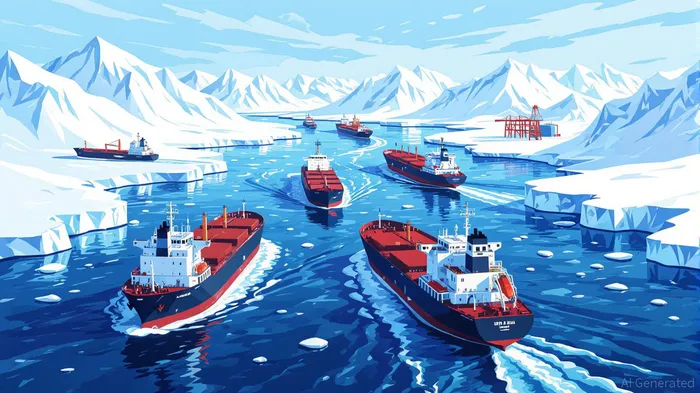
The Arctic is emerging as a critical corridor for global trade, driven by climate change, geopolitical realignments, and China’s strategic ambitions. As the Northern Sea Route (NSR) becomes increasingly navigable due to melting ice, Beijing is positioning itself to diversify trade away from traditional chokepoints like the Suez Canal and Strait of Malacca—routes it views as vulnerable to Western influence and geopolitical disruptions. This shift is not merely economic but deeply geopolitical, with Arctic infrastructure and energy projects serving as tools of soft power and strategic leverage.
Infrastructure Development: Building the Polar Silk Road
China’s Polar Silk Road (PSR), a component of its Belt and Road Initiative (BRI), aims to transform the NSR into a year-round shipping lane. By 2025, Russia and China have collaborated on infrastructure projects such as port expansions in Arkhangelsk and Kaliningrad, as well as the development of ice-class vessels to support Arctic navigation [1]. For example, the Arctic LNG 2 project—20% owned by Chinese firms—represents a $27 billion investment in liquefied natural gas (LNG) exports via the NSR, enabling China to secure energy supplies while helping Russia bypass Western sanctions [2].
However, infrastructure gaps persist. Russia’s shipbuilding industry has struggled to meet demand, with only 15 ships built for Arctic operations over five years—half the target [3]. Meanwhile, Chinese investments in Arctic ports, such as a proposed deep-sea terminal in Arkhangelsk, remain unfulfilled, underscoring the cautious approach of Beijing’s private sector [4]. Despite these challenges, the NSR’s potential to cut shipping times between Asia and Europe by up to 40% continues to attract interest [5].
Geopolitical Leverage: Sino-Russian Collaboration and Risks
The Russia-Ukraine war has accelerated Sino-Russian cooperation in the Arctic. With Western sanctions isolating Moscow, China has become a critical partner for Arctic development, providing both capital and political cover. For instance, the China-Russia Arctic Workshop—a platform for scientific and policy dialogue—has expanded to include discussions on digitalization and environmental governance, reflecting a broader strategic alignment [6].
Yet this partnership is fraught with risks. U.S. sanctions on projects like Arctic LNG 2 have forced Chinese firms to invoke force majeure, exposing the fragility of Sino-Russian economic ties [7]. Additionally, NATO’s northward expansion—evidenced by Sweden and Finland’s 2024 NATO accession—has heightened tensions, with the alliance designating both China and Russia as Arctic threats [8]. This dynamic raises concerns about militarization, as joint Sino-Russian naval exercises in the Bering Sea signal a growing security footprint in the region [9].
Environmental and Regulatory Challenges
The Arctic’s ecological fragility complicates infrastructure and energy projects. Increased shipping traffic has led to a surge in fossil fuel cargo along the NSR, with 84% of 2024 shipments being oil and gas [10]. Russia’s refusal to ban heavy fuel oil (HFO)—a pollutant restricted by the International Maritime Organization—further exacerbates environmental risks [11]. While China’s 14th Five-Year Plan emphasizes a “Green PSR,” enforcement of environmental standards remains inconsistent, particularly in Russia’s Arctic regions [12].
For investors, these challenges highlight the need for robust risk management. Energy firms must navigate sanctions and regulatory gaps, while shipping companies face high operational costs due to the need for ice-class vessels and logistical support. Infrastructure developers, meanwhile, must balance long-term gains with the volatility of Arctic governance and climate change impacts.
Investment Implications: Opportunities and Constraints
The Arctic corridor presents lucrative opportunities for firms in shipping, energy, and infrastructure. Chinese state-owned enterprises like CNPC and CNOOC have secured stakes in key LNG projects, while Russian ports are expanding to accommodate Arctic trade [13]. However, the region’s geopolitical volatility and environmental risks demand careful evaluation.
For example, the Yamal LNG project—30% owned by China—has thrived despite sanctions, but its success relies on Russia’s ability to maintain infrastructure and navigate international pressure [14]. Conversely, smaller projects, such as a proposed Belkomur railway line, have stalled, illustrating the limits of private-sector engagement [15].
Conclusion: A Calculated Bet on the Arctic
China’s Arctic ambitions are a blend of strategic vision and pragmatic caution. While the PSR offers a path to trade diversification and geopolitical influence, its success hinges on overcoming infrastructure, environmental, and geopolitical hurdles. For investors, the Arctic represents a high-stakes arena where long-term gains must be weighed against the risks of sanctions, regulatory fragmentation, and ecological fragility. As the region becomes a new frontier for global competition, firms positioned to navigate these complexities—while aligning with China’s strategic goals—stand to benefit from the Arctic’s transformative potential.
Source:
[1] China-Russia cooperation in arctic governance and sustainable development: A conference report from the 13th China-Russia Arctic Workshop [https://www.sciencedirect.com/science/article/abs/pii/S0308597X25000648]
[2] Sino-Russian Arctic LNG: A Shift in Global Energy Dynamics
https://petroleumenergyinsights.com/geopolitics-and-business-of-sino-russian-arctic-lng-strategic-realignments-amid-sanctions/
[3] Monthly Highlights from the Russian Arctic, April 2025 [https://etc.bellona.org/2025/06/25/monthly-highlights-from-the-russian-arctic-april-2025/]
[4] China's Polar Silk Road: Long Game or Failed Strategy? [https://www.thearcticinstitute.org/china-polar-silk-road-long-game-failed-strategy/]
[5] The Future of the Northern Sea Route - A “Golden Waterway” or Niche? [https://www.thearcticinstitute.org/future-northern-sea-route-golden-waterway-niche/]
[6] China-Russia cooperation in scientific and technological innovation [https://journals.sagepub.com/doi/10.1177/00094455251366744]
[7] Sino-Russian Arctic cooperation: systemic pressure and ... [https://www.tandfonline.com/doi/full/10.1080/2154896X.2025.2531718?src=]
[8] The Polar Silk Road: balancing development and ... [https://link.springer.com/article/10.1007/s44312-025-00056-3]
[9] Russia's Arctic Bet: Can Asia Deliver on NSR Ambitions? [https://chinaus-icas.org/research/russias-arctic-bet-can-asia-deliver-on-nsr-ambitions/]
[10] Russia Risks Arctic Environmental Disaster in Pursuit of Profit and Power [https://www.themoscovertimes.com/2025/08/26/russia-risks-arctic-environmental-disaster-in-pursuit-of-profit-and-power-a90351]
[11] The Polar Silk Road: balancing development and ... [https://link.springer.com/article/10.1007/s44312-025-00056-3]
[12] China's Arctic Strategy – a Comprehensive Approach in ... [https://sjms.nu/articles/10.31374/sjms.196]
[13] Global Energy Competition in the Arctic: A Reassessment [https://carnegieendowment.org/research/2025/07/arctic-energy-projects-overview?center=russia-eurasia⟨=en]
[14] Sino-Russian Arctic cooperation: systemic pressure and ... [https://www.tandfonline.com/doi/full/10.1080/2154896X.2025.2531718?src=]
[15] The Arctic Is Testing the Limits of the Sino-Russian ... [https://carnegieendowment.org/russia-eurasia/politika/2025/02/russia-china-arctic-views?lang=en]






Comentarios
Aún no hay comentarios