
Arctic Geopolitical Risk and Strategic Asset Allocation in the Age of Trump's Greenland Gambit
The Arctic is no longer a frozen frontier. It is a geopolitical chessboard where U.S.-Danish-NATO tensions, resource competition, and climate-driven infrastructure projects collide. At the center of this storm is Donald Trump's persistent "Greenland Gambit"-a bid to acquire the strategically vital island that has rattled alliances and reshaped investment dynamics. For investors, the Arctic's transformation presents both peril and promise.
The Greenland Gambit: A Fracture in Transatlantic Alliances
Trump's fixation on Greenland has escalated from diplomatic friction to existential threats. The U.S. president has openly floated military options to "acquire" the island, framing it as a national security imperative to counter Russian and Chinese influence in the Arctic. Denmark, however, has drawn a hard line, with Prime Minister Mette Frederiksen warning that any U.S. military action would "effectively end NATO". This standoff underscores a broader erosion of trust: Danish intelligence services now officially list the U.S. as a security threat due to its "economic and military leverage" over Greenland.
Greenland itself, a self-governing territory rich in rare earth minerals and home to critical U.S. military infrastructure like the Pituffik Space Base, is caught in the crossfire. Its government has condemned Trump's rhetoric as "completely and utterly unacceptable", while cautiously balancing ties with the U.S., EU, and China. The island's autonomy movement adds another layer of complexity, as Greenland moves closer to potential independence-a shift that could redefine Arctic power dynamics.
Investment Risks: Geopolitical Volatility and Environmental Constraints
The Arctic's geopolitical tensions create acute risks for investors. First, the U.S.-Danish rift could destabilize NATO's cohesion, which underpins much of the region's infrastructure and security. For example, Denmark's €2 billion 2025 defense boost for Greenland includes Arctic navy vessels and surveillance drones, signaling a militarization that could escalate regional conflicts. Similarly, Russia's Arctic militarization-such as drone nets shielding nuclear test sites- reflects a broader arms race.
Second, environmental and logistical challenges persist. Despite Greenland's rare earth mineral deposits, its harsh climate and underdeveloped infrastructure make resource extraction economically unviable for now. A 2025 report by the Arctic Institute notes that "environmental constraints and Indigenous rights concerns could delay projects for a decade." Meanwhile, China's Belt and Road Initiative (BRI) aims to integrate Arctic infrastructure into its "Polar Silk Road," but its efforts face political resistance and ecological scrutiny.
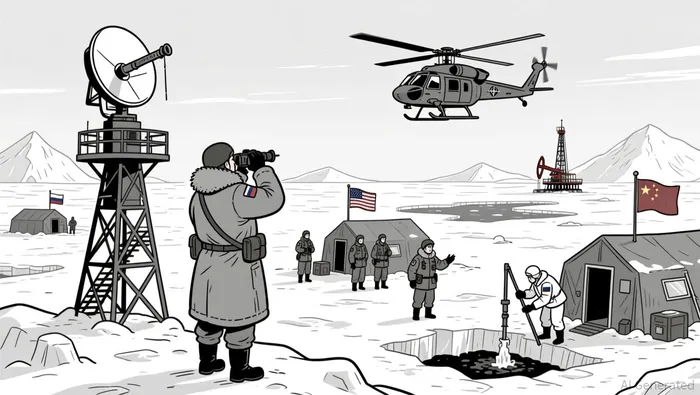
Third, energy projects in the Arctic are increasingly exposed to geopolitical shocks. As ice melts, the Northwest Passage and Northern Sea Route open for commercial shipping, but these routes are now contested. A 2025 Carnegie Endowment analysis warns that "energy projects in the Arctic are vulnerable to supply chain disruptions and regulatory shifts driven by U.S.-Russia-China rivalries."
Opportunities: Defense, Rare Earths, and Strategic Infrastructure
Despite the risks, the Arctic offers compelling opportunities for investors who can navigate its volatility.
Defense Sector Expansion: The U.S. and Nordic nations are pouring billions into Arctic defense. Norway's EUR 52.2 billion defense plan by 2036, Sweden's EUR 14.8 billion military spending, and Finland's push to reach 3.3% GDP defense budgets reflect a regional arms race. U.S. defense contracts for Arctic surveillance, icebreakers, and logistics are also surging, with the DoD's Arctic Strategy 2024 allocating $2.8 billion in FY2024 alone. Investors in defense tech-such as satellite surveillance, drone systems, and cold-weather equipment-stand to benefit.
Rare Earth Minerals and Critical Infrastructure: Greenland's rare earth elements (REEs) are critical for green technologies and semiconductors. While extraction remains challenging, U.S. and EU efforts to reduce reliance on China are driving investment. The U.S. Department of Defense's IBAS program, for instance, is prioritizing Greenland's mineral resources to secure supply chains. Similarly, the EU's normative approach to Arctic development-emphasizing sustainability-could create partnerships with Greenland's government.
Energy and Shipping Infrastructure: The Arctic's thawing environment is unlocking new shipping routes and energy reserves. Guggenheim Partners' $500 billion Arctic infrastructure fund and Canada's Northwest Territories' push for federal support highlight the scale of opportunities. However, success hinges on geopolitical stability and environmental compliance.
Strategic Asset Allocation: Hedging Against Uncertainty
For investors, the key is to balance exposure to Arctic opportunities with hedging against geopolitical and environmental risks.
- Diversify Across Sectors: A portfolio should include defense contractors (e.g., Raytheon, Lockheed Martin), rare earth mining firms (e.g., Greenland Minerals, MP Materials), and Arctic infrastructure developers (e.g., AECOM, Bechtel).
- Geopolitical Hedging: Given the U.S.-Danish tensions, investors should consider short-term positions in gold or safe-haven assets to offset potential shocks.
- Sustainability-Linked Bonds: With the EU and Indigenous groups prioritizing environmental stewardship, green bonds tied to Arctic infrastructure projects could offer both ethical and financial returns.
- Long-Term Positioning: Investors with a 10+ year horizon might focus on Greenland's autonomy transition, betting on eventual resource liberalization and infrastructure development.
Conclusion: Navigating the Thawing Arctic
The Arctic is a microcosm of 21st-century geopolitics: a region where climate change, resource scarcity, and great power rivalry converge. Trump's Greenland Gambit has accelerated this dynamic, creating a volatile but fertile ground for strategic investment. For those who can stomach the risks, the Arctic offers a unique blend of defense-driven growth, critical mineral scarcity, and infrastructure innovation. But as Denmark's warning makes clear-"Greenland is not for sale"-success will require more than capital. It demands geopolitical agility and a willingness to adapt to a rapidly shifting ice.







Comentarios
Aún no hay comentarios