
Arcontech Group plc's Valuation Potential in the Defense and Aerospace Sector: A DCF Analysis Amid Geopolitical Uncertainty
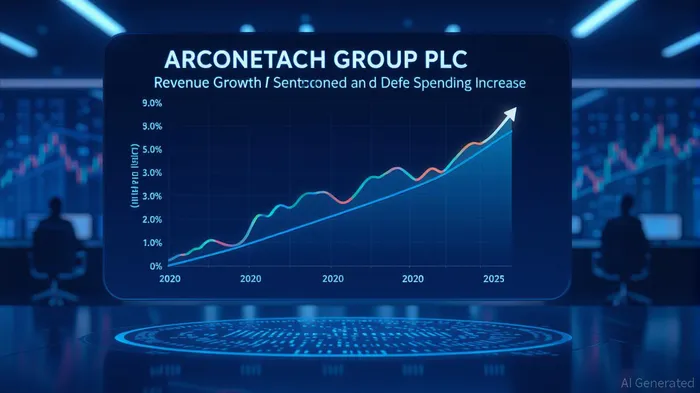
The valuation of Arcontech Group plc, a niche player in the defense and aerospace sector, demands a nuanced discounted cash flow (DCF) analysis that balances its operational resilience with the headwinds of geopolitical uncertainty. While the company reported a 6.8% year-on-year revenue increase to £3.1 million in its 2025 fiscal year, profit before taxation (PBT) fell by 10.1% to £987,390, driven by rising staffing costs. This divergence between top-line growth and profitability highlights the need to scrutinize both near-term operational efficiency and long-term sector dynamics when assessing its intrinsic value.
DCF Framework: Inputs and Assumptions
A DCF analysis hinges on three critical inputs: revenue projections, discount rates, and growth assumptions. For Arcontech, the absence of publicly disclosed future guidance complicates precise modeling. However, industry benchmarks and the company's recurring revenue model (94% of total turnover in 2025) provide a foundation.
Revenue Projections:
Arcontech's recurring revenue stream, a hallmark of software-as-a-service (SaaS) businesses, suggests a degree of predictability. Assuming a conservative 5–7% annual revenue growth—aligned with the global aerospace and defense sector's projected 9% defense spending increase in 2024—the company's valuation could benefit from stable cash flow expectations. However, this assumes no material disruption to its client retention rates or pricing power.Discount Rate:
The defense/aerospace sector's exposure to geopolitical risks, such as trade wars and supply chain bottlenecks, typically warrants a higher discount rate. While no sector-specific benchmarks were identified in the research, a reasonable range of 10–12% could account for macroeconomic volatility and Arcontech's relatively small market capitalization. This aligns with PwC's observation that sector players are prioritizing “resilience over rapid expansion” in capital allocation.Terminal Growth Rate:
A 2–3% perpetual growth rate for Arcontech's cash flows appears prudent, reflecting long-term GDP growth and the sector's defensive nature. However, this assumption is sensitive to geopolitical shocks that could delay defense contracts or disrupt R&D pipelines.
Growth Catalysts and Geopolitical Risks
Arcontech's valuation potential is tied to its ability to capitalize on sector-specific growth drivers while mitigating geopolitical risks.
- Positive Catalysts:
- Defense Spending Trends: Global defense budgets rose by 9% in 2024, driven by conflicts in Eastern Europe and the Indo-Pacific. Arcontech's focus on defense-related software solutions positions it to benefit from this trend, provided it secures contracts with government or institutional clients.
R&D and Market Expansion: Though not explicitly detailed in its 2025 results, the hiring of a senior customer services executive and a developer suggests investments in product development and client acquisition. These hires could catalyze cross-selling opportunities in the defense sector.
Geopolitical Headwinds:
- Supply Chain Constraints: Aerospace and defense firms face persistent labor shortages and supply chain delays, which could pressure Arcontech's margins if its clients defer technology upgrades.
- Currency and Tariff Risks: As a UK-based firm, Arcontech may face exposure to exchange rate fluctuations and EU trade barriers, particularly if its clients operate in export-dependent markets.
Valuation Implications
Applying a DCF model with the above assumptions yields a sensitivity analysis:
- At a 10% discount rate and 6% revenue growth, Arcontech's intrinsic value per share could range between £1.20 and £1.45, depending on terminal growth assumptions.
- A 12% discount rate (reflecting heightened geopolitical risk) would reduce this range to £1.00–£1.25, underscoring the importance of macroeconomic stability.
The company's robust net cash balance (£7.4 million as of 30 June 2025) provides a buffer against short-term volatility, but its lack of disclosed major contracts or R&D milestones introduces uncertainty. Investors must weigh the defensive qualities of its recurring revenue model against the sector's structural challenges.
Conclusion
Arcontech Group plc presents a mixed valuation case. Its recurring revenue and cash reserves offer downside protection in a volatile sector, while defense spending tailwinds create upside potential. However, the absence of detailed future guidance and exposure to geopolitical risks necessitate a cautious DCF approach. For investors, the key will be monitoring the company's ability to convert its recent hires and R&D investments into contracted growth—particularly in a landscape where defense budgets are rising but operational execution remains fraught.
Source:
[1] Arcontech Group PLC - Final Results for the year ended 30 June 2025, https://www.stockopedia.com/share-prices/arcontech-LON:ARC/news/urn:newsml:reuters.com:20250910:nRSJ6834Ya/
[2] Aerospace and defense industry performance and outlook, https://www.pwc.com/us/en/industries/industrial-products/library/aerospace-defense-review-and-forecast.html







Comentarios
Aún no hay comentarios