
Archer Aviation's 2026: The Scalability Test for a $6 Billion Vision
For Archer AviationACHR--, the narrative has shifted from promise to proof. The company bought itself time in 2025 with a strong balance sheet and international testing. Now, 2026 is the year investors will judge conversion, not just vision. The core question is whether ArcherACHR-- can turn its $2 billion cash position and strategic partnerships into a credible, scalable business. The bar has been raised.
The first and most critical test is certification. After years of steady progress updates, investors will demand irreversible milestones toward final type certification for the Midnight aircraft. Ambiguity will no longer be rewarded. The market will begin to discount the stock less as a "late bloomer" and more as a trailing contender if Archer fails to narrow the gap meaningfully with closer competitors. This is the binary decision point for the stock's rerating potential.
The second area is manufacturing discipline. Engineering success and manufacturing success are different skills. Archer has shown Midnight can fly. In 2026, it must prove it can be built repeatedly, predictably, and on schedule at its Georgia facility. Demonstrating a reliable production cadence and tighter build timelines will signal that Midnight is transitioning from a project into a product. This is where execution risk concentrates, and scaling even modest volumes introduces stress across suppliers and processes.
The third and perhaps most tangible test is the White House's eVTOL Integration Pilot Program. Archer has announced partnerships with multiple U.S. cities to submit applications, with selections expected in early to mid-2026. This program is a critical proving ground for its city partnership strategy. The company's application with Huntington Beach carries exclusive status, making it the sole air taxi operator involved in that submission. Success here would demonstrate that Midnight solves a real problem that local governments and public safety agencies are willing to pay for, converting pilot programs into tangible economic substance.
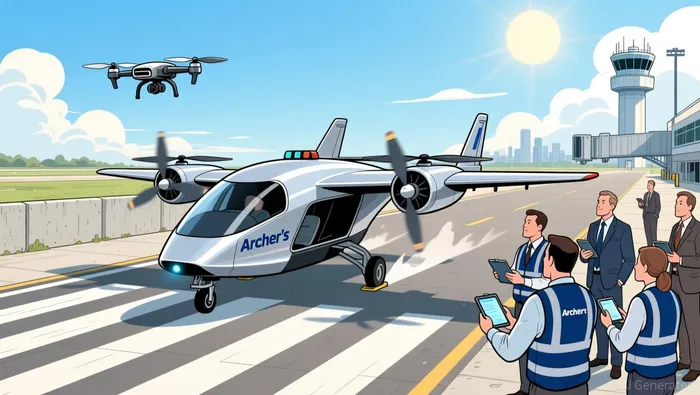
The $650 million capital raise that lifted liquidity above $2.0 billion extends the runway, but it also raises the bar for capital efficiency. Investors will focus less on the amount of cash and more on how effectively it is utilized. Every dollar must clearly move certification, production, or commercialization forward. A capital raise from strength after visible execution wins looks very different from raising capital to buy time.
The bottom line is decisive. Clear wins in 2026 could re-rate Archer meaningfully, while delays may prompt investors to shift toward better-positioned rivals. The company has bought itself time. In 2026, it must prove that time was well spent.
Certification and Production: The Execution Core
The path from prototype to profitable operation is the make-or-break test for Archer. After a volatile 2025, the company's stock is now squarely in the execution phase. The two most critical drivers for 2026 are clear: securing regulatory approval and proving the manufacturing model can scale. Success here will determine if Archer transitions from a speculative concept to a credible business; failure will likely relegate it to a trailing contender.
The certification timeline is the first major hurdle. While the FAA process remains the ultimate gate, an early commercialization path is emerging. The UAE's aviation regulator has publicly stated it remains on track for certification as early as Q3 2026. This is a tangible, near-term milestone that could enable passenger service and generate its first commercial revenue. For investors, this provides a binary test: either the UAE clears the way, validating the aircraft's safety and regulatory readiness, or delays compound the risk. The bottom line is that certification must move from steady progress to decisive closure in 2026.
More fundamentally, the company must prove its manufacturing model. Archer has built the infrastructure, completing its high-volume facility in Georgia. The stated goal is to ramp production to a rate of two aircraft per month by the end of 2025. This initial target is a critical first step in demonstrating operational discipline. The longer-term vision, however, is where scalability is tested. Archer and Stellantis are working toward scaling the Covington facility to 650 aircraft annually by 2030. Achieving this requires flawless execution across a complex supply chain and quality control system.
This is where the high execution risk becomes apparent. Aerospace history is littered with programs that flew successfully in prototype form but stumbled in production due to unforeseen supply chain bottlenecks, quality control issues, or cost overruns. Archer's challenge is to compress build timelines and maintain consistency as volumes increase. The company's recent capital raise, which brought its cash position to over $2 billion, provides a buffer. But the market will judge this capital not by its size, but by its efficiency in driving production milestones. Any slip in the ramp-up cadence would signal that scaling is more complex than planned.
The bottom line is that 2026 is the year of conversion. Investors will no longer reward progress updates; they will demand proof of certification closure and a reliable production cadence. Archer has bought time, but its ability to execute on these two fronts will decide whether the stock re-rates meaningfully or fades into the background as the flying taxi market narrows.
Market Positioning and Competitive Landscape
Archer Aviation's strategic positioning rests on a vertical integration model designed to secure early demand and build an economic moat. The company is not just a manufacturer; it aims to be a full-service air taxi provider. This dual role is exemplified by its joint venture called Soracle with Japan Airlines, which has announced its intention to purchase up to $500 million worth of Archer's Midnight aircraft. This type of agreement is a critical early anchor, providing a large, committed customer and helping to secure the company's manufacturing ramp. It directly addresses the capital-intensive nature of scaling production by locking in a portion of future revenue.
The company's valuation, however, reflects its pre-revenue status and high cash burn. With a price-to-book ratio of 3.8x, Archer trades modestly cheaper than the broader aerospace industry. This multiple suggests the market is assigning a lower premium to its asset base, likely due to the lack of meaningful revenue and the significant losses it continues to incur. The stark contrast with the SWS discounted cash flow model's fair value of $83.24 per share highlights the enormous gap between current pricing and the potential future cash flows from a successful, trillion-dollar market. The TAM is vast, but the current valuation prices in a high probability of continued losses and dilution.
Against this backdrop, the competitive benchmark is clear: Joby Aviation. Both companies are leading players with similar certification timelines and ambitions for 2026 commercial operations. Yet the gap in execution and valuation is telling. Joby has a market cap of $13.2 billion, more than double Archer's $5.9 billion, and it is already generating revenue from its Blade Air Mobility acquisition. This creates a direct execution benchmark. For growth investors, the question is whether Archer's lower valuation and vertical integration strategy-evidenced by the Soracle deal-offer a better margin of safety and upside potential, or if the market is correctly pricing in a slower path to commercialization and revenue generation compared to its closer peer.
Catalysts, Risks, and What to Watch
The investment thesis for Archer Aviation in 2026 hinges on a narrow window of decisive execution. The company has bought time, but 2026 is the year that time must be judged. The path forward is defined by a series of high-stakes milestones that will validate its position as a leader or expose it as a laggard in the converging eVTOL race.
The key catalysts are concrete, near-term milestones. First, the Federal Aviation Administration's selection from the White House-led eVTOL Integration Pilot Program is due in early-to-mid 2026. Success here, particularly with exclusive city partnerships, would be a tangible step toward commercial operations and a powerful validation of its strategy. Second, the company expects to begin recognizing revenue from its Middle East launch agreements as early as the first quarter of 2026. This initial cash flow would be a crucial signal that customers are willing to pay, moving partnerships from aspirational to economic. Finally, progress toward the 2028 Los Angeles Olympic and Paralympic Games air taxi service is a long-term but critical benchmark. Demonstrating tangible steps toward this exclusive, high-profile deployment would underscore its operational readiness and market positioning.
The primary risks are operational and financial. Regulatory delays remain a constant threat, and the market is no longer patient for vague "progress updates." Certification must move from steady advancement to clear, irreversible milestones toward final type certification. The company's Q3 net loss per share of $0.20 and wider adjusted EBITDA loss highlight the extreme capital intensity of the build-out. Continued high cash burn, even with over $2 billion in liquidity, pressures the runway. This raises the specter of further equity dilution, a risk that has already sparked market concern after a $650 million equity raise last quarter.
The bottom line is one of increasing differentiation. As the market narrows and timelines converge, investors will begin to shift capital toward companies demonstrating clear wins. For Archer, the paramount task in 2026 is to narrow the gap with peers. It must show that its time was well spent by converting its impressive partner roster into revenue-backed activity, demonstrating scalable manufacturing, and maintaining capital discipline. The company has the potential for a first big revenue breakthrough, but it must prove it can turn that potential into reality before the window for leadership closes.





Comentarios
Aún no hay comentarios