
Arch Capital Group's Strategic Resilience: A Deep Dive into Risk-Adjusted Returns and Niche Market Dominance
In the high-stakes world of specialty insurance, where niche risks and volatile markets test the mettle of even the most seasoned players, Arch Capital GroupACGL-- (NASDAQ: ACGL) has carved a unique path to long-term outperformance. While its 1-year Sharpe ratio of -0.23 lags behind the S&P 500's 0.95 as of September 2025, according to
PortfoliosLab's S&P page, a deeper analysis of its 5-year Sharpe ratio of 0.94, according to
PortfoliosLab's ACGL page, and strategic initiatives reveals a company poised to deliver robust risk-adjusted returns. This article examines ACGL's positioning in the rapidly expanding specialty insurance sector, its disciplined underwriting approach, and how these factors align with industry tailwinds to drive sustainable growth.
Risk-Adjusted Returns: A Tale of Two Timeframes
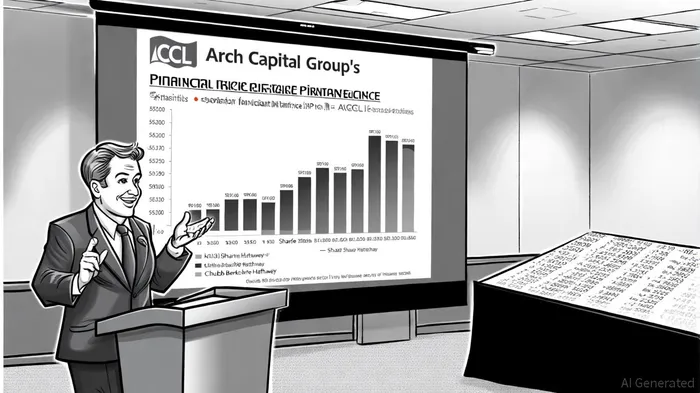
ACGL's recent underperformance, as reflected in its negative 1-year Sharpe ratio, masks a stronger long-term story. Over five years, its Sharpe ratio of 0.94 (PortfoliosLab's ACGLACGL-- page) outperforms the S&P 500's 0.79 (PortfoliosLab's S&P page) and rivals like Chubb (0.99) and Berkshire Hathaway (1.00). This resilience is particularly notable given the sector's exposure to catastrophic events, such as the Florida property reinsurance market, where ACGL has strategically allocated capital, according to
Arch Capital's Q1 2025 results.
The company's 10-year Sharpe ratio of 0.53 (PortfoliosLab's ACGL page) further underscores its ability to balance risk and reward, a critical trait in an industry where downside volatility is inevitable. For context, the RISX Index—a benchmark for global specialty (re)insurance—posted annualized returns of 9.4% with 14.4% risk as of September 2025, according to
the RISX Index, suggesting ACGL's metrics are in line with sector norms. However, its focus on casualty lines and niche markets, such as entertainment insurance (acquired from Allianz in 2023, per ArchACGL-- Capital's Q1 2025 results), positions it to outperform as these segments mature.
Strategic Positioning: Niche Markets and Underwriting Discipline
ACGL's success hinges on its ability to capitalize on underserved niches. The acquisition of Allianz's U.S. MidCorp and Entertainment businesses (Arch Capital's Q1 2025 results) not only expanded its middle-market footprint but also unlocked high-growth opportunities in entertainment risk management—a sector projected to grow as the demand for tailored coverage in film, music, and digital assets rises, according to
Innoveo's trends report. This strategic pivot aligns with broader industry trends: the global specialty insurance market is expected to grow at a 10.6% CAGR from $104.7B in 2021 to $279B by 2031 (Innoveo's trends report), driven by climate-related risks, cyber threats, and regulatory complexity.
ACGL's underwriting discipline is another cornerstone of its strategy. In Q1 2025, the company achieved an 11.5% annualized operating return on average common equity despite significant catastrophe losses (Arch Capital's Q1 2025 results). This performance highlights its ability to deploy capital selectively in areas with attractive risk-adjusted returns, such as property catastrophe reinsurance and casualty lines. By leveraging advanced data analytics and AI-driven risk modeling (Arch Capital's Q1 2025 results), ACGL mitigates downside exposure while maintaining pricing power—a critical advantage in a sector where margins are often squeezed by unexpected claims.
Navigating Challenges: A Sector in Flux
The specialty insurance sector is not without its challenges. Rising inflation, climate-driven catastrophes, and regulatory scrutiny (e.g., SEC cybersecurity disclosures noted in Innoveo's trends report) create headwinds for insurers. However, ACGL's diversified portfolio and proactive capital management—returning excess capital to shareholders via dividends and buybacks (Arch Capital's Q1 2025 results)—position it to weather these pressures. Its focus on downside risk mitigation, as measured by the Sortino ratio (though sector-specific data is sparse), further strengthens its appeal to risk-conscious investors.
Conclusion: A Long-Term Outperformer
While ACGL's short-term Sharpe ratio may disappoint, its 5-year and 10-year metrics, combined with a strategic emphasis on niche markets and disciplined underwriting, paint a compelling case for long-term outperformance. As the specialty insurance sector expands—projected to reach $486.83B by 2033 (Innoveo's trends report)—ACGL's ability to balance innovation with risk management will likely drive superior risk-adjusted returns. For investors seeking exposure to a dynamic industry with a proven operator, ACGL represents a strategic bet worth considering.







Comentarios
Aún no hay comentarios