
ArcelorMittal's Hunedoara Plant Closure: A Wake-Up Call for Energy-Intensive Industries in Europe
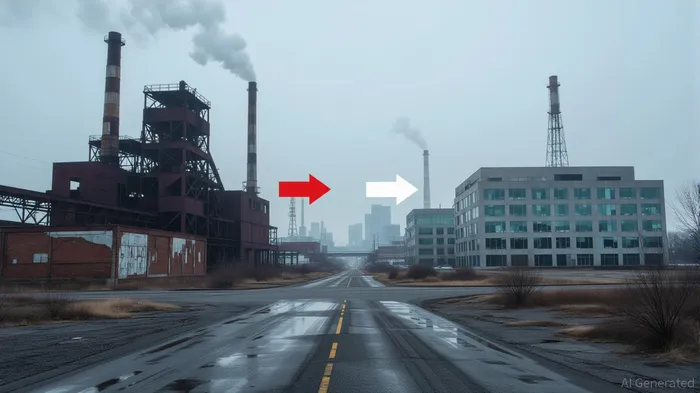
The closure of ArcelorMittal’s Hunedoara plant in 2023–2025 marks a pivotal moment for Europe’s energy-intensive industries. Driven by soaring energy costs, regulatory pressures under the Just Transition Operational Program 2021–2027, and economic unviability, the decision underscores the fragility of traditional industrial models in a decarbonizing world [1]. This case study serves as a wake-up call for investors and policymakers, highlighting how carbon pricing, energy transition policies, and global competition are reshaping industrial valuations.
The Triple Threat to Energy-Intensive Industries
Europe’s steel, cement, and chemical sectors face a perfect storm of challenges. The EU Emissions Trading System (ETS) has driven operational costs upward, with carbon prices peaking at €100 per ton in 2025 [1]. Simultaneously, the European Green Deal’s stringent decarbonization targets—such as the Carbon Border Adjustment Mechanism (CBAM)—threaten to erode competitiveness against lower-cost producers in Asia and the U.S. [1]. Compounding these pressures, global supply chains are shifting toward reshoring and nearshoring, with U.S. policies like the Inflation Reduction Act offering $29 billion in grid modernization funding to outcompete European counterparts [1].
The Hunedoara closure exemplifies this trend. Despite being a major employer in Hunedoara County, the plant’s reliance on carbon-intensive blast furnaces made it unsustainable under the new regulatory and economic landscape. This signals a broader risk: energy-intensive industries may face systemic underinvestment, leading to a “valley of death” for companies unable to pivot to green technologies [1].
Sectoral Reallocation: Capital Fleeing Risk, Seeking Resilience
As energy-intensive sectors falter, capital is reallocating toward industries insulated from energy costs and policy risks. According to the World Energy Investment 2025 report, global energy investment reached $3.3 trillion in 2025, with $2.2 trillion directed toward clean energy technologies—twice the amount allocated to fossil fuels [4]. This shift is not merely environmental but strategic: investors are prioritizing sectors with long-term resilience against geopolitical and macroeconomic volatility.
Underexposed Sectors: Healthcare, Consumer Staples, and AI-Driven Tech
- Healthcare: The sector’s operating income surged 60.39% year-on-year in Q3 2025, driven by AI-enhanced diagnostics and digital transformation [3]. With 70% of health system executives prioritizing AI and digital tools, the sector is insulated from energy costs while benefiting from aging populations and regulatory tailwinds [2].
- Consumer Staples: Despite being labeled a “weaker performer” in Q2 2025, companies like Dollar TreeDLTR--, Inc. (DLTR) show potential for margin improvement through capital discipline and pricing flexibility [3]. The sector’s defensive characteristics—stable demand and low energy intensity—make it a safe haven amid inflationary pressures.
- AI-Driven Tech: The global AI market is projected to reach $244.22 billion in 2025, with 78% of organizations now using AI in daily operations [3]. Sectors like Medical Diagnostics and Health Management Solutions are attracting $12.1 billion in funding for 2025, leveraging AI to drive efficiency and scalability [2].
Strategic Recommendations for Investors
- Rebalance Portfolios Toward Resilient Sectors: Underexposed sectors like healthcare and AI-driven tech offer insulation from energy costs and policy risks. For example, the ETF XQLT’s quality factor tilt—overweighting healthcare and consumer staples—has outperformed high-beta sectors in volatile markets [1].
- Leverage Policy-Driven Opportunities: The Inflation Reduction Act and Bipartisan Infrastructure Law are creating $83 billion in private-sector opportunities for grid modernization by 2030 [1]. Investors should target infrastructure ETFs like XLB and PAVEPAVE--, which align with decarbonization goals.
- Avoid Overconcentration in Energy-Intensive Sectors: With energy security scores improving only marginally (3.4% over a decade) and grid flexibility lagging, energy-intensive industries face uneven growth [4]. Diversifying into sectors with ESG-aligned valuations can mitigate exposure to regulatory and geopolitical shocks.
Conclusion
ArcelorMittal’s Hunedoara closure is a harbinger of the challenges facing Europe’s energy-intensive industries. As carbon pricing, energy transition policies, and global competition converge, investors must reallocate capital to sectors with long-term resilience. Healthcare, consumer staples, and AI-driven tech offer a compelling alternative—shielded from energy costs, supported by policy tailwinds, and aligned with secular growth trends. The future of industrial investment lies not in high-emission legacy models but in innovation and sustainability.
**Source:[1] International Conference on Applied Sciences – ICAS 2023 [https://machinery.mas.bg.ac.rs/bitstream/handle/123456789/6869/Program_ICAS2023.pdf?sequence=1][2] 2025 global health care outlook | Deloitte Insights [https://www.deloitte.com/us/en/insights/industry/health-care/life-sciences-and-health-care-industry-outlooks/2025-global-health-care-executive-outlook.html][3] Healthcare Sector Growth Rates [https://csimarket.com/Industry/industry_growth_rates.php?s=800][4] World Energy Investment 2025 highlights electricity demand and energy security new drivers [https://www.iigcc.org/insights/world-energy-investment-2025-highlights-electricity-demand-and-energy-security-new-drivers]





Comentarios
Aún no hay comentarios