
Arbitrum's Bullish Falling Wedge and Ecosystem Growth Signal a High-Probability Breakout to $2.00+
The cryptocurrency market is no stranger to volatility, but when technical patterns align with robust on-chain fundamentals, the odds of a high-probability breakout increase dramatically. ArbitrumARB-- (ARB) is currently in such a position, with a well-defined falling wedge pattern on its price chart and a rapidly expanding ecosystem that positions it as a leader in EthereumETH-- Layer-2 scaling. This article synthesizes technical and fundamental analysis to argue that ARBARB-- is primed for a breakout to $2.00+ in 2025–2026, driven by a confluence of structural and macroeconomic factors.
Technical Case: The Falling Wedge and Historical Precedent
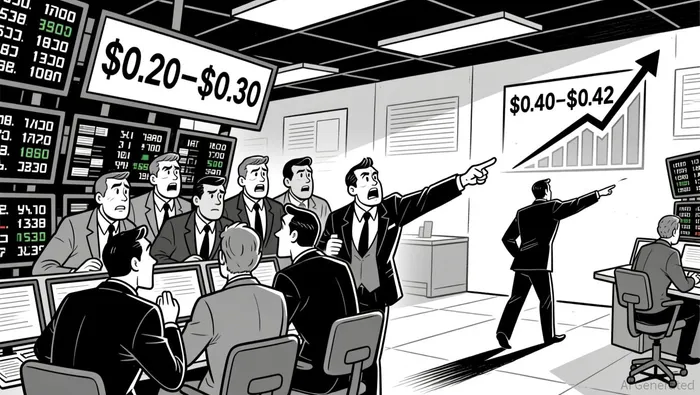
Arbitrum's price action on both weekly and daily charts has formed a falling wedge pattern, a classic bullish reversal structure. This pattern is characterized by converging trendlines that slope downward, with price consolidating near a key support zone of $0.20–$0.30. Crucially, buyers have consistently defended this area, signaling quiet accumulation and weakening bearish momentum.
Historically, falling wedge patterns have acted as launchpads for sharp rebounds. For example, in late 2024, ARB broke out of a similar wedge and surged 121% in a matter of weeks. A repeat scenario is now in play: if ARB breaks above the wedge's upper trendline at $0.40–$0.42, it could trigger a wave of institutional and retail buying, targeting $0.46+.
The pattern's validity hinges on volume confirmation. A breakout must occur with increased volume and a reclamation of key moving averages (e.g., 50-day and 200-day EMAs) to signal conviction. Recent on-chain data shows that ARB has already begun to reclaim its 200 EMA on the 4-hour chart, a technical green flag.
On-Chain Fundamentals: A Network on the Rise
While technical patterns provide a roadmap, on-chain fundamentals are the engine. Arbitrum's 2025 performance has been nothing short of extraordinary:- Total Value Locked (TVL): Nearing $20 billion, with a peak of $3.2 billion in TVL for Arbitrum One.- Transaction Volume: Second only to Base in organic activity, with over $240.8 billion in DEX trading volume.- Developer Activity: Nearly 3.9 million smart contracts deployed in the past year, outpacing Optimism by a factor of two.- Stablecoin Demand: $6.6 billion in stablecoin supply, with $1.5 billion in active loans via AaveAAVE-- and UniswapUNI--.
These metrics underscore Arbitrum's role as the leading Ethereum Layer-2 by utility and adoption. Institutional players like Robinhood have further accelerated growth by launching tokenized US stocks and ETFs on the chain.
Valuation Model: Bridging Fundamentals to Price Targets
The disconnect between ARB's fundamentals and its current price of $0.19 is striking. However, this gap is not a flaw but an opportunity. A valuation model that links TVL, transaction volume, and developer activity to token price reveals a compelling case for a $2.00+ target:
- TVL-to-Price Ratio: Arbitrum's TVL of $20 billion implies a network value-to-token price ratio of ~100,000:1. If this ratio normalizes to 10,000:1 (common for high-utility tokens), ARB would trade at $2.00.
- Transaction Volume Capture: With $240.8 billion in DEX volume, even a 0.01% fee capture would generate $24 million in annual revenue. At a 10x revenue multiple, this implies a token price of $2.40.
- Developer Growth: The deployment of 3.9 million smart contracts suggests a thriving ecosystem. If ARB's utility expands to include staking or fee-sharing mechanisms (as planned in 2026), token demand could surge.
Macro and Tokenomics: Challenges and Catalysts
No analysis is complete without addressing risks. ARB faces ongoing supply unlocks of 90–100 million tokens monthly until March 2027, creating downward pressure. However, this overhang is temporary. By 2026, as unlocks taper, ARB's price could re-rate to reflect its growing utility.
On the macro side, Ethereum's scalability challenges and the rise of real-world assets (RWAs) will drive demand for Layer-2 solutions. Arbitrum's recent upgrades-Stylus (Rust/C++ support), Orbit Chains (customizable L3s), and BoLD (permissionless validation)-position it to capture this growth.
Conclusion: A High-Probability Breakout
Arbitrum's falling wedge pattern and on-chain fundamentals form a convincing case for a $2.00+ breakout. The technical setup is primed for confirmation, while the ecosystem's growth metrics justify a re-rating of the token's valuation. While tokenomics and macro risks persist, they are short-term headwinds in a long-term story of Ethereum scaling and decentralized innovation.
For investors, the key is to monitor the $0.40–$0.42 breakout level and the reclamation of key moving averages. If confirmed, this could mark the beginning of a multi-year bull run for ARB.






Comentarios
Aún no hay comentarios