
Arbitrage Opportunities in Energy Markets: Mars Crude, Zinc Contamination, and Geopolitical Tariffs
The energy market is a tapestry of interconnected dynamics, and nowhere is this clearer than in the current dislocations between Mars crude oil, zinc contamination risks, and geopolitical tariffs. Investors can capitalize on these cross-market distortions by identifying asymmetries in pricing, supply-demand imbalances, and policy-induced volatility. Here's how to navigate this landscape.
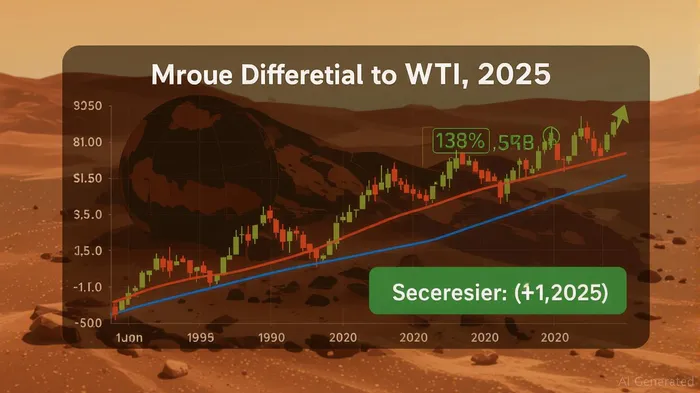
Mars Crude: From Premium to Discount and Back?
Mars crude, a key Gulf of Mexico sour blend, is a linchpin of the Argus Sour Crude Index (ASCI). In 2023, its differential to WTI hit a $1.43/b premium, driven by OPEC+ cuts, U.S. SPR repurchases, and hurricane risks. However, in Q2 2025, a zinc contamination incident at Shell's Mars platform upended this dynamic. The contamination—traced to an additive—led to a 10-cent discount for Mars versus Cushing crude, reversing its 75-cent premium just days earlier. Refiners, fearing corrosion damage to equipment, reduced demand for the contaminated crude, even as Mars production remained steady at ~160,000 barrels/day.
This volatility presents an arbitrage opportunity. Short-term traders could buy Mars at the discounted price while hedging against its eventual rebound once the contamination is resolved (or dilution techniques are applied). Meanwhile, long-term investors might consider Mars futures contracts if the issue is temporary, as its role in ASCI and the CME paper market ensures liquidity.
Zinc Contamination: A Catalyst for Refining Sector Risks
The zinc contamination underscores a broader operational challenge in refining. Zinc, not naturally present in crude, can corrode pipelines and units, forcing costly repairs. Refiners now face a double-edged sword: avoiding Mars crude to mitigate risks while grappling with reduced Venezuelan heavy crude imports. This tightness in sour crude supply could reverse the discount once the contamination subsides, creating a short squeeze.
Investors might short zinc futures (e.g., LME zinc) if the contamination drives a temporary oversupply of refined zinc (projected global surplus of 93,000 mt in 2025). Pairing this with a long position in Mars crude could hedge against zinc's downside while capitalizing on Mars's eventual rebound.
Geopolitical Tariffs: Fueling Energy Market Dislocations
U.S. tariffs on steel (25%) and aluminum (10%) under Section 232 have raised infrastructure costs, delaying projects like LNG terminals and pipelines. OPEC+'s overproduction (22.22 mb/d) has further depressed oil prices to $70/b, while natural gas prices are climbing due to surging LNG exports (+22% in 2025). This divergence creates a cross-market arbitrage vector:
Natural Gas as a Contrarian Play: With Henry Hub prices projected to hit $4.80/MMBtu by 2026, investors can long natural gas futures or ETFs (e.g., UNG) while shorting oil. The tariff-induced oversupply in oil and structural LNG demand favor this strategy.
Silver's Renewable Edge: Silver's role in photovoltaic panels makes it a beneficiary of green energy demand. A long position in silver (e.g., SLV ETF) could hedge against energy market volatility, as its price is projected to rise to $52.50/oz by 2026.
The Arbitrage Playbook
- Short-Term: Buy Mars crude futures now at the discount and pair with a short position in zinc. Close both when Mars recovers and zinc stabilizes.
- Medium-Term: Long natural gas and short oil, leveraging OPEC+ overproduction and LNG demand growth.
- Long-Term: Invest in silver via ETFs or mining stocks (e.g., Pan American Silver), capitalizing on its industrial and monetary demand.
Risks and Considerations
- Contamination Persistence: If ShellSHEL-- cannot resolve the zinc issue, Mars's discount could widen, damaging its ASCI relevance.
- Tariff Reversals: A U.S. policy shift (e.g., lifting steel tariffs) could collapse natural gas's arbitrage advantage.
- Geopolitical Shocks: Iran-Israel tensions or Russian supply cuts could disrupt crude prices independently of fundamentals.
Conclusion
The Mars crude-zinc-tariff nexus is a microcosm of energy market dislocations. By exploiting the contamination-driven discount, natural gas's structural upside, and silver's green catalyst, investors can construct a portfolio resilient to policy and operational risks. As always, stay nimble: the energy market rewards those who turn volatility into opportunity.
Invest wisely—but don't bet the farm on a single play. Diversification is key.







Comentarios
Aún no hay comentarios