
ARB's Long-Term Value Proposition Amid Whale Accumulation: Strategic Patterns and DeFi Tailwinds in 2025
In October 2025, the ArbitrumARB-- (ARB) token ecosystem stands at a pivotal juncture, driven by a confluence of strategic whale accumulation patterns and macro-level tailwinds in the decentralized finance (DeFi) sector. As institutional adoption and technological innovation converge, ARB's long-term value proposition is increasingly underpinned by both on-chain behavioral signals and broader market dynamics.
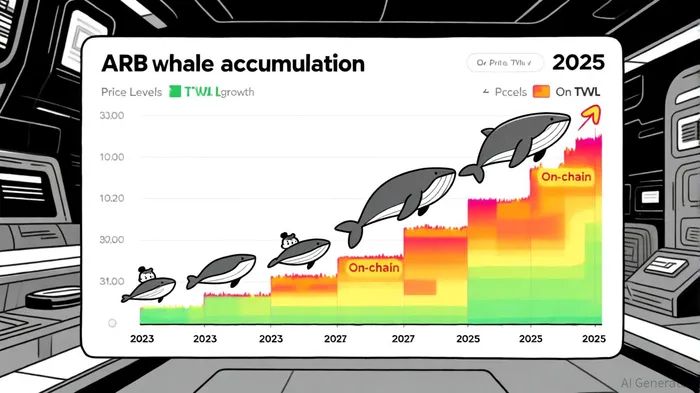
Whale Accumulation: A Bullish Signal Amid Sideways Momentum
Whale activity has emerged as a critical barometer for ARB's trajectory. Data from blockchain analytics platforms like ArkhamARKM-- Intelligence reveals that in the third week of August 2025, whales holding between 1 million and 10 million ARBARB-- tokens acquired an additional 10 million tokens, pushing their collective holdings to 2.45 billion tokens[1]. This accumulation coincided with ARB trading near a key resistance level of $0.52, suggesting growing confidence in a potential breakout.
Historical patterns further reinforce this narrative. Between April and May 2023, whale holdings nearly doubled during a 35% price correction, with on-chain data indicating strategic buying during dips[2]. Similarly, in late 2024, despite a 10% monthly price decline, whale addresses increased by 4% in 30 days, adding 251.79 million tokens to their portfolios[3]. These trends align with the "on-chain accumulation" playbook observed in BitcoinBTC--, where large holders often accumulate during early morning UTC hours, a pattern historically correlated with subsequent price gains[2].
The Market Value to Realized Value (MVRV) ratio for ARB also suggests undervaluation, with 80% of holders in a loss position despite whale buying[3]. This divergence between on-chain behavior and broader market sentiment creates a compelling case for ARB's retest of the $1.50 level, particularly if bullish momentum persists.
DeFi Sector Growth: TVL, Innovation, and Competitive Positioning
Arbitrum's dominance in the DeFi sector is another cornerstone of its value proposition. As of early September 2025, the network hosts $19.21 billion in Total Value Locked (TVL), securing its position as the leading EthereumETH-- Layer-2 solution[4]. This growth is fueled by protocols like GMXGMX-- (with $784 million in TVL) and AaveAAVE-- (contributing $1.24 billion in TVL), which leverage Arbitrum's low fees and high throughput to attract institutional and retail liquidity[4].
Technological advancements have further solidified Arbitrum's edge. The Bounded Liquidity Delay (BoLD) protocol, introduced in October 2025, enhances decentralized validation through an "all-vs-all" dispute resolution mechanism, while the Stylus upgrade enables smart contract development in multiple languages, broadening developer appeal[5]. These innovations, coupled with a 121% surge in dApp volumes to $1.27 billion in 24 hours[3], underscore Arbitrum's role as a scalable infrastructure for the next phase of DeFi.
Competitively, Arbitrum maintains a 37.1% market share among Ethereum Layer-2 platforms[4], outpacing rivals like Optimism and zkSyncZK--. Institutional adoption, including the U.S. Department of Commerce's on-chain GDP data and Robinhood's tokenized stock offerings, has further diversified the network's utility[4].
Regulatory Clarity and Macroeconomic Tailwinds
The macroeconomic environment in 2025 has also favored DeFi's expansion. The U.S. passed the GENIUS Act in July 2025, establishing a regulatory framework for stablecoins and signaling institutional confidence in Ethereum-based ecosystems[6]. This clarity has spurred record inflows into spot ETH ETFs and crypto-native infrastructure, with DeFi protocols benefiting from improved liquidity and yield strategies[6].
Additionally, the Federal Reserve's rate-cutting cycle and regulatory harmonization between the CFTC and SEC have created a favorable backdrop for DeFi adoption[6]. As cross-chain interoperability improves, Arbitrum's role in enabling seamless transactions across blockchain networks positions it to capture a larger share of the tokenized asset market[4].
Conclusion: A Case for ARB's Undervaluation and Future Appreciation
While ARB's price remains below its full valuation potential relative to its TVL growth, the interplay of whale accumulation, DeFi innovation, and regulatory tailwinds paints a compelling long-term picture. Whale activity has historically exerted upward pressure on ARB's price, and the network's TVL of $19.21 billion-combined with 1.45 million active wallets and 3.4 million daily transactions[4]-highlights its robust user base.
For investors, the current undervaluation of ARB, as evidenced by its lagging market cap compared to TVL, presents a strategic opportunity. If bullish momentum continues and regulatory frameworks further stabilize, ARB could see a retest of the $1.50 level, driven by both on-chain confidence and macroeconomic tailwinds.





Comentarios
Aún no hay comentarios