
Why Aptos and Ripple's Market Declines Signal a Critical Inflection Point for Altcoins and XRP Strategy in 2026
The recent market declines of AptosAPT-- (APT) and Ripple (XRP) have emerged as pivotal indicators of a broader shift in the altcoin landscape, reflecting both technical vulnerabilities and macroeconomic headwinds. These movements underscore a critical inflection point for altcoin exposure in 2026, where strategic positioning must account for systemic risk, regulatory clarity, and evolving investor behavior. This analysis examines the technical and macroeconomic drivers behind APT and XRP's underperformance, their correlation with broader altcoin trends, and the implications for 2026 investment strategies.
Technical Weakness in APT: A Case of Structural Vulnerability
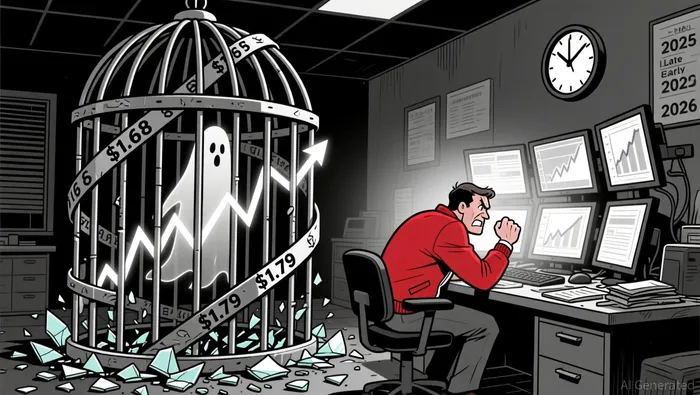
Aptos (APT) has been trapped in a range-bound pattern since late 2025, oscillating within an $0.11 band despite a 31% surge in trading volume above the 7-day average. Key support levels at $1.68–$1.69 and resistance at $1.75 have repeatedly failed to catalyze a breakout, with high-volume rejections indicating a lack of conviction among buyers according to CoinDesk. Technical indicators like the RSI and MACD remain mixed, suggesting a cautious outlook. While some analysts predict a short-term recovery to $1.75–$1.80, the absence of sustained momentum highlights structural weaknesses in APT's market structure. This pattern aligns with broader altcoin underperformance, where liquidity exhaustion and capital flight to BitcoinBTC-- have exacerbated volatility.
Macroeconomic Headwinds for XRP: A Tale of Global Liquidity and Risk Appetite
XRP's decline in late 2025 was driven by macroeconomic factors that transcended individual project fundamentals. The unwinding of the yen carry trade, rising global interest rates, and a lack of synchronized liquidity expansion by central banks created a risk-off environment, pushing investors toward safer assets according to Crypto Research. Additionally, geopolitical tensions and the absence of compelling macroeconomic improvements-such as rate cuts or economic stimulus-further dampened XRP's appeal as reported by The Motley Fool. Despite regulatory clarity from the SEC settlement in August 2025, which opened the door for ETF approvals, XRP's price failed to sustain momentum, underscoring the dominance of macroeconomic sentiment over regulatory progress according to Finance Magnates.
Altcoin Market Correlation and Systemic Risk
The declines of APT and XRPXRP-- are not isolated events but part of a broader altcoin market correction. In 2025, XRP fell 15% while the broader altcoin market dropped 40%, reflecting divergent resilience levels. However, both tokens remain highly correlated with macroeconomic liquidity conditions and institutional adoption trends. For instance, the maturation of Bitcoin's institutional adoption has siphoned capital away from altcoins, leaving projects like APT and XRP vulnerable to liquidity shocks as detailed in Grayscale Research. Furthermore, technical indicators such as the death cross and bearish RSI readings for XRP highlight systemic fragility in the altcoin sector.
Strategic Positioning for 2026: Navigating Fed Policy and Institutional Flows
The 2026 outlook for altcoins hinges on two critical factors: Federal Reserve policy and institutional adoption. A dovish pivot by the Fed, including rate cuts and balance sheet expansion, could reduce the opportunity cost of holding non-yielding assets like Bitcoin and altcoins, potentially reigniting risk appetite according to CFA Benchmarks. Additionally, the approval of altcoin ETFs-particularly for projects with clear use cases like SolanaSOL-- and XRP-could enhance liquidity and attract institutional capital as reported by Coinpedia. For XRP, real-world adoption as a cross-border payment solution and regulatory clarity will be key differentiators in a competitive landscape dominated by stablecoins and CBDCs according to JPMorgan.
However, strategic positioning must also account for systemic risks. Altcoins with robust infrastructure and utility-such as those enabling tokenized real-world assets (RWAs) or decentralized finance (DeFi)-are better positioned to weather volatility compared to speculative mid-cap tokens as outlined by TradingView. Investors should prioritize projects with durable economic fundamentals and regulatory alignment, while hedging against macroeconomic shocks through diversified exposure to Bitcoin and EthereumETH--.
Conclusion: A New Paradigm for Altcoin Investing
The declines of APT and XRP signal a critical inflection point for altcoin markets, where technical and macroeconomic risks converge to redefine investment strategies. As 2026 unfolds, the interplay between Fed policy, institutional adoption, and project fundamentals will determine which altcoins thrive. Investors must adopt a disciplined approach, leveraging technical analysis to identify resilient tokens and macroeconomic insights to time market cycles. For XRP, the path to recovery hinges on real-world utility and regulatory progress, while APT's success will depend on breaking out of its range-bound pattern with sustained volume and narrative-driven momentum.






Comentarios
Aún no hay comentarios