
Aptiv PLC: Assessing the Recent Dip as a Strategic Entry Opportunity Amid Autonomous Vehicle Growth
Aptiv PLC (APTV) has experienced a recent stock price decline, with shares falling 2.67% in a single trading session and underperforming the S&P 500's 0.38% loss, according to Yahoo Finance. This dip, however, occurs against a backdrop of mixed performance: while APTVAPTV-- has gained 6.44% over the past month-outpacing the S&P 500's 4.06% gain-its 52-week return remains negative at -22.5%, contrasting sharply with the S&P 500's 8.1% growth, as noted by Benzinga. For investors, the critical question is whether this correction reflects temporary challenges or a deeper misalignment with long-term fundamentals.
Financial Performance: Short-Term Volatility vs. Long-Term Resilience
Aptiv's recent underperformance stems from a combination of macroeconomic headwinds and sector-specific pressures. The company lowered its 2024 revenue guidance by $450 million in July 2024, citing slowed electrification momentum, rising labor and material costs, and foreign exchange rate impacts, according to Sahm Capital. These factors contributed to a 22% year-to-date decline in its stock price as of July 2024, per Sahm Capital. However, recent quarters show resilience: Q2 2025 revenue reached $5.2 billion, a 3% year-over-year increase, with an improved adjusted operating income margin of 12.1%, as reported in Aptiv's Q2 2025 release.
Valuation metrics further suggest undervaluation. AptivAPTV-- trades at a forward P/E of 11.40, below the industry average of 14.16, according to Benzinga, and an EV/EBITDA ratio of 7.66, significantly lower than the sector median reported in Aptiv's Q2 2025 release. Analysts estimate a fair value of $210.56, implying the stock is undervalued by over 59%, according to SimplyWall.St. This disconnect between fundamentals and price raises the question: Is the dip a buying opportunity?
Strategic Position in Autonomous Vehicle and ADAS Markets
Aptiv's long-term growth hinges on its leadership in Advanced Driver-Assistance Systems (ADAS) and autonomous vehicle (AV) technologies. The company has invested $4.5 billion in R&D since 2023, developing over 250 ADAS solutions and the Gen 6 platform, which supports hands-free driving in urban environments, according to Mordor Intelligence. Its partnerships, such as the collaboration with Axera to integrate AI chips into ADAS systems, underscore its commitment to innovation, as reported by Telematics Wire.
Market dynamics further validate Aptiv's strategic bets. The global ADAS market is projected to grow from $42.9 billion in 2024 to $212.2 billion by 2034, driven by AI integration and regulatory mandates, per GlobeNewswire. Aptiv reported a 15.87% market share in the Auto & Truck Parts industry in its investor release, and holds a 49.5% revenue share in Level 2 autonomous driving-a segment expected to dominate due to its maturity and adoption rates, according to Fundamental Business Insights. Analysts project the ADAS market to reach $35.99 billion by 2030, with Aptiv well-positioned to capture a significant portion, per Mordor Intelligence.
Catalysts for the Dip: Temporary or Structural?
The recent stock decline appears rooted in short-term challenges rather than long-term fundamentals. While Aptiv's Q3 2025 earnings guidance (net sales of $4.95–5.1 billion) reflects cautious optimism, analysts expect a 3.83% year-over-year earnings decline, according to MarketScreener. However, these projections overlook the company's structural advantages: a 19.01% year-over-year EPS increase in 2025, reported by Finviz, a planned spin-off of its software division to unlock value (noted by Benzinga), and diversification into aerospace and defense, which could stabilize margins per Aptiv's Q2 2025 release.
Moreover, Aptiv's PEG ratio of 0.9 suggests its valuation is aligned with earnings growth expectations (Finviz), and its 5-year EPS growth forecast stands at 12.12% per SimplyWall.St. Risks remain, including global supply chain disruptions and slower-than-expected EV adoption, but these are industry-wide and not unique to Aptiv.
Conclusion: A Strategic Entry Opportunity?
Aptiv's recent dip appears to be a correction rather than a collapse. While macroeconomic and sector-specific headwinds have pressured its stock, its strategic position in high-growth AV and ADAS markets, robust R&D investments, and attractive valuation metrics suggest the decline is temporary. For investors with a medium- to long-term horizon, the current price offers an entry point to capitalize on Aptiv's potential to benefit from the $212.2 billion ADAS market and its own innovation-driven margin expansion.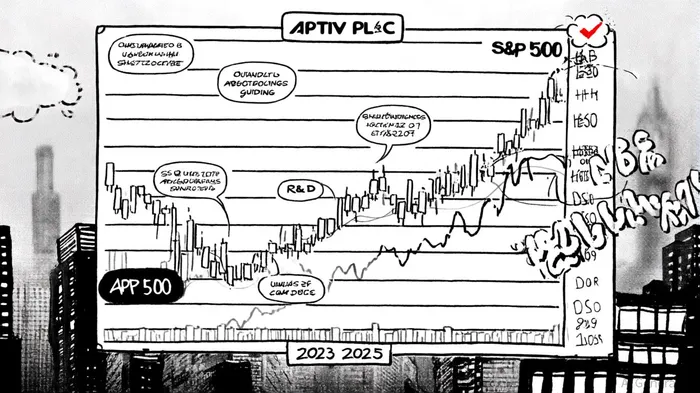





Comentarios
Aún no hay comentarios