
AppLovin's High-Flying Growth: A Cautionary Tale of Re-Rating Risk in AdTech
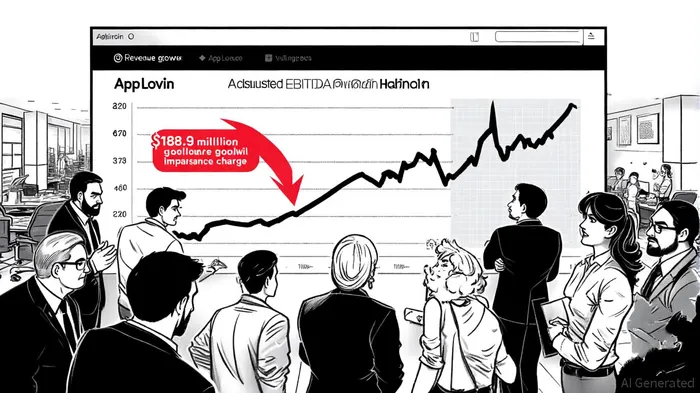
The recent surge in AppLovin's financial performance has painted a picture of a high-flying AdTech success story. According to a Panabee report, the company's Q2 2025 revenue from continuing operations soared 77% year-over-year to $1.3 billion, driven by its AppDiscovery platform's 70% increase in net revenue per installation. Adjusted EBITDA margin expansion to 81% and $1.6 billion in free cash flow for the first half of 2025 further underscore its operational prowess, per that report. Yet beneath these metrics lies a growing re-rating risk-a phenomenon where high-growth stocks face sharp valuation corrections as markets reassess their fundamentals.
The Illusion of Sustained Momentum
AppLovin's strategic divestiture of its mobile gaming operations to Tripledot Studios for $400 million in cash and a 20% equity stake has streamlined its focus on advertising technology, according to the Panabee report. While this move boosted profitability-operating income rose 149% to $957.7 million-the company's reliance on a single business model now exposes it to sector-specific headwinds. For instance, the Axon Ads Manager, a key growth driver slated for broader access in October 2025, faces an uncertain regulatory and competitive landscape, as noted on an earnings call transcript. If user acquisition costs rise or ad inventory tightens, AppLovin's margins could erode rapidly.
Compounding this risk is a $188.9 million goodwill impairment charge in Q2 2025, signaling that some of its past acquisitions or assets are underperforming, a point raised in the Panabee report. While management attributes this to the divestiture of its Apps business, the charge highlights a pattern of aggressive M&A that may not always align with long-term value creation.
Analyst Optimism vs. Market Realities
Despite these red flags, analysts remain bullish. A Nasdaq survey pegs the average 12-month price target at $490.07, with a high estimate of $650.00, as noted in an earnings analysis. This optimism is partly fueled by AppLovin's $1.3 billion stock repurchase program in H1 2025, which signals confidence in its intrinsic value, per the Panabee report. However, such buybacks also reflect a defensive strategy to offset declining organic growth. The company's Q2 2025 revenue guidance of $1–$1.215 billion, while robust, represents a deceleration from Q1's 40% YoY growth.
Historical data on AppLovin's earnings performance offers mixed insights. Since 2022, the stock has historically delivered a 1-day average pop of ~+4% following earnings beats, with a ~78% win rate across nine such events. By day 30, the median cumulative return reached ~+17%, outpacing the Nasdaq Composite benchmark's ~+12%. However, statistical significance tapered after day 1, and the strongest rallies occurred in 2023–2024 when EPS surprises exceeded +0.14. These patterns suggest that while positive earnings surprises can drive short-term momentum, long-term sustainability depends on broader fundamentals.
The danger for investors lies in the disconnect between AppLovin's current valuation and its ability to sustain these growth rates. High-growth tech stocks often trade at multiples that assume perpetual acceleration. If AppLovin's AdTech platform faces saturation or regulatory scrutiny-common pitfalls in digital advertising-the market could swiftly re-rate its stock downward.





Comentarios
Aún no hay comentarios