
Applied Materials' Strategic Position in the AI-Driven Semiconductor Revolution
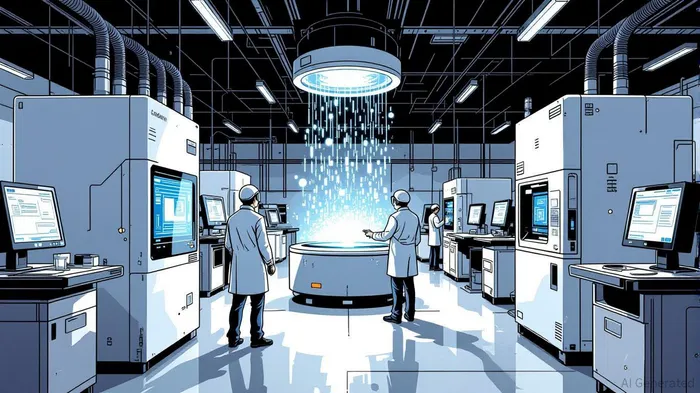
The semiconductor industry is undergoing a seismic shift, driven by the insatiable demand for artificial intelligence (AI) infrastructure. At the forefront of this transformation is Applied Materials, a leader in semiconductor equipment and materials innovation. With global semiconductor revenue projected to grow 14% in 2025 to $717 billion, fueled largely by AI-related demand for GPUs and high-bandwidth memory (HBM) [1], Applied MaterialsAMAT-- is uniquely positioned to capitalize on long-term tailwinds in the sector.
Market Context: AI as the Catalyst for Semiconductor Demand
The growth of AI infrastructure is reshaping semiconductor manufacturing priorities. Advanced nodes (5nm and below), heterogeneous chip integration, and advanced packaging technologies are now critical to enabling the performance required for AI workloads. According to a report by IntelINTC-- Market Research, the semiconductor robotic automation market—essential for precision handling in AI-driven fabrication—is expected to grow at a 4.7% CAGR through 2031 [2]. Applied Materials, with its expertise in thermal processing equipment like rapid thermal processing (RTP) furnaces, is a key enabler of these advancements. These systems are indispensable for processes such as gate oxide formation and dopant activation in cutting-edge memory architectures and 3D NAND technologies [3].
The global semiconductor supply chain is also reorienting to address geopolitical risks, with the U.S. and China investing heavily in domestic production. Applied Materials' strategic expansion of U.S. manufacturing facilities, including a $200 million Arizona plant, aligns with this trend and strengthens its role in securing critical AI infrastructure supply chains [4].
Financial Strength and R&D Leadership
Applied Materials' financial performance underscores its resilience and growth potential. In 2024, the company reported $27.18 billion in revenue, with a robust net margin of 26.41% [5]. Its R&D investments, accounting for 12.27% of revenue, are a testament to its commitment to innovation. A strategic 9% equity stake in BE Semiconductor Industries (Besi) has positioned Applied Materials at the forefront of hybrid bonding technology, a critical enabler of wafer-level chiplet integration for AI chips [6].
Recent financial results further highlight its strength. In Q3 2025, Applied Materials reported record revenue of $7.3 billion, with non-GAAP earnings per share (EPS) reaching $2.48—a 17% year-over-year increase [7]. The company's cash reserves of $8.02 billion provide a buffer against near-term uncertainties, such as U.S. export controls and China market fluctuations, while its diversified product portfolio ensures adaptability to shifting demand.
Strategic Partnerships and Technological Innovation
Applied Materials' partnerships with industry leaders like AppleAAPL-- and Texas InstrumentsTXN-- (TI) exemplify its strategic alignment with AI-driven growth. Under a landmark collaboration, Applied Materials is supplying U.S.-made equipment to TI's fabrication plants, which produce semiconductors for Apple products. This partnership, part of Apple's $600 billion American Manufacturing Program, reinforces domestic chip production and reduces reliance on global supply chain vulnerabilities [8].
Beyond traditional manufacturing, Applied Materials is pioneering next-generation technologies. Its collaboration with Xanadu to develop 300 mm high-volume-compatible processes for superconducting transition edge sensors (TESs) in photonic quantum computing underscores its forward-looking approach [9]. Additionally, the company's joint lab with CEA-Leti in France is advancing energy-efficient solutions for AI data centers, focusing on specialty semiconductors for IoT, automotive, and power applications [10].
Market Share and Competitive Positioning
Applied Materials dominates key segments of the semiconductor capital equipment market. In the wafer fabrication equipment (WFE) segment, its market share exceeds that of its closest competitors, with leadership in deposition and etch processes [11]. While Lam ResearchLRCX-- holds a larger share in the etch equipment market (39% in 2023), Applied Materials' 22% share and expertise in physical vapor deposition (PVD) technologies solidify its competitive edge [12].
The company's focus on advanced packaging—critical as Moore's Law plateaus—is another growth driver. Hybrid bonding and 3D stacking technologies, which Applied Materials is actively developing, are essential for achieving the performance and energy efficiency required by AI applications [13].
Challenges and Long-Term Outlook
Despite its strengths, Applied Materials faces near-term headwinds, including China market uncertainties and delays in export license approvals. These factors have led to a cautious Q4 2025 outlook, with revenue expected to dip to $6.7 billion [14]. However, the company's long-term prospects remain robust. The global semiconductor capital equipment market is projected to grow from $116 billion in 2025 to $210.58 billion by 2034, driven by AI, automotive, and data center applications [15].
Applied Materials is also preparing for the future with initiatives like the upcoming EPIC Center in 2026, which will accelerate development of Gate-All-Around (GAAFET) and HBM architectures [16]. These investments position the company to lead in the "Ångstrom era" of chip manufacturing, where atomic-level precision and materials innovation define success.
Conclusion
Applied Materials is not merely a beneficiary of the AI semiconductor boom—it is a foundational enabler of the technologies driving this revolution. Through its leadership in advanced manufacturing processes, strategic partnerships, and R&D investments, the company is poised to capture significant value as AI infrastructure demand accelerates. While short-term challenges persist, the long-term trajectory is clear: Applied Materials is a cornerstone player in the semiconductor industry's evolution toward AI-centric innovation.





Comentarios
Aún no hay comentarios