
Applied Digital's AI Breakthrough: Bridging 19th-Century Innovation with Modern Scalability and Efficiency
The intersection of historical scientific breakthroughs and cutting-edge technology is rarely as explicit as it is in the case of Applied DigitalAPLD-- (NASDAQ: APLD). The company's AI infrastructure design, which prioritizes energy efficiency and neural network-inspired scalability, draws surprising parallels to 19th-century electrical brain research. This synthesis of old and new is not merely symbolic-it is foundational to Applied Digital's ability to meet the surging demand for AI workloads while maintaining a competitive edge in a rapidly evolving market.
Historical Roots: From 19th-Century Electrical Brain Research to Modern AI
The 19th century laid the groundwork for understanding the brain as an electrical network. Pioneers like Robert Bentley Todd and Michael Faraday conceptualized nervous conduction through principles of "nervous polarity," foreshadowing the development of electroencephalography and later, neural networks. These early insights revealed the brain's decentralized, energy-efficient architecture-a model that modern AI systems now emulate. For instance, the Human Brain Project and brain-inspired computing initiatives highlight how biological efficiency informs artificial systems, reducing computational overhead while maintaining robust performance.
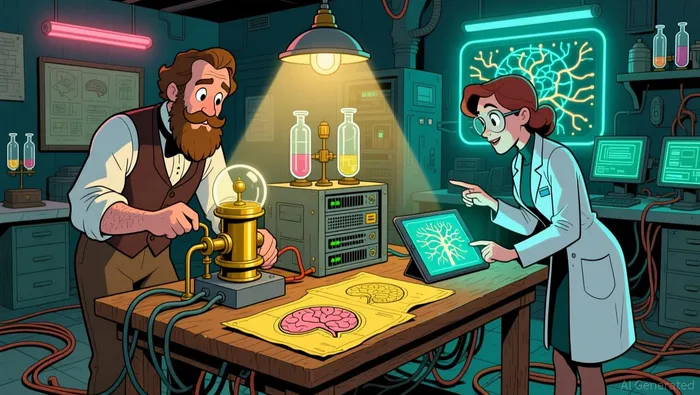
Applied Digital's engineering philosophy mirrors these principles. The company's AI factories, designed for high-performance computing (HPC) and AI workloads, leverage liquid cooling and renewable energy to achieve energy efficiency akin to the brain's metabolic constraints. By situating data centers near stranded power sources and optimizing for high-density computing (up to 132 kW per rack), Applied Digital reduces operational costs while aligning with sustainability goals- a direct nod to the 19th-century emphasis on harnessing natural electrical phenomena.
Engineering Innovation: Neural Network Inspiration and Scalability
The neural network, a cornerstone of modern AI, owes its conceptual roots to 19th-century theories of brain function. Early experiments by scientists like Roberts Bartholow demonstrated how electrical stimulation could map brain activity, a precursor to today's deep learning architectures. Applied Digital's infrastructure design reflects this lineage. Its "inside-out" approach prioritizes server-centric optimization, enabling scalable deployment of GPU-ready facilities that mirror the brain's interconnected, parallel processing capabilities.
This scalability is critical as AI workloads grow exponentially. Training large language models like GPT-4 requires energy equivalent to thousands of U.S. households annually. Applied Digital's liquid-cooled data centers, which reduce energy consumption by up to 40% compared to traditional facilities, directly address this challenge. The company's Polaris Forge 1 campus in North Dakota, now fully operational, exemplifies this strategy, delivering 100 MW of power while leveraging the region's abundant renewable energy.
Market Positioning and Growth Projections for 2026
Applied Digital's strategic alignment with historical innovation is translating into tangible financial performance. In Q4 2025, the company reported $126.6 million in revenue-a 250% year-over-year increase-and achieved adjusted net income, signaling a pivotal step toward profitability. The Zacks Consensus Estimate projects 2026 revenue of $281 million, driven by long-term leases with hyperscalers and the energization of additional campuses.
The company's financial discipline further strengthens its growth narrative. A $2.35 billion senior secured private notes offering and $900 million in preferred equity financing from Macquarie Asset Management underscore its ability to fund expansion while maintaining a strong liquidity position. With three additional campuses in advanced discussions-each scalable to 2 GW-Applied Digital is poised to capitalize on the $350 billion annual investment in AI infrastructure by hyperscalers.
The Spin-Off of Applied Digital Cloud: A Strategic Catalyst
The impending spin-off of Applied Digital Cloud into ChronoScale adds another layer of strategic flexibility. By separating the AI infrastructure and cloud services divisions, the company can pursue independent growth trajectories, potentially unlocking value for shareholders. CEO Wes Cummins has emphasized that this move will enhance focus on core strengths, including modular construction and energy-efficient design.
Risks and Mitigations
While Applied Digital's trajectory is compelling, risks such as high leverage and execution challenges in construction projects remain. However, the company's emphasis on stranded power and modular design mitigates these concerns. For example, North Dakota's access to affordable energy and favorable climate for free cooling reduces dependency on volatile power markets. Additionally, the spin-off of ChronoScale is expected to streamline operations, focusing resources on AI infrastructure development.
Conclusion: A Historical Leap Forward
Applied Digital's success lies in its ability to bridge centuries of scientific progress. By integrating 19th-century principles of electrical brain efficiency with modern engineering, the company is redefining AI infrastructure for an era of exponential demand. As the AI revolution accelerates, Applied Digital's historical innovation-rooted in energy efficiency, neural network scalability, and strategic sustainability-positions it as a key player in the $350 billion AI infrastructure market. For investors, the combination of robust financials, technological differentiation, and a clear growth path makes Applied Digital a compelling high-growth opportunity in 2026 and beyond.





Comentarios
Aún no hay comentarios