
Apple's Strategic Cost Restructuring Amid Global Market Pressures
Targeted Layoffs and Strategic Refocusing
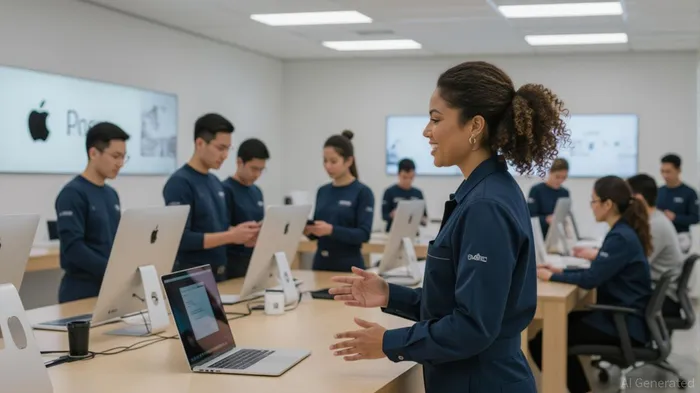
Apple's November 2025 announcement revealed job cuts across its sales teams, particularly affecting account managers serving enterprise, education, and government clients, as well as employees at briefing centers according to reports. The government sales team, which had already faced challenges due to a 43-day federal shutdown and budget constraints, became a focal point of these reductions as data shows. The company emphasized that the cuts were not a broad workforce reduction but a targeted effort to eliminate overlapping roles and shift toward third-party resellers, aligning with client preferences and reducing salary costs according to Apple's restructuring plan. This approach highlights Apple's commitment to refocusing resources on customer engagement rather than maintaining redundant structures.
Financial Performance and Profit Margin Implications
Apple's Q3 2025 financial results, released in July 2025, demonstrated resilience despite the restructuring. , depending on the report), surpassing analyst expectations, according to earnings data. The iPhone 16 lineup and M4 MacBook Air drove product sales, as reported by Apple. However, , , as analysts noted.
Comparative analysis with peers reveals Apple's operating margin of 31.6% remained stable, , Microsoft (14.8%), and Alphabet (17.6%) according to market research. This disparity suggests that while Apple's restructuring may bolster short-term efficiency, its long-term growth trajectory faces challenges in keeping pace with competitors.
Broader Tech Sector Trends and Investor Sentiment
Apple's moves align with a sector-wide trend of cost discipline. From 2023 to mid-2025, over 96,000 tech jobs were cut across 408 layoff events, with Amazon planning to reduce 30,000 corporate roles as part of an AI-driven reorganization according to industry reports. While companies frame these cuts as necessary for streamlining operations and enhancing productivity, critics argue that cost reduction-not genuine innovation-often drives such decisions as research indicates.
Investor confidence in big tech remains polarized. Apple's Q3 results were praised for exceeding revenue and EPS forecasts, with analysts highlighting its strong customer loyalty and AI integration plans according to earnings analysis. However, the stock's post-earnings dip and broader concerns about CEO-to-worker pay ratios (285:1 in 2024) reflect lingering skepticism about equitable value distribution as data shows. For AppleAAPL--, the challenge lies in balancing cost efficiency with sustained innovation to avoid eroding long-term trust.
Long-Term Value Creation and Strategic Resilience
Apple's restructuring underscores its ability to adapt to economic pressures while maintaining core strengths. By shifting to third-party resellers and prioritizing high-impact roles, the company aims to reduce costs without compromising customer engagement-a critical differentiator in a competitive market. However, the success of this strategy will depend on its execution: retaining key talent, avoiding operational bottlenecks, and ensuring that cost savings translate into meaningful margin expansion.
Comparisons with peers like Microsoft and Amazon highlight the need for Apple to accelerate growth in high-margin services and AI-driven offerings. While its services segment outperformed expectations, the company must address slower hardware growth and external risks, such as tariffs, to sustain investor optimism.
Conclusion
Apple's strategic cost restructuring reflects a calculated response to global market pressures, aligning with broader tech sector trends while emphasizing operational efficiency. Though the layoffs are modest, they signal a shift toward leaner operations and client-centric models. For investors, the key takeaway is Apple's ability to balance short-term cost discipline with long-term innovation-a balance that will determine its resilience in an era of economic uncertainty. As the company navigates these challenges, its commitment to AI integration, services growth, and shareholder returns will remain critical indicators of its strategic success.





Comentarios
Aún no hay comentarios