
Is Apple Stock (AAPL) a Sell Amid Escalating Tariff Risks?
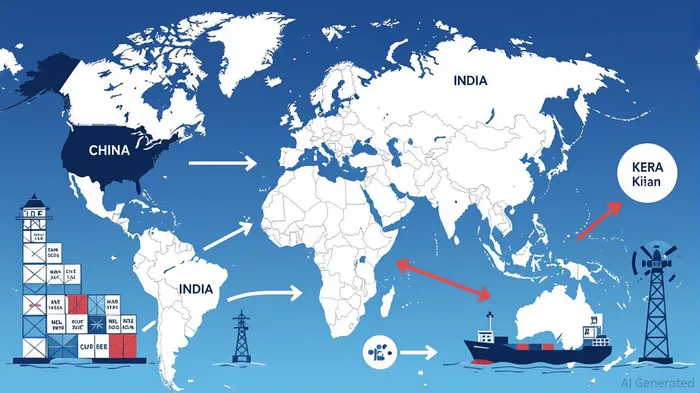
In the ever-evolving landscape of global trade, Apple Inc.AAPL-- (AAPL) stands at a crossroads. The company's supply chain, long anchored in China, is undergoing a strategic recalibration to mitigate escalating tariff risks and geopolitical uncertainties. Yet, as AppleAAPL-- diversifies its production to India and Vietnam, the question remains: Is this enough to shield its long-term valuation from the headwinds of a fragmented global economy?
Supply Chain Vulnerability: A Delicate Balancing Act
Apple's supply chain has historically been a double-edged sword—enabling cost efficiency while exposing the company to geopolitical volatility. As of 2025, over 75% of iPhones destined for the U.S. market are assembled in India, a sharp increase from just 15% a year earlier. This shift, part of Apple's “China plus one” strategy, aims to reduce reliance on a single region. However, the transition is far from complete. Higher-value components, such as semiconductors and advanced glass, remain concentrated in China, with critical chip fabrication still dependent on Taiwanese and Japanese partners.
The expiration of U.S. tariff exemptions on smartphones in August 2025 has further complicated matters. Analysts estimate that without relief, Apple may face a $350 price hike on the iPhone 16 Pro Max or absorb costs internally, squeezing profit margins. Meanwhile, new reciprocal tariffs on India and Vietnam—key manufacturing hubs—threaten to undermine the financial benefits of diversification. These developments underscore a critical vulnerability: while Apple has made progress in decentralizing its supply chain, it remains exposed to the whims of global trade policies.
Valuation Concerns: Earnings Resilience vs. Structural Risks
Apple's financial performance in 2025 has been a mixed bag. Q3 2025 earnings hit $94 billion, driven by a 13.5% year-on-year increase in iPhone revenue and record Services revenue of $27.4 billion. However, tariff-related costs added $900 million to the company's expenses during the quarter, with further increases expected in Q4. The stock, which fell to $169.21 in April 2025, has since rebounded to $224, but its forward P/E ratio of 26.95 remains elevated compared to peers.
The company's valuation hinges on its ability to sustain innovation and market share in a competitive landscape. While Apple's Services segment offers recurring revenue, hardware demand is slowing, particularly in China, where geopolitical tensions have dampened consumer sentiment. Additionally, Apple's AI ambitions—though advancing—lag behind rivals like MetaMETA-- and MicrosoftMSFT--. The recent overhaul of Siri and partnerships with GoogleGOOGL-- highlight efforts to catch up, but monetizing AI remains a long-term challenge.
Strategic Mitigations: Reshoring and AI Investments
Apple has responded to these risks with a dual strategy: reshoring and technological reinvention. The $500 billion U.S. Manufacturing Program, including partnerships with CorningGLW-- and TSMCTSM--, aims to localize critical components and reduce reliance on foreign suppliers. Domestically produced rare earth materials and AI-driven supply chain analytics further underscore a commitment to resilience.
However, reshoring is not without costs. Rising logistics expenses and lower yield rates in India have already impacted gross margins. Moreover, the political calculus of navigating U.S. tariffs—exemplified by CEO Tim Cook's high-profile engagement with former President Trump—reveals the precarious balance between diplomacy and profitability.
The Verdict: A Sell or a Strategic Hold?
Apple's stock valuation reflects both its enduring strengths and emerging vulnerabilities. While the company's financial resilience and innovation pipeline justify a cautious “Buy” rating from some analysts, the interplay of tariff risks, geopolitical volatility, and competitive pressures cannot be ignored. For investors, the key lies in assessing whether Apple's supply chain reorientations and AI investments can offset these challenges.





Comentarios
Aún no hay comentarios