
Apple's Smart Home Gambit: How Supply Chain Shifts and Product Innovation Signal a $299 Billion Opportunity
Apple's strategic pivot in the smart home sector is gaining momentum, and investors would be wise to pay attention. The company's dual focus on supply chain resilience and product innovation-particularly with its upcoming HomePod with a display-signals a calculated move to dominate a market projected to grow to $299 billion by 2030[1]. Let's break down how AppleAAPL-- is threading the needle between manufacturing pragmatism and technological ambition.
Supply Chain Diversification: A Hedge Against Geopolitical Risk
Apple's decision to shift iPhone production from China to India and Vietnam isn't just about tariffs-it's about risk mitigation. By 2027, the company aims to produce 25% of iPhones in India, up from 15% in late 2024[2]. Vietnam, meanwhile, has become a hub for AirPods and Apple Watch assembly[3]. This diversification is part of a $50 billion global investment plan to build a "resilient, sustainable supply chain"[4].
For the HomePod, the strategy is similar. While the device itself will still be assembled in China by BYD, Apple is locking in key suppliers like Tianma Microelectronics for its 7-inch LCD panel[5]. This ensures component availability even if geopolitical tensions disrupt broader manufacturing hubs. The lesson here? Apple is insulating its smart home ambitions from supply shocks, a critical factor in a sector where reliability trumps novelty.
The HomePod with a Display: A $299 Premium Play
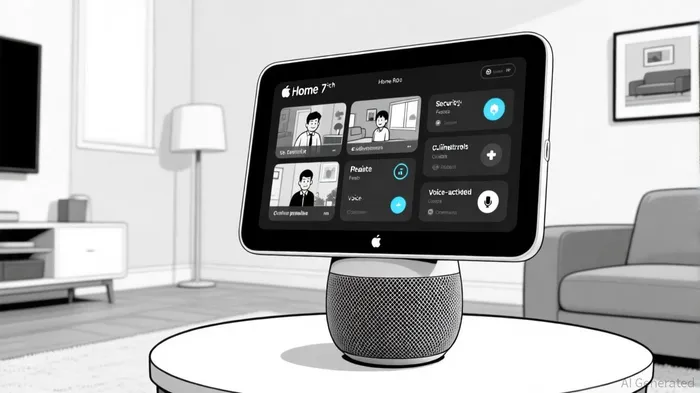
The HomePod with a display, delayed to Q3 2025 due to software challenges[6], is no ordinary smart speaker. Packed with a 7-inch LCD, A18 chip, and a reengineered Siri AI, it's designed to be the nerve center of Apple's smart home ecosystem. Analyst Ming-Chi Kuo notes this device will likely integrate Apple Intelligence and align with iOS 19 updates[7], positioning it as a bridge between the iPhone and the home.
But how does this stack up financially? Manufacturing costs are estimated at $216 per unit[8], with a retail price of $299 yielding a $83 gross margin. While that's lower than iPhone margins, it reflects Apple's strategy to prioritize ecosystem lock-in over short-term profits. The HomePod isn't just a speaker-it's a gateway to recurring revenue from HomeKit subscriptions, security services, and AI-driven personalization.
The Bigger Picture: Smart Home as Apple's Next $100 Billion Business
The HomePod's evolution mirrors Apple's broader smart home ambitions. The upcoming "HomePad" (HomePod 3) is rumored to include a FaceTime camera, Thread/UWB connectivity, and a custom OS derived from tvOS[9]. These features align with the rise of Matter, an open-standard protocol that could unify fragmented smart home devices. By 2026, Apple could capture 30% of the premium smart home market[10], leveraging its ecosystem to outpace competitors like Amazon and Google.
Why This Matters for Investors
Apple's supply chain diversification reduces exposure to China-centric risks, while its product roadmap ensures it stays ahead in the smart home race. For investors, the key takeaway is clear: Apple is betting big on the home as the next frontier for AI and IoT. The HomePod's premium pricing and ecosystem integration suggest a long-term play, not a one-off product.
The risks? Delays in AI software development could push the HomePad to 2026[11], and supply chain hiccups in India/Vietnam might slow iPhone production. But given Apple's $50 billion investment in resilience[12], these are manageable headwinds.
Conclusion: Buy the Vision, Not Just the Product
Apple's HomePod isn't just a smart speaker-it's a strategic lever to anchor the smart home. With supply chains diversified, margins stabilized, and AI innovation on the horizon, this is a growth story worth betting on. For investors, the message is simple: Apple's smart home strategy is no longer speculative-it's a $299 billion inevitability.





Comentarios
Aún no hay comentarios