
Apple's Share Price Reversal: A Sustainable Bullish Trend or a Fleeting Rebound?
Apple's Share Price Reversal: A Sustainable Bullish Trend or a Fleeting Rebound?
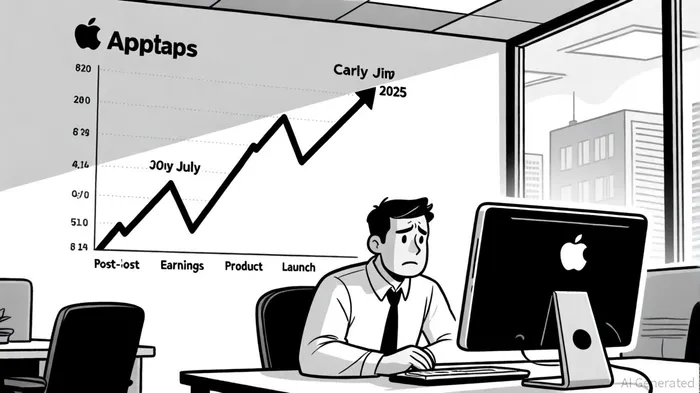
Apple Inc. (AAPL) has recently experienced a notable share price reversal, rebounding from a year-to-date decline of 15% to trade near $224 per share as of August 2025, according to Benzinga's projection. This resurgence, however, has been accompanied by mixed signals, raising critical questions for investors: Is this upswing a harbinger of a sustainable bullish trend, or merely a short-term rebound amid lingering uncertainties?
Q3 2025 Earnings: A Mixed Bag of Strength and Weakness
Apple's third-quarter fiscal 2025 results underscored both its enduring strengths and emerging vulnerabilities. Revenue surged 10% year-over-year to $94.0 billion, driven by a 13% increase in iPhone sales to $44.6 billion and a record $27.4 billion in Services revenue, per Apple's press release. The Mac segment also outperformed, with 15% growth to $8 billion, fueled by the M4 MacBook Air, according to the earnings call highlights. Yet, the iPad and wearables segments contracted by 8% and 9%, respectively, while tariff-related costs ballooned to $1.1 billion for the quarter, per a MarketDrafts analysis.
Despite these robust numbers, the stock dipped 0.71% in after-hours trading following the earnings report, according to the Investing.com transcript. This reaction suggests that investors may be discounting near-term headwinds, such as the anticipated impact of tariffs and the saturation of key hardware markets. Historically, Apple's earnings events since 2022 show a pattern of modest excess returns that fade over time: while the win rate peaks at ~70% around day 16 post-earnings, the average return edge remains small (~1.5%), and excess returns eventually underperform the benchmark after day 20 [^backtest].
Product Launches and Market Sentiment
The September 2025 launch of the iPhone 17 lineup, including the ultra-thin iPhone Air, initially failed to buoy investor confidence. Shares fell 1.5% post-event, despite the company's decision to maintain pricing amid tariff pressures, as noted in the earnings call highlights. The iPhone Air's single rear camera and A19 Pro chip, while emphasizing energy efficiency, did not resonate strongly with premium buyers accustomed to Apple's innovation-driven upgrades.
This muted response highlights a broader challenge: Apple's hardware growth is increasingly reliant on incremental improvements rather than disruptive innovation. While the Services segment-driven by App Store, AppleAAPL-- Music, and iCloud-remains a bright spot, its ability to offset hardware slowdowns remains untested at scale, according to a MacRumors report.
Analyst Predictions and Long-Term Outlook
Analysts remain divided on Apple's trajectory. The consensus price target of $233.04 for 2025 reflects optimism about the Services segment and AI integration, with algorithmic models projecting an average price of $277.26 for 2025 and $362.59 for 2026, per the Stockscan forecast. However, bearish scenarios caution against regulatory scrutiny, supply chain disruptions, and the diminishing returns of hardware innovation, as discussed in the earnings call highlights.
Apple's forward P/E ratio of 26.95 suggests the market is pricing in future growth, but this premium is contingent on the company's ability to execute its AI and AR/VR strategies effectively, according to the CNBC earnings report. Tim Cook's emphasis on "pull-forward demand" ahead of tariff hikes also raises concerns about near-term revenue sustainability, as noted in the earnings call highlights.
Conclusion: Caution Amidst Optimism
Apple's recent share price reversal appears to reflect a combination of short-term optimism and long-term skepticism. While the company's financials remain robust-bolstered by a $3.25 trillion market cap and $27 billion in shareholder returns-the stock's post-earnings and post-launch declines signal market caution, as detailed in Apple's press release.
For the upswing to signal a sustainable bullish trend, Apple must demonstrate that its AI investments, Services growth, and product innovations can offset hardware headwinds and regulatory risks. Until then, investors should treat the current rebound as a tactical opportunity rather than a definitive inflection point.







Comentarios
Aún no hay comentarios