
Apple's Legal Strategy and Its Impact on Long-Term Profitability: Navigating Appellate Rulings in Tech Regulation
Apple Inc. (AAPL) has long been a bellwether for innovation and profitability in the tech sector, but its legal battles over the past three years have introduced a complex layer of risk and opportunity. From antitrust lawsuits to patent disputes, the company's legal strategy is now a critical factor in assessing its long-term financial health. Recent appellate rulings-ranging from partial victories to setbacks-highlight the evolving regulatory landscape and its implications for investor confidence and market positioning.
The Epic Games Saga: A Mixed Appellate Outcome
The 9th U.S. Circuit Court of Appeals' 2025 decision in Epic Games v. Apple exemplifies the nuanced nature of these legal challenges. While the court upheld most injunctions against AppleAAPL--, including a contempt order for violating prior rulings, it instructed lower courts to reevaluate the commission Apple could charge developers for in-app purchases outside the App Store. 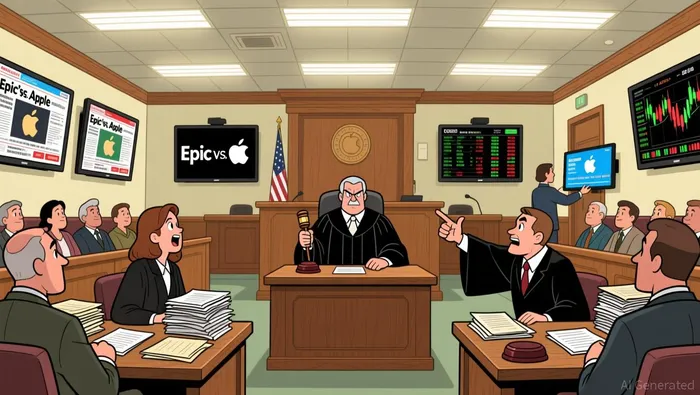 This partial victory signals a potential recalibration of Apple's App Store policies, which could reduce its 15-30% transaction fees-a significant revenue stream. However, the continued enforcement of antitrust measures against the App Store's gatekeeping practices may limit Apple's ability to maintain its current digital ecosystem dominance.
Investors have shown resilience in the face of these rulings. Despite the legal uncertainty, Apple's fiscal Q3 2025 results-marked by a 15% increase in iPhone sales and record Services revenue-have reinforced confidence in its core business. A study analyzing 16,955 social media posts about Apple's legal cases found that positive sentiment outweighed negative, suggesting investors view these challenges as manageable rather than existential.
Patent Disputes: Financial Exposure and Strategic Reassurance
Apple's legal exposure extends to patent litigation, as seen in its 2025 defeat to Masimo, which was awarded $634 million for alleged infringement of pulse-oximetry technology in the Apple Watch. Such rulings underscore the risks of relying on cutting-edge hardware features, which are increasingly subject to intellectual property claims. However, Apple's recent Supreme Court win in its dispute with Gesture Technology Partners (GTP) offers a counterbalance. The Court's refusal to hear GTP's appeal upheld the invalidation of expired patents that had previously threatened Apple, Google, and LG. This outcome reinforces Apple's ability to defend its products against overbroad patent claims, a critical advantage in a sector prone to litigation.
Antitrust Scrutiny and Global Regulatory Pressures
The U.S. Department of Justice and 21 states' antitrust lawsuit against Apple-accusing the company of monopolizing the smartphone market through exclusionary practices-represents a broader regulatory shift. Coupled with the European Union's Digital Markets Act (DMA), which mandates greater openness in digital platforms, these pressures are forcing Apple to adapt its business model. While compliance costs may rise, the company's ecosystem-driven strategy-centered on AI integration and cross-device services-positions it to retain user loyalty even as it cedes some control over app distribution.
Investor Sentiment: OptimismOP-- Amid Complexity
Despite the legal headwinds, Apple's financial metrics remain robust. Its high price-to-earnings ratio and strong profitability indicators suggest that investors continue to value its long-term growth potential.
Conclusion: Balancing Risk and Resilience
Apple's legal strategy is a double-edged sword. While appellate rulings have exposed the company to financial liabilities and regulatory scrutiny, they have also compelled strategic adaptations that could strengthen its market position over time. For investors, the key lies in assessing whether Apple can maintain its premium valuation while navigating these challenges. The mixed outcomes in recent cases suggest that the company's long-term profitability will depend not only on its legal defenses but also on its ability to innovate and retain customer trust in an increasingly regulated world.







Comentarios
Aún no hay comentarios