
Apple's Legal Battle in India: Implications for Global Tech Giants and Antitrust Enforcement
The Core of the Dispute: Global Turnover vs. Local Accountability
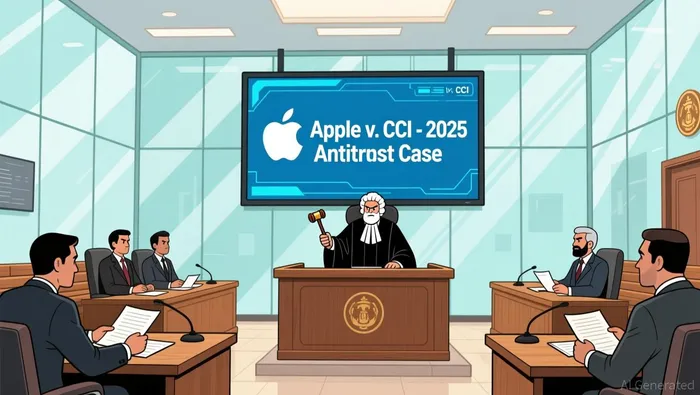
Apple's legal challenge hinges on a fundamental argument: that India's new penalty framework is "manifestly arbitrary, unconstitutional, and grossly disproportionate" as reported by Reuters. The company contends that penalties should be tied to the revenue of the specific business unit involved in the alleged violation, not the entire global enterprise. For example, Apple argues that if a company operates both a stationery store and a toy store, and the toy store violates antitrust rules, the penalty should reflect the toy store's revenue, not the combined total of both businesses as noted by Economic Times.
The CCI, however, maintains that the 2023 amendment to India's Competition Act explicitly permits the use of global turnover for penalty calculations as reported by Yahoo Finance. This shift reflects a broader trend in emerging markets: regulators are no longer content to treat MNCs as mere foreign entities but are instead holding them accountable for their global operations. For Apple, the stakes are clear. A $38 billion fine would not only cripple its financial flexibility but also set a precedent that could embolden regulators in other markets to adopt similarly aggressive enforcement strategies as highlighted by Sherwood News.
Broader Implications: A New Era of Antitrust Risk
Apple's case is emblematic of a larger problem for global tech giants. India's antitrust reforms, including stricter interpretations of the Green Channel Route (GCR) for mergers and acquisitions, have created a minefield for MNCs. As experts at Mondaq point out, the CCI's recent rulings-such as CA Plume Investments (2025) and Platinum Jasmine (2025)-demonstrate a zero-tolerance approach to even minor overlaps in market dominance. What was once a streamlined process for low-risk deals has become a high-stakes compliance challenge, with inadvertent misstatements or overlooked overlaps triggering penalties and reputational damage.
The 2023 amendment to India's Competition Act has further complicated matters by expanding the definition of "control" and shortening merger review timelines as detailed by Mondaq. For MNCs with sprawling global portfolios, this means that even indirect investments or limited rights in subsidiaries can trigger merger control obligations. The result? A regulatory environment where self-certification is fraught with risk, and companies must now allocate significant resources to navigate India's antitrust labyrinth as observed by Mondaq.
Strategic Risks and the Cost of Compliance
The financial and strategic risks for MNCs are mounting. Beyond the immediate threat of exorbitant fines, companies must now factor in the long-term costs of compliance. For instance, the CCI's 2024 settlement framework-illustrated by its case against Google's pre-installation practices in the smart TV market-requires firms to reengineer business models, renegotiate contracts, and address cybersecurity vulnerabilities as detailed by Trilegal. While settlements aim to expedite resolution, they also open the door to follow-on litigation and civil liabilities, particularly if competition harm is explicitly acknowledged as noted by Trilegal.
Moreover, the CCI's growing focus on digital markets adds another layer of complexity. The Google case, which labeled the Play Store an "essential facility," signals a shift toward stricter oversight of dominant platforms as reported by Trilegal. For tech giants, this means balancing competitive neutrality with data security and interoperability-a balancing act that becomes increasingly precarious as legacy systems are restructured or new market entrants are integrated as observed by Mondaq.
What's Next for Apple and the Industry?
The Delhi High Court's December 3 hearing will be a pivotal moment. If Apple prevails, it could limit the CCI's ability to impose global penalties, offering MNCs a temporary reprieve. However, as competition law expert Gautam Shahi notes, the amended law is "clear in allowing global turnover to be considered," and overturning it may prove difficult as reported by Pymnts. Even if Apple loses, the case will likely prompt a broader debate about proportionality and fairness in antitrust enforcement-a debate that could influence regulatory approaches in other emerging markets as reported by Reuters.
For investors, the takeaway is clear: the era of lax antitrust enforcement in emerging markets is over. Companies must now treat India-and similar jurisdictions-as high-risk environments where regulatory shifts can rapidly alter the financial calculus of global operations. This means not only beefing up compliance teams but also rethinking market entry strategies to mitigate exposure to jurisdictions with aggressive enforcement regimes as noted by Economic Times.
Conclusion: Navigating the New Normal
Apple's legal battle in India is more than a corporate drama-it's a harbinger of the challenges ahead for global tech giants. As emerging markets assert their regulatory authority, MNCs must adapt to a world where local compliance is no longer sufficient. The lessons from India's antitrust reforms are stark: global turnover is now a liability, compliance is a strategic imperative, and the cost of doing business in emerging markets is rising fast. For investors, the key is to stay ahead of these trends, ensuring that their portfolios are resilient in the face of an increasingly unpredictable regulatory landscape as reported by Sherwood News.





Comentarios
Aún no hay comentarios