
Apple's JPMorgan Card Shift: Strategic Credibility vs. Limited Financial Impact
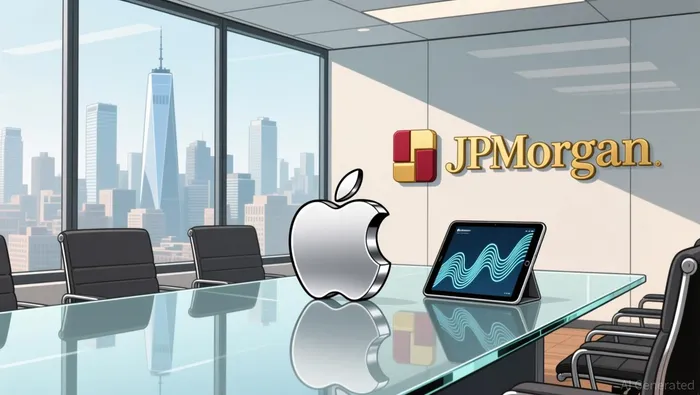
Apple's decision to transition its co-branded credit card from Goldman Sachs to JPMorgan ChaseJPM-- has sparked a nuanced debate about its implications for the company's long-term brand value versus its short-term earnings. While the move underscores Apple's commitment to maintaining a premium financial services offering, the immediate financial impact on AAPLAAPL-- appears muted. This analysis evaluates how the partnership with JPMorganJPM-- Chase-backed by its scale and operational expertise-bolsts Apple's strategic credibility, while the upfront costs and limited revenue upside suggest the transaction is more symbolic than transformative for the stock.
Strategic Credibility: A Win for Brand Positioning
Apple's partnership with JPMorgan Chase, announced in late 2025, reflects a calculated alignment with a financial institution that shares its emphasis on innovation and customer-centricity. According to a report by , Jennifer Bailey of AppleAAPL-- emphasized that Chase's "commitment to innovation and customer experience" mirrors Apple's own ethos, ensuring continuity in the Apple Card's user-friendly features such as Daily Cash rewards and Apple Card Family sharing. This alignment is critical for maintaining Apple's premium brand positioning, particularly as the company seeks to expand its financial services ecosystem.
The transition also reinforces Apple's credibility in the fintech space. By partnering with JPMorgan Chase-the largest lender in the U.S.-Apple signals its ability to leverage institutional-grade infrastructure while retaining control over product design and user experience. As noted by , the deal "strengthens JPMorgan's leadership in the U.S. credit card market and expands its reach among digitally engaged consumers," a demographic that aligns closely with Apple's core user base.
Moreover, the transition mitigates risks associated with Apple's previous partnership with Goldman Sachs, which reportedly incurred over $7 billion in losses since 2020. By exiting a costly venture, Goldman Sachs has freed up capital to refocus on its core institutional businesses, while Apple avoids reputational damage from a partnership that strained its financial credibility.
Limited Financial Impact: A Short-Term Earnings Neutral
Despite the strategic benefits, the financial implications for Apple are modest. Unlike Goldman Sachs, which expects a 46-cent-per-share earnings boost in Q4 2025 from the transition, Apple's direct financial exposure remains opaque. The company has not disclosed specific revenue-sharing terms with JPMorgan Chase, and analysts suggest the partnership is unlikely to significantly alter AAPL's earnings trajectory in the near term.
JPMorgan Chase, meanwhile, is absorbing the upfront costs of the transition. The bank has set aside $2.2 billion in Q4 2025 as a provision for credit losses, reflecting the higher risk profile of the Apple Card portfolio, which includes a concentration of subprime borrowers. While this acquisition expands JPMorgan's consumer credit footprint, the immediate financial burden underscores the limited near-term value for Apple.
Apple's financial services segment, though growing, remains a small portion of its overall revenue. Even if the Apple Card's $20 billion in balances drive incremental transaction fees or cross-selling opportunities, these gains are unlikely to offset the company's reliance on hardware sales. As noted by , the transition "is not expected to transform Apple's financial results but rather to stabilize its financial services offering."
Brand Value vs. Earnings: A Long-Term Play
The Apple-JPMorgan partnership is best understood as a long-term brand-building exercise. Apple's customer retention rates-89% for smartphones and 92% for iPhone users- remain robust, supported by its ecosystem-driven loyalty. The Apple Card, despite a drop in customer satisfaction rankings to third place in 2025, continues to benefit from its association with the Apple brand. By partnering with JPMorgan, Apple ensures that its financial services remain aligned with its premium positioning, even as competitors like Costco and Hilton offer more lucrative rewards.
However, the transition also carries risks. If JPMorgan introduces stricter underwriting standards or alters savings account terms, customer trust could erode. Yet, Apple has emphasized that core features will remain unchanged during the 24-month transition. This continuity is vital for preserving the Apple Card's appeal to a user base that values simplicity over complexity.
Conclusion: A Strategic Win, Not a Financial Catalyst
Apple's shift to JPMorgan Chase for the Apple Card is a masterstroke in strategic credibility. It aligns the company with a financial partner capable of scaling its offerings while reinforcing its reputation for innovation and customer trust. However, the transaction's financial impact on AAPL is limited, with JPMorgan bearing the upfront costs and Goldman reaping immediate earnings benefits. For investors, this suggests that the move is more about long-term brand value than short-term profitability. While the Apple Card remains a symbol of the company's premium positioning, its contribution to earnings is likely to remain modest, at least in the near term.





Comentarios
Aún no hay comentarios