
Apple's iPhone 17 Launch and Its Implications for Long-Term Shareholder Value
The global smartphone market, now a $485.34 billion industry in 2025, is entering a phase of cautious optimism. While the sector faces saturation in mature markets like China—where sales have slowed—technological advancements such as 5G, foldable screens, and AI integration are projected to drive a compound annual growth rate (CAGR) of 6.24% through 2033[1]. For AppleAAPL--, the launch of the iPhone 17 series represents both a strategic pivot and a test of its ability to sustain post-launch momentum in a maturing landscape.
Market Positioning and Financial Performance
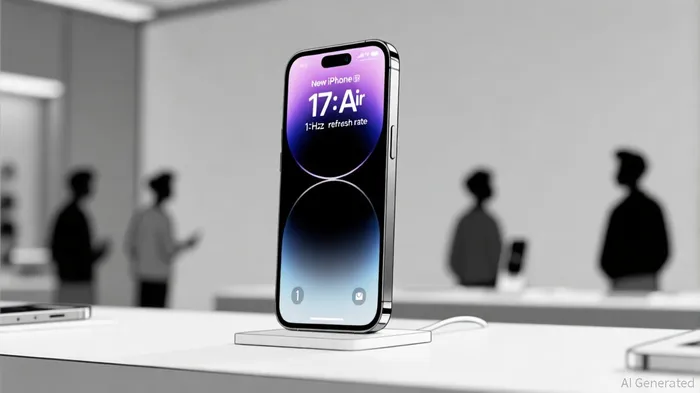
Apple's Q3 2025 results underscore its dominance in the premium segment, with record revenue of $94.0 billion, driven by $44.6 billion in iPhone sales[2]. The iPhone 17 lineup, including the ultra-thin iPhone Air and redesigned Pro models, reflects a calculated balance between innovation and cost management. The iPhone Air, priced at $1,099, targets luxury consumers with its 0.22-inch profile and energy-efficient 1Hz-to-120Hz display[3]. Meanwhile, localized production in India and component cost negotiations have reduced manufacturing expenses by 12–8%, enabling Apple to maintain hardware gross margins above 42%[4].
However, market share dynamics reveal challenges. Despite a 3% year-over-year increase in premium smartphone sales, Apple's U.S. share fell from 56% to 49% in Q2 2025 as Samsung gained traction with foldables[5]. Analysts like Wamsi Mohan of Bank of AmericaBAC-- acknowledge this competitive pressure but raised Apple's stock price target to $270, citing confidence in its AI-at-the-edge roadmap and in-house silicon advantages[6].
Sustainability as a Strategic Pillar
Apple's sustainability efforts, now central to its brand identity, are deeply embedded in the iPhone 17's design. The Pro models use 100% recycled cobalt in batteries and aluminum frames that are 20x more heat-efficient than titanium[7]. The A19 chip's 10% power efficiency improvement and the iPhone Air's high-density battery further align with the company's 2030 carbon neutrality goal[8].
Yet, environmental critics highlight unresolved challenges. Manufacturing remains the largest contributor to an iPhone's carbon footprint, with the Pro Max 2TB model emitting 134kg of CO2[9]. While Apple's Supplier Clean Energy program now covers 45% of production energy, repairability issues persist. Independent analyses show 80–90% of an iPhone's lifetime emissions stem from its manufacturing phase, and self-service repair kits have yet to fully address “right to repair” concerns.
Analyst Reactions and Long-Term Outlook
Post-launch, analyst sentiment is mixed. Morgan StanleyMS-- and Wedbush analysts upgraded Apple's stock, emphasizing the iPhone 17's potential to boost upgrade cycles in emerging markets like India, where sales surged 37% year-over-year[11]. Conversely, JefferiesJEF-- maintained a “Hold” rating, cautioning about rising R&D costs (up 22% to $8.3 billion in Q3 2025) and regulatory risks[12].
The stock's immediate 4.1% post-event decline reflects investor skepticism about delayed AI feature rollouts and the absence of a major AI partnership announcement[13]. However, historical patterns suggest recovery within 30–60 days, as noted by Bank of America's Mohan.
Conclusion: Sustaining Momentum in a Maturing Market
Apple's iPhone 17 launch demonstrates its ability to innovate within a saturated market, leveraging design differentiation, sustainability, and strategic pricing. However, long-term shareholder value hinges on addressing repairability concerns, accelerating AI integration, and maintaining pricing agility in emerging markets. With the global smartphone market projected to reach $932.61 billion by 2033[1], Apple's success will depend on its capacity to balance premium positioning with scalable sustainability—a challenge that could redefine its role in the industry.





Comentarios
Aún no hay comentarios