
Apple's Intrinsic Value: A Value Investor's Assessment
For a value investor, the central question is not about quarterly earnings or product launches, but about the gap between price and intrinsic value. Intrinsic value is the present worth of all future cash flows a business can generate, discounted back to today. It is the bedrock of the Buffett/Munger philosophy: buy a wonderful company at a fair price, and you are likely to compound wealth over decades.
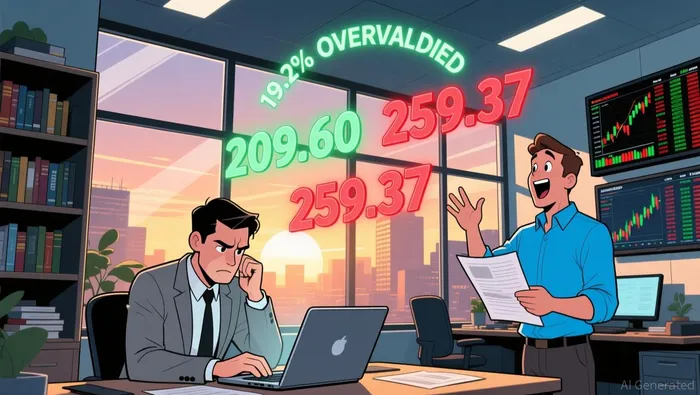
Applying a classic two-stage discounted cash flow (DCF) model to AppleAAPL--, the math suggests the stock is trading at a significant premium to its calculated intrinsic value. The model, which assumes a period of high growth followed by a stable terminal phase, arrives at a fair value of $209.60. With the stock currently priced around $259.37, that implies a potential downside of 19.2%. This is not a minor discount; it is a meaningful gap that demands an explanation.
The model's conclusions hinge on its key assumptions. The terminal growth rate, representing the perpetual growth rate after the initial high-growth period, is set at 4.0%. This is a conservative figure, roughly in line with long-term nominal GDP growth, and it is a critical input for valuing a mature giant like Apple. The discount rate, which reflects the risk of those future cash flows, is estimated at 8.8%. These inputs are not arbitrary; they are grounded in standard financial theory and the company's cost of capital. The resulting valuation is a direct output of these disciplined inputs.
To reinforce this conclusion, it is instructive to consider a different, more conservative benchmark. Morningstar's analysis, which employs a similar DCF framework but with stricter assumptions, arrives at a fair value estimate of $150. That figure implies an even steeper discount to the current market price. When two respected valuation approaches converge on the same side of the ledger-both indicating overvaluation-it strengthens the case that the market is pricing in a level of future perfection that may be difficult to achieve.
The bottom line for a value investor is clear. The current price of Apple stock does not offer a margin of safety. It trades at a notable discount to a DCF-derived intrinsic value, and that gap widens when viewed through a more cautious lens. For the patient capital required by this philosophy, the setup is not compelling. The market is paying for a future that is not yet written.
Assessing the Foundation: The Quality of Apple's Cash Flows and Moat
A value investor's focus is on the quality and durability of a business's cash flows. This is where the concept of an economic moat becomes paramount. Morningstar's recent upgrade of Apple's rating to "Wide" is a key signal. The firm cites high customer switching costs, intangible assets, and network effects within the iOS ecosystem as the pillars of this advantage. The logic is straightforward: a billion-plus installed base creates a powerful network where developers prioritize iOS, making the platform more valuable for users and harder to leave. This integration across hardware, software, and now chip design is a rare strength, allowing Apple to command premium prices and margins. For a long-term investor, a wide moat is the best guarantee of a business's ability to compound value.
Yet, even the strongest moats do not guarantee smooth sailing. The recent trajectory of Apple's free cash flow presents a clear challenge to the narrative of effortless, predictable cash generation. For the full year 2025, the company's annual free cash flow was $98.767 billion, marking a 9.23% decline from 2024. This follows a year of growth, as 2024 itself saw a 9.26% increase from 2023. The data reveals a volatile pattern, with the cash flow metric swinging from a 10.64% decline in 2023 to a 9.26% gain in 2024, and now back into negative territory. This is a far cry from the steady, reliable cash machine that classic wide-moat companies are often expected to be. The contrast is instructive. History shows that businesses with durable competitive advantages typically outperform the broader market over the long term. Apple has certainly done that, but the recent volatility in its cash flow suggests a potential shift. The company's historical 10-year average annual free cash flow growth rate of 4% provides a baseline, but the last few years have been a departure from that trend. The question for a value investor is whether this is a temporary cycle or the beginning of a new, less predictable phase. The wide moat remains intact, but the cash it generates is showing more choppiness than one might expect from a business of its stature.
The bottom line is one of tension. The foundation of Apple's business-its ecosystem lock-in and integration-is arguably stronger than ever. Yet the financial output from that foundation is less stable. For a disciplined investor, this volatility in the cash flow stream is a red flag that tempers the optimism from the moat assessment. It underscores that even the best businesses face headwinds, and the path to intrinsic value is rarely a straight line.
The Forward Look: Growth, AI, and the Path to Compounding
The recent quarterly results provide a clear snapshot of Apple's current engine. For the fiscal fourth quarter, the company posted revenue of $102.5 billion, up 8 percent year over year. This growth was powered by a record Services segment and a strong iPhone performance, with Tim Cook highlighting a September quarter revenue record for iPhone. The momentum extended to the full year, which ended with revenue reaching $416 billion. This is the kind of top-line expansion that fuels intrinsic value. Yet, as we've seen, translating that revenue into stable, growing cash flow remains the critical challenge.
Looking ahead, the primary catalyst for a re-rating appears to be artificial intelligence. Analyst Dan Ives has set a $350 price target for Apple, citing strong iPhone momentum and the potential for significant AI features. His forecast points to a partnership with Google for AI capabilities, including a revamped Siri, and the launch of an AI-driven subscription service. The logic is that these features could reinvigorate the ecosystem, drive new services revenue, and extend the lifecycle of the iPhone, which has a high installed base of 2.4 billion active iOS devices. This represents a classic value investor's dream: a powerful moat being leveraged to create new, high-margin cash flows.
Yet, the path to compounding is not guaranteed. The DCF model's conclusion that the stock is overvalued hinges on a critical assumption: the terminal growth rate. The model uses a 4.0% terminal growth rate, which is a conservative figure for a mature company. The stark reality is that this rate assumes a significant slowdown from Apple's historical performance. The company's 10-year average annual free cash flow growth rate of 4% is a baseline, but the last few years have shown volatility, with cash flow swinging from declines to gains. For the model to work, the market must believe that Apple can sustain a growth rate near that long-term average for decades to come. That is a tall order for a business of its size.
The bottom line is one of high-stakes uncertainty. On one side, there is tangible growth from a record quarter and a promising AI roadmap that could unlock new value. On the other, the valuation math demands a level of perpetual, predictable growth that the company's own recent cash flow history does not fully support. For a value investor, the margin of safety is thin. The stock's premium price already prices in a successful AI integration and a smooth transition to a new growth phase. Any stumble in execution or a slower-than-expected adoption of these new features could quickly close the gap between the bullish analyst targets and the more cautious DCF-derived intrinsic value. The forward look is bright, but the path to realizing that value is fraught with the very volatility in cash flows that we have already identified.
Margin of Safety and the Value Investor's Framework
The core of value investing is not about finding the perfect company, but about finding it at a price that offers a sufficient margin of safety. This principle, championed by Warren Buffett, dictates that a purchase should be made only when the market price is significantly below the estimated intrinsic value. The traditional rule of thumb is a discount of 20% to 30%. This buffer is the insurance policy against error in estimation, unforeseen business challenges, or simply a period of market pessimism. It is the difference between a speculative gamble and a disciplined investment.
Applying that standard to Apple today reveals a tight fit. The DCF model's conclusion that the stock is overvalued by 19.20% means the current price falls just short of the classic safety margin. For a value investor, this is a critical threshold. The model's output is a direct result of its inputs, particularly the 4.0% terminal growth rate. This conservative assumption is justified by the company's wide economic moat, which Morningstar recently affirmed. The firm's analysis points to high customer switching costs, intangible assets, and network effects as durable advantages. These factors support the view that Apple can sustain a growth rate near the long-term average of nominal GDP for decades, which is the essence of a wide-moat business.
Yet, the margin of safety is further compressed by the volatility in the cash flow stream that underpins the model. The recent history of Apple's annual free cash flow-a 9.23% decline in 2025 following a gain in 2024-introduces a tangible risk that the future cash flows may not materialize as smoothly as the model assumes. For a disciplined investor, this inconsistency in the output of the moat is a material consideration. It suggests that the path to realizing the terminal value is less certain, which should demand a larger discount, not a smaller one.
The bottom line is one of tension between principle and price. The analysis supports the existence of a wide moat and a reasonable terminal growth rate. However, the current valuation does not provide the 20-30% discount that would make the investment compelling from a pure margin-of-safety perspective. The stock trades at a notable discount to a DCF-derived intrinsic value, but that gap is insufficient to fully compensate for the recent volatility in cash generation. For the patient capital required by this philosophy, the setup is not yet compelling. The market is paying for a future that is not yet written, and the margin of safety is thin.
Catalysts, Risks, and What to Watch
For a value investor, the current setup is defined by a clear catalyst and a set of material risks. The next major event is the release of Apple's Q1 2026 earnings report on January 29, 2026. This report will provide updated guidance and a direct look at the company's financial trajectory in the new year. It is the first concrete data point on whether the recent volatility in cash flows is a cyclical blip or the start of a sustained trend. The market will be watching for any shift in the growth rate assumptions that underpin the DCF model.
The key risks are threefold. First, execution on the promised AI integration remains unproven. Analysts see significant potential, but the success of new features and services is not guaranteed. Second, regulatory pressures are a persistent overhang, with antitrust and competition issues in various jurisdictions posing a tangible threat to the company's ecosystem and pricing power. Third, and most critical for the valuation thesis, is the risk that Apple's long-term growth rate deviates from the 4.0% terminal growth rate assumed in the DCF model. The recent history of its free cash flow-a 9.23% decline in 2025-shows the business is not immune to material headwinds.
For a disciplined investor, the critical watchpoint is singular: the stabilization and growth of free cash flow. The DCF model's conclusion of a 19% discount hinges on the assumption that Apple can compound its cash generation at a rate near the long-term average. The recent choppiness in the cash flow stream introduces significant uncertainty. The next few quarters will test whether the company can demonstrate a return to steady, reliable growth that exceeds the model's conservative terminal assumption. Until that pattern is clear, the margin of safety remains thin, and the stock's premium price will continue to demand flawless execution on its future promises.





Comentarios
Aún no hay comentarios