
The Apple-Goldman Sachs Credit Card Split: Implications for Consumer Lending and Fintech Strategy
The dissolution of the Apple-Goldman Sachs credit card partnership marks a pivotal moment in the evolution of fintech collaborations and consumer lending strategies. This transition, now set to see JPMorgan ChaseJPM-- assume control of the AppleAAPL-- Card program, underscores the challenges of balancing innovation with profitability in the consumer finance sector. For investors, the split offers critical insights into the risks of overextending into non-core markets and the future viability of high-profile tech-bank partnerships.
Strategic Missteps in GoldmanGS-- Sachs' Consumer Banking Approach
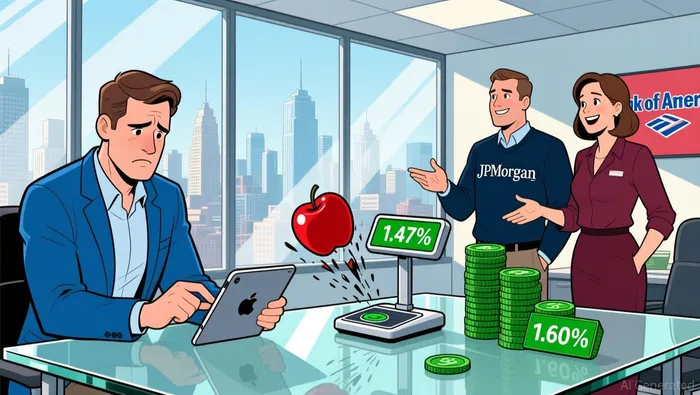
Goldman Sachs' foray into consumer finance, epitomized by the Apple Card, was driven by a desire to diversify revenue streams beyond its traditional Wall Street operations. However, the venture exposed significant strategic flaws. According to a report by , the Apple Card's profitability was undermined by a no-fee structure, relaxed underwriting standards, and a high proportion of subprime borrowers, leading to a net loss rate of 6.2% in Q3 2023-far exceeding industry averages of 1.47% for JPMorganJPM-- and 1.60% for Bank of America.
Goldman's CEO, David Solomon, candidly acknowledged these missteps, stating the firm had "tried to do too much, too quickly" and that the consumer banking initiative was "small and distracting" from its core competencies according to company statements. The decision to exit the Apple partnership aligns with a broader retreat from retail banking, including the sale of its Marcus and GreenSky businesses. Financially, the split is projected to yield a one-time earnings per share (EPS) boost of $0.46 in Q4 2025 for Goldman, driven by the release of $2.48 billion in loan loss reserves, though this is partially offset by a $2.26 billion net revenue decline as reported in their press release.
Implications for Consumer Lending and Risk Management
The transition to JPMorgan highlights the critical role of scale and risk management in consumer lending. As the largest U.S. credit card issuer, JPMorgan brings operational expertise and a mature credit risk framework to the Apple Card portfolio, which includes $20 billion in balances according to market analysis. However, the bank faces its own challenges, including a $2.2 billion provision for future credit losses and the need to manage a portfolio with higher delinquency rates than typical as detailed in financial reports. This underscores the inherent risks of acquiring high-risk consumer assets, even for industry leaders.
 For Apple, the partnership shift is expected to be seamless for users, with core features like Daily Cash rewards and in-app account management remaining unchanged according to user experience reports. This reflects a broader fintech trend where technology companies prioritize user experience while financial institutions handle backend infrastructure and credit risk as observed in industry analysis. However, the Apple-Goldman experience serves as a cautionary tale: while the Apple Card achieved remarkable customer adoption, its financial sustainability for the bank partner remains questionable without robust risk controls.
The Future of Tech-Bank Collaborations
The Apple-Goldman split signals a recalibration in the fintech landscape. High-profile partnerships between tech giants and banks are increasingly scrutinized for their alignment of business models and risk tolerance. As noted by , the dissolution highlights the difficulties of balancing innovation with profitability in consumer finance, particularly when tech firms prioritize user growth over immediate financial returns.
For future collaborations, the key lesson lies in aligning incentives. Goldman's exit demonstrates that banks must ensure consumer lending ventures are not only scalable but also financially resilient. Meanwhile, tech companies must recognize that financial infrastructure requires more than brand appeal-it demands expertise in credit underwriting, regulatory compliance, and long-term portfolio management.
Conclusion
The Apple-Goldman Sachs credit card split is a case study in strategic overreach and the complexities of fintech partnerships. For Goldman, it represents a return to core competencies and a rejection of the "Jack-of-all-trades" approach in consumer finance. For JPMorgan, it offers an opportunity to leverage scale but at the cost of absorbing a high-risk portfolio. Investors should monitor how this transition unfolds, as it may set a precedent for future tech-bank collaborations. The broader takeaway is clear: in consumer lending, innovation must be paired with prudent risk management to avoid the pitfalls that derailed one of the most ambitious fintech ventures of the decade.





Comentarios
Aún no hay comentarios