
Apple's Gemini Partnership: Accelerating the AI S-Curve with a Privacy-First Infrastructure Layer
For years, Apple's AI strategy has been a study in cautious vertical integration. The company built its own foundational models in-house, prioritizing privacy and control. Yet that first-principles approach created a costly lag. Its flagship assistant, Siri, became a symbol of that delay, with a promised overhaul repeatedly postponed. This gap wasn't just a technical setback; it was a competitive vulnerability that left AppleAAPL-- trailing in the race to define the next user interface.
The partnership announced this week is the clearest admission yet that Apple's internal build-out couldn't keep pace with the exponential adoption curve of AI. By choosing to power its future "Apple Foundation Models" with Google's Gemini technology, Apple is making a calculated pivot. This is a multi-year deal where Apple will leverage Google's models and cloud infrastructure to accelerate its own AI roadmap. The move directly addresses the core problem: the need for a more capable foundation to deliver the "innovative new experiences" users expect.
Apple's own statement frames the decision as a pragmatic evaluation of capability. The company determined that Google's AI technology provides the most capable foundation for Apple Foundation Models. That is a direct, first-principles admission of its own foundational model gap. It's a strategic retreat from pure self-reliance, acknowledging that in the race for AI dominance, access to the most advanced infrastructure is now a prerequisite for participation. This isn't a surrender; it's a necessary acceleration to close the S-curve gap and get its next-generation AI features, including the long-delayed Siri, to market.
The Infrastructure Layer: Compute, Privacy, and Adoption Path
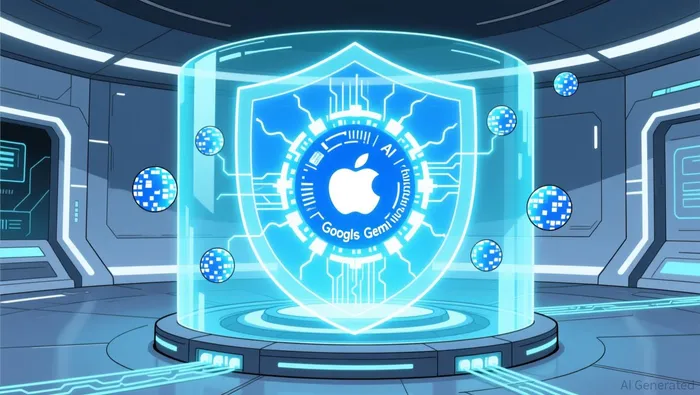
The partnership fundamentally upgrades the infrastructure layer for Apple's AI ambitions. By leveraging Google's cloud technology, Apple gains immediate access to massive, scalable compute power for both training its own models and handling the inference load for on-device features. This is the critical first step in closing the S-curve gap. For years, Apple's vertical integration meant it had to build this foundational compute capacity itself, a costly and time-consuming process that contributed to its lag. Now, it can bypass that phase and focus its engineering on the next layer: integration and user experience.
Crucially, Apple's core privacy architecture remains intact. The company has made clear that Apple Intelligence will continue to run on Apple devices and Private Cloud Compute, while maintaining Apple's industry-leading privacy standards. This is a key differentiator in a market where data security is paramount. The deal works by using Google's advanced Gemini models on the backend for complex reasoning, while Apple's own local models and its tightly controlled Private Cloud Compute service handle sensitive data processing on-device. This hybrid model attempts to have the best of both worlds: the raw power of Google's infrastructure without compromising Apple's fundamental promise of user privacy.
Success now hinges entirely on the revamped Siri delivering a reliable, personalized experience that drives exponential user adoption. The new assistant, powered by Gemini on the backend, is expected to launch this spring. Its features-like App Intents for deeper app integration and on-screen awareness to interact with what's displayed-aim to create a "wow factor" that Apple's earlier, more subtle AI rollout lacked. Yet, as one analysis notes, Siri still needs to be more reliable and less prone to errors. If the overhaul fails to meet user expectations for accuracy and responsiveness, the partnership's infrastructure advantage will be wasted. The path to adoption is not automatic; it requires the new Siri to function flawlessly as the primary interface for "Apple Intelligence," convincing users to engage with its full suite of features.
Financial and Competitive Implications
The partnership carries a clear financial cost and reshapes the competitive landscape. While the exact terms are undisclosed, prior reports indicate Apple could be paying GoogleGOOGL-- around $1 billion for access to its AI technology annually. This is a significant outlay, but it represents a strategic investment to accelerate a critical timeline. For Apple, the cost of delay was becoming unsustainable; this payment buys immediate access to the most capable infrastructure, effectively short-circuiting years of internal build-out. The deal is not exclusive, which gives Apple some leverage, but the sheer scale of the potential payment underscores the premium it is placing on closing the AI gap.
Strategically, the move intensifies pressure on other AI infrastructure providers. By publicly choosing Google's technology as the "most capable foundation," Apple signals a clear benchmark. This directly pressures rivals like OpenAI and Anthropic, which Apple also tested, to demonstrate they can match or exceed Google's current performance. The partnership validates Google's recent Gemini launch, which received strong reviews, and positions it as the de facto standard for premium, privacy-conscious AI integration into a major hardware ecosystem. For OpenAI and Anthropic, this is a setback in their quest to become the foundational layer for the next generation of consumer devices.
The deal also appears to be a direct response to regulatory headwinds. It comes just months after a federal judge ruled that Google's previous exclusive default search agreement with Apple was illegal and issued final remedies that will ban Google from entering into exclusive, default agreements with device makers. By structuring this AI partnership as non-exclusive, Apple and Google are navigating that legal landscape. This is a pragmatic move to maintain a key technology relationship while complying with new rules. It shows how regulatory pressure is forcing a recalibration of tech alliances, with Apple now leveraging its own platform to negotiate terms that avoid the pitfalls of past exclusive deals.
The bottom line is that Apple is betting heavily on Google's infrastructure to power its next S-curve of growth. The financial outlay is steep, but it is a calculated risk to regain competitive footing. The partnership not only secures Apple's AI future but also sets a new bar for the industry, forcing other AI providers to prove their worth against a validated benchmark.
Catalysts and Risks: The Path to Exponential Growth
The partnership's thesis now faces a clear set of near-term milestones. The primary catalyst is the spring launch of the updated Siri and the broader "Apple Intelligence" suite. This debut must demonstrate a qualitative leap in performance, reliability, and personalization. Features like App Intents and on-screen awareness are designed to create a "wow factor," but the system must also be less prone to errors. Success here is non-negotiable; it will validate the infrastructure investment and drive the first wave of user adoption. Failure would expose the partnership as a costly stopgap rather than a true accelerator.
A key risk is that the partnership does not accelerate Apple's AI timeline enough to close the gap with cloud-native rivals. While Google's Gemini provides a powerful foundation, Apple's core strength has always been its vertical integration. The hybrid model-using Google's backend for complex reasoning while relying on Apple's local models and Private Cloud Compute for privacy-adds complexity. If this architecture introduces latency or limits the scope of new features, it could slow down the innovation cycle. The real danger is that Apple remains in a state of "managed dependency," gaining capability but not regaining the full control over its AI stack that it once sought. This would leave it perpetually playing catch-up to companies like Google and Microsoft, whose AI is natively woven into their cloud and operating systems.
Investors should also watch for Apple's ambitious device rollout target. The company aims to have 250 million devices with comprehensive AI capabilities by the end of 2025. This is a critical metric for exponential growth. Achieving it requires flawless execution on the hardware-software-AI integration front. Any delay in shipping these AI-ready devices would directly impact the timeline for user adoption and the return on the significant infrastructure investment. The spring launch of the new Siri is the first step toward that goal, but the path from a new assistant to 250 million intelligent devices is a long and demanding one.





Comentarios
Aún no hay comentarios