
Apple's Gemini Deal: A 2026 Catalyst or a Delayed Admission?
The core news is a straightforward resolution of a major uncertainty. On Monday, AppleAAPL-- and GoogleGOOGL-- confirmed a multi-year deal where Google's Gemini AI models will serve as the foundation for Apple's future "Apple Intelligence" features. This includes the long-delayed revamped Siri, which is now expected to launch this year. The partnership is explicitly not exclusive, allowing Apple to maintain its own AI work, but it marks a clear tactical win for Google and a strategic admission for Apple.
The setup is critical. This deal resolves a nearly yearlong delay in Apple's AI ambitions, a period during which the company faced increasing questions about its plans while rivals spent billions. By choosing Google's technology, Apple is effectively outsourcing the costly, resource-intensive development of core AI models. The companies state that Apple Intelligence will continue to run on Apple devices and Private Cloud Compute, maintaining the company's industry-leading privacy standards. This preserves Apple's control over the user experience and data flow, even as it leans on Google's foundational work.
The bottom line is that this is a catalyst that removes a significant overhang. For investors, it confirms a path forward for Apple's AI rollout, albeit one that acknowledges a year of strategic hesitation. The partnership provides a tangible timeline for new Siri features and other AI enhancements, but it also highlights the gap Apple has fallen behind in the race to build its own cutting-edge models.
Financial Impact: Timing, Costs, and Competitive Positioning
The deal's immediate financial impact is a double-edged sword. On one side, it accelerates a key product launch. The partnership directly enables the revamped Siri to arrive this year, a feature critical for the upcoming iPhone 18 cycle. Analysts at Wedbush see 2026 as a monumental year for Apple, with the new Siri being a linchpin for proving the value of its AI strategy. This timely upgrade could boost user engagement and help sustain demand for the new iPhone range, especially with a potential foldable model on the horizon.
On the other side, the arrangement likely introduces new costs. While the exact financial terms are undisclosed, the collaboration involves Google's Gemini models and cloud technology. This means Apple will incur significant cloud compute expenses to run these models, a known pressure point for margins. The company's "restrained" AI approach, as noted by The Information, is now shifting from a capital expenditure strategy to an operational cost one. This trade-off is clear: Apple avoids the hundreds of billions in data center and chip spending that rivals like Google and Meta are committing, but it pays for the service instead.
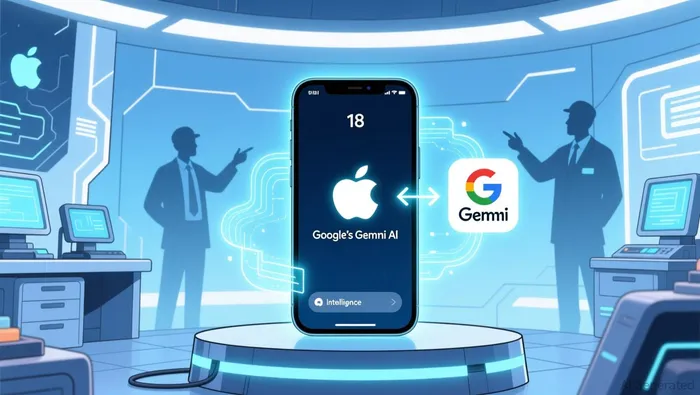
The competitive positioning is the core of the trade-off. By partnering with Google, Apple is catching up to rivals who have been racing to build their own foundational models. The deal signals that Apple acknowledges large language models may be becoming commoditized, making proprietary development less of a differentiator and more of a costly burden. This allows Apple to focus its massive resources on what it does best-system-level integration and privacy-while outsourcing the model layer. The bottom line is that the partnership buys Apple competitive parity and speed at the cost of ongoing cloud fees and a degree of control. It's a pragmatic, event-driven move to close a gap, not a long-term infrastructure bet.
Valuation and Scenario Analysis: The 2026 Inflection Point
The Gemini deal crystallizes a clear 2026 catalyst, but the near-term risk/reward hinges entirely on execution. Analyst firm Wedbush maintains its $350 price target, calling 2026 a "monumental year" for Apple. Their thesis is now more concrete: success depends on converting the Google partnership into a revamped Siri that delivers a tangible user experience upgrade, driving sales of the new iPhone 18 range. This creates a binary setup. A successful rollout could validate the partnership and unlock upside, while a stumbles would likely confirm the skepticism that has built over the past year.
There's also a potential valuation hedge. Apple's restrained AI strategy may now be a defensive advantage if market sentiment toward massive AI spending continues to sour. While rivals pour hundreds of billions into proprietary models, Apple's partnership model avoids that capital-intensive path. This could insulate the company from a perceived "AI bubble" risk, preserving its massive cash position. In this scenario, the deal isn't just a catch-up move-it's a way to participate in the AI wave without bearing the full financial burden.
The primary risk is execution. The partnership must deliver a Siri upgrade that is more than a technical footnote. It needs to be a direct answer to competitors like Perplexity and ChatGPT, capable of completing multi-step tasks and justifying a potential AI subscription service. The clock is tight; the revamped assistant is expected to arrive in the spring. Any delay or underwhelming performance would validate the criticism that Apple's AI efforts have been "invisible" and could quickly reset expectations. For now, the deal changes the setup from a prolonged uncertainty to a high-stakes test of Apple's ability to integrate and deliver.
Tactical Takeaway: Catalysts, Risks, and Price Action
The Gemini deal sets a clear timeline for Apple's AI validation. The key near-term catalyst is the revamped Siri, powered by Google's technology, which is expected to launch this year. Wedbush's thesis hinges on this event, calling 2026 a "monumental year" for Apple. The stock's path will be dictated by whether this spring rollout delivers a tangible user experience upgrade that justifies a potential AI subscription service and drives demand for the new iPhone 18 range.
Execution risk is the primary overhang. The partnership must deliver on promised performance and privacy without significant cost overruns. While the deal avoids Apple's massive capital expenditure on data centers, it introduces new operational costs for cloud compute. The company's restrained AI strategy is now a trade-off between avoiding capital intensity and paying for services. Any material margin pressure from these fees, or a performance gap against competitors like Perplexity and ChatGPT, would quickly invalidate the bullish setup.
Competitive watch is also critical. Rivals like OpenAI and Meta are investing heavily in proprietary models. Apple's new AI capabilities, integrated deeply into its ecosystem, could shift market share in its favor. However, the partnership is not exclusive, leaving room for Apple to integrate other models later. The market will scrutinize how quickly Apple can leverage its hardware advantage to convert the Gemini partnership into a competitive moat.
The price target provides a clear benchmark. Wedbush maintains its $350 price target, implying roughly 35% upside from recent levels. This valuation is explicitly contingent on successful execution of the 2026 plan. For investors, the actionable insight is to monitor the spring Siri launch and early user reception. A strong debut would validate the partnership and the $350 thesis. Any delay or underwhelming performance would likely trigger a reassessment, resetting expectations after a year of strategic hesitation.







Comentarios
Aún no hay comentarios