
Apple's Gemini Bet: Accelerating the AI Infrastructure S-Curve
This partnership is not a retreat; it's a calculated sprint to accelerate Apple's position on the AI adoption curve. After an extensive evaluation, Apple's leadership determined that Google's technology provides the most capable foundation for Apple Foundation Models. This is a first-principles decision to leverage a superior infrastructure layer, not a sign of weakness. The goal is to build a superior user experience by combining Google's raw model power with Apple's unique integration and privacy architecture.
The scale of the model involved underscores the strategic leap. AppleAAPL-- is planning to use a 1.2 trillion parameter artificial intelligence model developed by GoogleGOOGL--. This represents a massive leap from the 150 billion parameter model currently used for cloud-based Apple Intelligence. It's a quantum jump in complexity and capability, providing the computational muscle needed to power the next generation of AI features.
Crucially, this is a multi-year, non-exclusive partnership focused on building Apple's own models, not outsourcing Siri. As industry analysts note, Apple is using Gemini as a foundational layer, then building its own systems on top. This allows Apple to maintain its core strategy of vertical integration and privacy, while gaining the time and technological headroom to develop its own models. The partnership is a pragmatic infrastructure play, using Google's model as a launchpad to accelerate the entire S-curve of AI adoption within the Apple ecosystem.
Financial & Competitive Impact: Speed vs. Cost
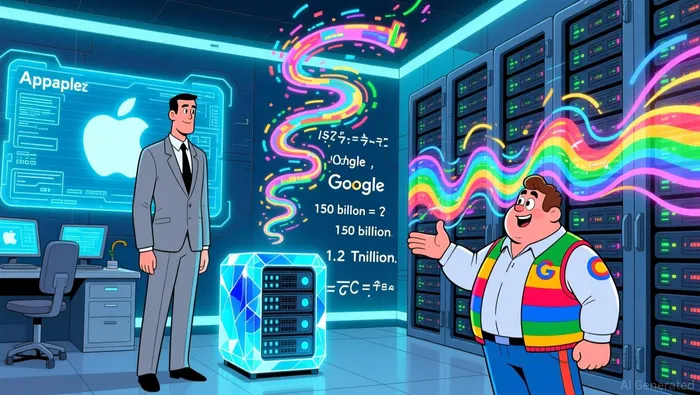
The partnership comes with a clear price tag, estimated at about $1 billion a year. For Apple, this is a significant but strategic investment. It's a direct cost to accelerate the AI S-curve, buying time and capability to catch up on a critical timeline. The immediate financial outlay is justified by the need to deliver a 'smarter Siri' later this year, a feature that was delayed until 2026. This deal directly addresses that delay, aiming to close the gap with competitors who have already rolled out more advanced AI assistants.
Competitively, the move is a pivot. While Apple continues to work with OpenAI to integrate ChatGPT, this multi-year contract with Google puts Gemini at the center of Apple's future AI strategy. It signals that for the foundational layer of Apple's own AI models, Google's technology is the chosen infrastructure. This is a pragmatic choice to gain a foothold in the AI race, leveraging Google's model power to build a superior user experience while Apple develops its own systems on top.
The bottom line is one of calculated trade-offs. Apple is paying a premium to speed up its adoption curve, trading immediate margin pressure for long-term positioning. The partnership is a bet that the enhanced Siri and Apple Intelligence features will reinvigorate iPhone demand after a period of stagnation. For now, the market sees it as a positive step, but the true test will be whether this infrastructure layer can fuel the exponential growth of AI features that users and investors are demanding.
Catalysts, Risks, and What to Watch
The partnership now sets a clear timeline. The primary catalyst is the launch of the updated Siri and Apple Intelligence features, expected in the spring. This will be the first real test of the Gemini foundation in the user's hands. The market will watch closely to see if the promised "innovative new experiences" translate into a tangible upgrade that reinvigorates the iPhone ecosystem. Success here could accelerate the adoption S-curve, while a lukewarm reception would validate concerns about Apple's lagging AI momentum.
A significant risk looms from the regulatory landscape. The deal unfolds just weeks after a federal judge issued final remedies in a major antitrust case, banning Google from entering into exclusive, default agreements with Apple. While the partnership is non-exclusive, it still involves a massive, multi-year payment for core AI technology. This could draw renewed scrutiny from regulators and lawmakers, potentially complicating future negotiations or forcing structural changes. The legal overhang adds a layer of uncertainty that wasn't present a year ago.
What investors should watch is Apple's execution on its own model development. The partnership provides a foundation, but the long-term strategic win depends on Apple's ability to build its own models on top of Gemini. The key differentiator will be how Apple integrates its privacy-first architecture and hardware-software synergy to create a final product that feels distinct from Google's offerings. If Apple can successfully layer its vertical integration onto the Gemini base, it could create a unique, high-margin AI experience. If it merely replicates Google's capabilities, the $1 billion annual cost may not yield the desired competitive edge. The coming months will show whether this infrastructure bet is building a rocket or just a faster car.
First Principles Analysis: Why Partner, Not Build?
The decision to partner with Google is a classic first-principles move. Apple isn't trying to win the AI arms race on every front. Instead, it's applying a fundamental rule: when the cost of building a capability from scratch is measured in years and billions, the optimal path is often to leverage an existing infrastructure layer. This is about exponential growth, not incremental improvement.
The core trade-off is stark. Building a 1.2 trillion parameter model internally would require Apple to replicate Google's massive compute and data advantage. That's not just a matter of buying more servers; it's about training a model of that scale, which demands years of dedicated engineering effort and astronomical power costs. By choosing Google's technology, Apple bypasses this entire foundational phase. It's like having a rocket already built versus spending a decade constructing one from raw materials. The partnership provides immediate access to a model that would take Apple years to develop, allowing the company to focus its finite resources on what it does best: integration and user experience.
This shift is a pragmatic evolution of Apple's strategy. The company has long championed vertical integration, controlling every layer from silicon to software. But in the AI paradigm, the foundational model layer is a different beast. As industry analysts note, Google is the foundational model behind the new Siri. Apple's business model isn't to be a cloud or AI infrastructure company; it's to design the final product. By using Gemini as a foundational layer, Apple can stick to its strengths. Its engineers can now pour energy into building the unique systems on top-how AI runs on-device, in its private cloud, and across its ecosystem-creating the differentiation that matters.
The bottom line is one of strategic acceleration. This partnership is a calculated bet to catch up on the AI adoption curve. It allows Apple to deliver a smarter Siri this spring, a feature delayed for years, without the internal AI team being bogged down in the immense task of model training. The $1 billion annual cost is the price of admission to the next phase of the S-curve. For Apple, the goal isn't to own the engine; it's to design the car that runs on it.







Comentarios
Aún no hay comentarios