
Apple's Ecosystem Resilience and Service Reliability: Navigating Outages and Investor Sentiment
Apple's ecosystem has long been a cornerstone of its competitive advantage, with services like iCloud, AppleAAPL-- Pay, and the App Store generating high-margin, recurring revenue. However, critical service outages and regulatory challenges in 2025 have tested investor confidence, revealing both the company's resilience and vulnerabilities. This analysis examines how service disruptions and external pressures have shaped Apple's stock performance and investor sentiment, while underscoring the long-term strength of its ecosystem.
The Financial Toll of Service Outages
Apple's services segment, which contributed $27.4 billion in revenue during Q3 2025, is a critical growth driver, according to Q3 results. Yet, outages in 2025 exposed operational risks. For instance, a 2023 iCloud outage reportedly cost the company $135 million in daily revenue, according to Quartz, while a 2025 App Store downtime-though not quantified-coincided with a court ruling that could reduce annual App Store revenue by $5.8 to $11.6 billion, according to Financhle. These disruptions highlight the fragility of high-margin services, even as they underscore Apple's ability to adapt. For example, the company's Q3 2025 results showed a 12% year-over-year increase in Services revenue, demonstrating resilience despite challenges.
Investor Sentiment and Stock Price Volatility
Service outages and strategic missteps have directly influenced investor sentiment. At the 2025 Worldwide Developers Conference (WWDC), Apple's delayed AI revamp of Siri disappointed investors, triggering a 2.5% stock price drop and a $75 billion market cap loss, according to 360miq. Similarly, the iPhone 17 launch in September 2025 led to a 1.5% decline as investors questioned the product's incremental innovations, per IndMoney. These events reflect the market's sensitivity to Apple's ability to innovate and maintain service reliability.
Geopolitical risks further amplified volatility. In April 2025, Apple's stock plummeted 9% amid fears of 54% tariffs on Chinese-manufactured goods, erasing $640 billion in market value over three days, as reported by CNBC. Analysts warned that tariffs could force Apple to either raise iPhone prices by $350 or absorb costs, potentially reducing earnings per share by 15%. Such scenarios underscore how external shocks can overshadow service reliability concerns.
Long-Term Resilience and Strategic Adaptation
Despite short-term turbulence, Apple's ecosystem remains a stabilizing force. The Services segment's 70% gross margins are noted in Forbes, and the recurring revenue model provides a buffer against hardware headwinds. For example, even as iPad and Wearables revenue declined in Q3 2025, Services revenue hit a record $27.4 billion. Additionally, Apple's $100 billion net income in 2024 and $30 billion R&D investment were highlighted by DCFModeling, which underscores its financial fortitude. The same DCFModeling analysis also attributes roughly a 38% gross profit contribution to Services.
The company has also taken steps to mitigate risks. Diversifying iPhone production to India and Vietnam was reported by AppleInsider, and the outlet also noted efforts to reinforce U.S. manufacturing-moves that aim to reduce reliance on China. These measures, coupled with a $115 billion annual free cash flow reported in the DCFModeling analysis, position Apple to navigate geopolitical and regulatory challenges.
Conclusion: Balancing Risks and Rewards
Apple's ecosystem resilience is evident in its ability to sustain Services growth and maintain a strong balance sheet. However, service outages and regulatory pressures-such as the Epic Games ruling-reveal vulnerabilities that could erode margins. For investors, the key lies in balancing these risks against Apple's long-term strengths: a 110.61% total return over five years, per FinanceCharts, a substantial gross profit contribution from Services (as detailed by DCFModeling), and a strategic pivot toward AI and spatial computing. While short-term volatility is inevitable, the company's ecosystem-driven model suggests enduring value, provided it continues to innovate and adapt.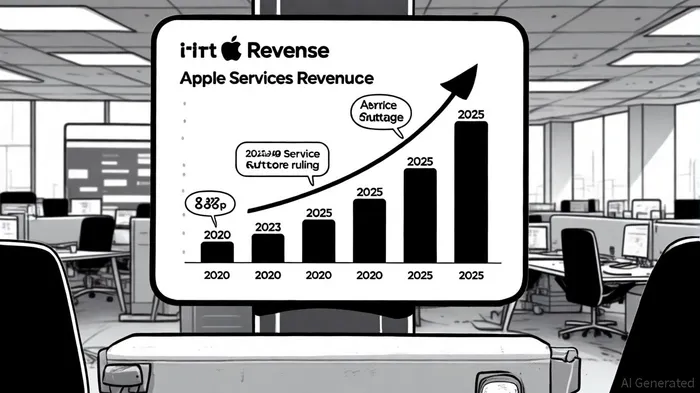







Comentarios
Aún no hay comentarios