
Apple's Breakout Past Buy Point: A Momentum Play in the AI-Driven Tech Sector
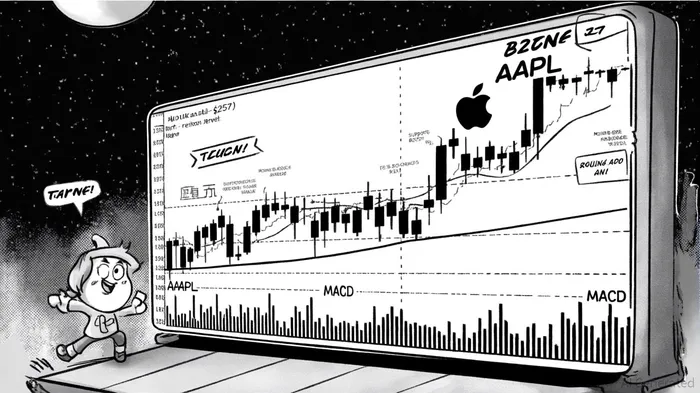
Apple (AAPL) has recently broken above a critical resistance level at $257, sparking renewed interest among momentum investors. This breakout, validated by mixed but increasingly bullish technical signals, occurs against a backdrop of surging AI sector momentum and Apple's strategic AI investments. For investors, the interplay between technical validation and fundamental catalysts presents a compelling case for a re-rating of the stock.
Technical Validation of the Breakout
Apple's price action in late 2025 has been a study in duality. While the stock trades above its 20-day, 50-day, and 100-day exponential moving averages—a classic “Buy” signal[1]—indicators like the MACD (4.41) and CCI (146.13) suggest caution[1]. However, the RSI (67.93) remains neutral, indicating no immediate overbought conditions[1]. The key technical inflection came on September 19, 2025, when AAPLAAPL-- closed at $256.08, surpassing the $257 resistance level identified by horizontal trend channels[2]. This move not only confirmed a bullish breakout but also aligned with a broader shift in investor sentiment.
Analysts at TipRanks note that the stock's position between defined support ($225) and resistance ($257) levels creates a high-probability scenario for further gains if the breakout holds[2]. A failure to retest the $257 level could trigger a retest of the $225 support, but the current trajectory suggests strong buying pressure. This is reinforced by the 4.31% single-day gain on September 19, 2025, which closed the stock at $256.08, just shy of the resistance level[5].
AI-Driven Fundamentals: A Catalyst for Momentum
The technical breakout coincides with Apple's aggressive AI strategy, which is reshaping its ecosystem and investor expectations. CEO Tim Cook has emphasized a “significant growth” in AI investments, including $3.5 billion in capital expenditures for infrastructure[1]. Unlike rivals like Microsoft or Google, Apple's approach prioritizes on-device AI (e.g., AppleAAPL-- Intelligence) to preserve privacy while enabling features in Photos, Mail, and FaceTime[3]. This strategy, while slower to deliver standalone products, aligns with the company's ecosystem-driven model, which boasts 2.4 billion active devices[2].
The broader AI sector's momentum further amplifies Apple's potential. Global AI investment hit $280 billion in 2025—a 40% increase from 2024—with 85% of venture funding directed toward AI startups[3]. Enterprises are now prioritizing AI integration, with Microsoft's Azure AI achieving a $13 billion annualized run-rate and NVIDIA's Data Center revenue surging 94% year-over-year[4]. Apple's AI initiatives, including in-house foundation models and partnerships with OpenAI and Alibaba, position it to capitalize on this trend without the same cloud infrastructure costs as competitors[5].
Momentum Investing in the AI Era
Momentum investing thrives on the convergence of technical validation and sector-wide trends. Apple's breakout aligns with the AI sector's explosive growth, which is projected to expand from $97.2 billion in 2025 to $229.3 billion by 2030[4]. For AAPL, the stock's 1.89% upside from the current price of $237.43 to the average analyst target of $241.93[6] appears conservative given its AI-driven hardware and services growth. Analysts at JPMorgan and Citi have upgraded their price targets, citing Apple's potential to leverage AI for premium features and an iPhone 16 Pro-driven upgrade cycle[1].
However, risks remain. The stock's 29x forward P/E ratio is lower than peers like Microsoft or NVIDIA, but margin pressures from tariffs and aggressive pricing in China could temper long-term gains[5]. Additionally, technical indicators like the MACD and CCI still suggest caution, requiring a sustained close above $257 to confirm a definitive trend[1].
Conclusion: A High-Conviction Trade
Apple's breakout past $257 represents a pivotal moment for momentum investors. Technically, the stock's alignment with bullish moving averages and a key resistance level validates its upward trajectory. Fundamentally, Apple's AI strategy—anchored in ecosystem integration and infrastructure investments—positions it to benefit from the sector's $1.5 trillion spending boom[2]. While risks like margin pressures and technical divergences persist, the confluence of AI-driven growth and technical validation makes AAPL a compelling case for a re-rating in 2026.





Comentarios
Aún no hay comentarios