
Apple's App Store Reforms and EU Compliance: A Strategic Win for Long-Term Shareholder Value
In the ever-evolving landscape of global tech regulation, Apple Inc.AAPL-- (AAPL) has emerged as a case study in strategic adaptability. The company's recent overhaul of its App Store to comply with the European Union's Digital Markets Act (DMA) is not merely a compliance exercise—it is a calculated move to safeguard long-term profitability, reinforce ecosystem loyalty, and maintain its dominance in one of the world's most lucrative markets. While critics argue that the reforms dilute Apple's control, a closer examination reveals a masterstroke of regulatory navigation and economic resilience.
The DMA Imperative: Compliance as Competitive Advantage
The DMA, enacted in 2023, mandates that “gatekeeper” platforms like AppleAAPL-- open their ecosystems to foster competition. Noncompliance risks daily fines of up to 5% of average daily revenue—approximately €50 million. Apple's reforms, including reduced commissions for small developers (13%), tiered fees for external payments (5–15%), and the introduction of a Core Technology Commission (CTC) of €0.50 per install for high-volume apps, are technically compliant. Yet, they are designed to preserve Apple's revenue model while appeasing regulators.
By introducing a 20% base fee for App Store purchases (down from the traditional 15–30%), Apple has maintained a revenue stream that offsets the loss of in-app purchase exclusivity. The CTC, set to replace the Core Technology Fee (CTF) in 2026, ensures that even developers using external marketplaces pay for access to Apple's infrastructure, including security tools and distribution networks. This hybrid model allows Apple to monetize its ecosystem without fully ceding control—a critical differentiator in a regulatory climate where “openness” is often weaponized against incumbents.
Navigating Complexity to Protect Margins
Apple's reforms are not without controversy. Critics argue that the company's fee structures—particularly the CTC—amount to “malicious compliance,” subtly disincentivizing developers from using alternative payment methods. However, this complexity serves a strategic purpose: it deters mass exodus from the App Store while allowing Apple to retain a revenue stream from alternative distribution. For instance, developers opting for external marketplaces must still pay Apple for notarization and access to iOS's security frameworks, ensuring the company's infrastructure remains indispensable.
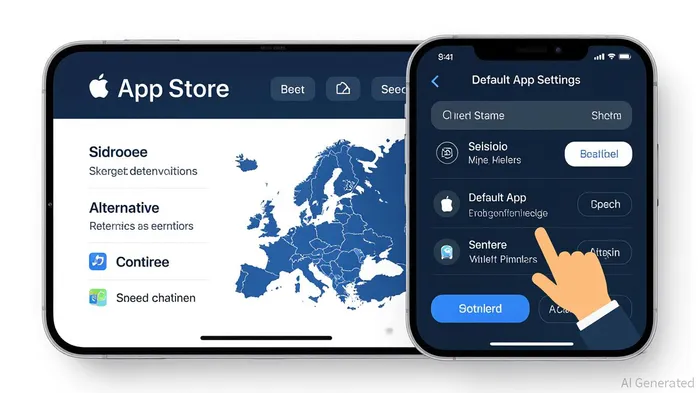
Moreover, Apple's user experience (UX) updates—such as streamlined sideloading and default app settings—position the company as a facilitator of choice rather than a gatekeeper. By allowing users to set default browsers, payment apps, and contactless transaction tools, Apple aligns with the DMA's spirit while maintaining its brand as a user-centric innovator. This duality—compliance through UX enhancements—reinforces trust with both regulators and consumers, a rare win in the zero-sum game of digital regulation.
Long-Term Ecosystem Resilience
Apple's App Store reforms are underpinned by a broader strategy to future-proof its services segment. With services revenue hitting $26.6 billion in 2025 (up 12% YoY), the company has diversified beyond hardware, leveraging its 1.8 billion active devices to drive recurring revenue. The App Store, while a smaller component of this ecosystem, remains a critical touchpoint for developer engagement and user retention. By adapting its fee structure to EU rules, Apple ensures that the App Store remains a viable platform for developers, who are then incentivized to stay within Apple's ecosystem for tools, analytics, and marketing support.
The company's $500 billion U.S. investment plan further underscores its confidence in long-term growth. By expanding domestic manufacturing and R&D, Apple is mitigating supply chain risks while signaling to investors that it remains a capital-efficient, high-margin player. The EU compliance costs, while significant, are a one-time adjustment compared to the recurring revenue and ecosystem lock-in Apple stands to gain.
Risk Mitigation and Investor Implications
For investors, Apple's approach to the DMA represents a textbook example of regulatory risk mitigation. By preemptively aligning with EU requirements, the company has avoided the reputational and financial damage of protracted legal battles. While the reforms may slightly reduce App Store margins in the short term, the long-term benefits—reduced regulatory scrutiny, preserved market share, and enhanced developer loyalty—far outweigh these costs.
Moreover, Apple's global expansion into markets like India and Southeast Asia, where regulatory scrutiny is less stringent, provides a buffer against EU-related headwinds. The company's ability to scale its App Store model in these regions, while maintaining its premium pricing in the U.S. and EU, ensures that its services segment remains a growth engine.
Conclusion: A Win for Shareholders and the Ecosystem
Apple's App Store reforms are a testament to the company's ability to adapt to regulatory headwinds without compromising its core value proposition. By balancing compliance with strategic monetization, Apple has positioned itself to thrive in a fragmented global regulatory environment. For investors, this represents a rare combination of short-term pragmatism and long-term vision—a company that is not only surviving but thriving in the era of digital regulation.
As the EU continues to shape the future of tech governance, Apple's proactive approach serves as a blueprint for sustainable market leadership. With its ecosystem intact, services segment growing, and regulatory risks mitigated, Apple remains a compelling long-term investment—proving that even in a world of constraints, innovation and adaptability can drive unparalleled shareholder value.







Comentarios
Aún no hay comentarios