
Apple's AI Infrastructure Bet: Riding the Siri S-Curve with Google
Apple is at a clear inflection point on the AI adoption S-curve. For years, its strategy of building proprietary AI in-house left it lagging behind the current wave of generative AI hype. The result was a slow adoption of its previous AI efforts, with Siri becoming a symbol of that stagnation. The company is now making a decisive pivot, betting that the next major adoption curve will be powered by a fundamental ecosystem layer, not a standalone app.
This shift is embodied in a historic partnership with GoogleGOOGL--. AppleAAPL-- is integrating a custom Gemini AI model into the next generation of Siri, set to debut around March 2026. This is a direct response to the slow user engagement with its previous AI. By outsourcing the core intelligence to Google, Apple aims to accelerate adoption by giving Siri the conversational depth and task-completion ability that users now expect. The move is a pragmatic recognition that large language models may become commoditized, making a massive, in-house build-out less cost-justified.
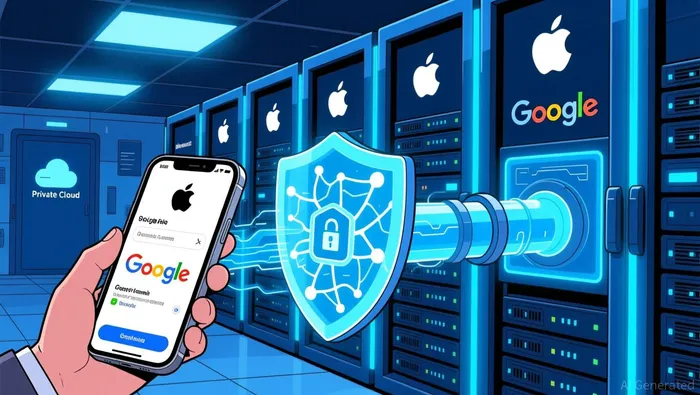
Strategically, this partnership is an infrastructure bet. Apple is paying Google to develop the model, but the AI will run on Apple's own Private Cloud Compute servers, preserving its privacy architecture. The user experience will be seamless, with no visible Google branding-just a smarter Siri. This allows Apple to leapfrog its own slow development cycle and immediately tap into the exponential growth of the AI paradigm, using its unmatched distribution through over 2 billion devices as the launchpad.
The Infrastructure Bet: Cost, Cash, and Exponential Growth Catalysts
The financial mechanics of Apple's Siri pivot reveal a classic infrastructure play. The company is reportedly paying Google to build a custom Gemini AI model for the overhaul, a move that sidesteps the massive capital outlays required for in-house model development. The selection reportedly hinged on financial terms, with one source indicating that Anthropic's alternative would have cost Apple more than $1.5 billion annually. This is the core trade-off: paying a premium for speed and expertise to avoid a multi-year, multi-billion dollar build-out.
This approach is a masterstroke in cash preservation. While rivals pour hundreds of billions into data centers and chips, Apple's restrained strategy has left it with more than $130 billion in cash and marketable securities. By outsourcing the model, Apple limits its AI-specific capital expenditures, preserving this war chest for other strategic uses-whether that's acquisitions if AI valuations correct, or funding other exponential bets. It's a way to ride the AI S-curve without burning through the fuel needed to build the engine.
The growth catalyst here is immense, centered on the Services segment. That division already generated $109.2 billion in sales last year, a figure that could accelerate dramatically with a truly capable, conversational Siri. A successful overhaul would transform Services from a stable, high-margin revenue stream into a dynamic growth engine. It would drive deeper user engagement, increase the value of Apple's ecosystem lock-in, and open new monetization avenues for features like AI-powered search, personalization, and commerce. The infrastructure layer-Apple's devices and servers-is already in place; the smarter AI is the missing catalyst for exponential adoption.
The bottom line is a low-risk, high-reward setup. Apple is paying for a proven technology to solve a critical user experience problem, all while protecting its balance sheet. If the Gemini-powered Siri achieves rapid adoption, it could be the catalyst that propels the Services segment into a new growth phase, validating the partnership as a pivotal infrastructure bet.
Valuation, Scenarios, and What to Watch
The partnership sets up a clear binary for Apple's valuation. The bullish scenario, as outlined by Wedbush's Dan Ives, is a multi-year inflection. He projects a formal AI alliance between Apple and Google could anchor Apple's long-term AI strategy and eventually support a subscription-driven model capable of pushing the company's valuation toward $5 trillion. This isn't a near-term earnings play; it's a bet on the next infrastructure layer. A successful Siri overhaul would transform Services from a stable, high-margin segment into a dynamic growth engine, directly fueling that exponential trajectory.
The key watchpoints are now concrete and time-bound. The first is the March 2026 launch of the new Siri. This is the initial catalyst that will validate the partnership's technical execution. The second, and more critical, is the initial user adoption and engagement metrics. The stock's recent underperformance reflects deep skepticism. Apple shares are down about 4.6% year-to-date, a clear signal that the market is waiting for proof that this AI bet can overcome years of stagnation. Success will be measured by whether the new Siri achieves rapid, organic adoption and drives meaningful engagement within the ecosystem.
The current sentiment is one of cautious waiting. The stock's volatility and recent decline show investors are pricing in execution risk. The partnership is a low-cost way to ride the AI S-curve, but its success is now the single most important near-term catalyst for the entire thesis. If the March launch delivers a genuinely smarter, more capable Siri, it could catalyze a re-rating. If it falters, the skepticism will deepen, and the $5 trillion scenario will recede. For now, the investment hinges entirely on this one infrastructure layer delivering the promised paradigm shift.
Risks and Guardrails: Dependency and Execution
The partnership is a smart, low-cost bet on the AI S-curve, but it introduces significant strategic dependencies and execution hurdles. The core risk is a shift in control. By outsourcing the core intelligence to Google, Apple is ceding long-term utility control over a fundamental user interface. The custom Gemini model will power Siri's new capabilities, and while it runs on Apple's servers, the underlying technology and its evolution will be in Google's hands. This creates a dependency that could limit Apple's ability to innovate independently on the core AI layer and potentially dilute its brand as the sole innovator.
Execution is the other critical guardrail. Apple must seamlessly integrate Google's model into its Private Cloud Compute infrastructure while maintaining its ironclad privacy promise. The goal is a background operation where Gemini works behind the scenes, with Apple branding the results. Any misstep in this integration-whether in latency, data handling, or the user experience-could break the illusion and damage trust. The company is also betting that its own Foundation Models can continue to handle sensitive on-device processing without conflict, a complex technical challenge.
Viewed through a long-term lens, however, this partnership is a foundational step. As Wedbush's Dan Ives projects, a formal alliance could anchor Apple's long-term AI strategy and eventually support a subscription-driven model. The immediate goal is to fix Siri and accelerate adoption. The longer-term vision is to use that platform to build a new, recurring revenue stream. The risks are real, but the guardrails are clear: success depends on flawless integration and the partnership delivering the promised paradigm shift in user engagement.





Comentarios
Aún no hay comentarios