
Apple's AI Crossroads: Can Tim Cook's Pivot Salvage Innovation Leadership?
Apple's journey into the AI era has reached a critical inflection point. Despite its storied history of disrupting markets, the company now faces existential risks as delayed AI integration, regulatory headwinds, and fierce competition from NVIDIANVDA-- and OpenAI-driven rivals threaten its innovation crown. Yet, its ecosystem dominance and upcoming hardware/software synergies—such as the anticipated foldable iPhone—offer a path to redemption. Let's dissect the risks, opportunities, and investment implications for Apple's AI pivot.
The Delays: A Trust Deficit and Legal Fallout
Apple's AI timeline has been plagued by setbacks. Promised upgrades to Siri, central to its “Apple Intelligence” vision, were pushed from 2024 to 2026, sparking a class-action lawsuit in June 2025 alleging misleading investor disclosures. This has fueled a 25% stock decline since December 2024, erasing $900 billion in market value.
The lawsuit's fallout extends beyond litigation costs. Analysts cite 50% of iPhone 16 holdouts delaying purchases due to AI feature delays, per Morgan StanleyMS--. Competitors like Samsung (Galaxy AI) and GoogleGOOGL-- (Pixel AI) are capitalizing on Apple's hesitancy, offering real-time translations and task automation now—not later.
Regulatory Pressures: A Compliance Tightrope
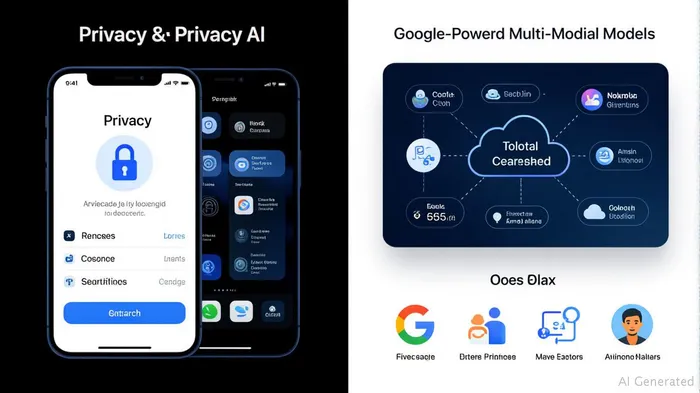
Apple's strict adherence to privacy—its hallmark—is both a shield and a sword. The EU's Digital Markets Act (DMA) mandates AppleAAPL-- to allow alternative app stores, threatening its lucrative 30% App Store commission. This could slice $30 billion annually from services revenue, which already accounts for 28% of total sales.
Meanwhile, GDPR compliance requires Apple to keep AI processing on-device, slowing innovation compared to rivals who leverage cloud-scale models. For instance, OpenAI's partnership with Google Cloud (via TPU v7 chips) enables multi-modal capabilities Apple lacks, critical for emerging markets like AR/VR.
The Competitive Gauntlet: NVIDIA's GPU Dominance and OpenAI's Expansive Alliances
NVIDIA's AI chip dominance is a strategic nightmare for Apple. Its $2 trillion market cap—surpassing Apple—reflects investor confidence in its data-center GPU leadership. Apple's hardware-centric approach, reliant on its A-series and M-series chips, struggles to compete with NVIDIA's scalable infrastructure for AI training.
OpenAI's Google Cloud partnership further complicates matters. By diversifying its compute stack beyond MicrosoftMSFT-- Azure, OpenAI gains access to Google's TPU v7 chips, enabling faster AI model development. This partnership underscores Apple's isolation: it lacks such alliances and trails in multi-modal AI (e.g., image/audio/language fusion), a must-have for future products like AR glasses.
The Silver Lining: Hardware-Software Synergy and Services Resilience
Apple's ecosystem remains its greatest asset. The foldable iPhone, slated for 2026, could capture 20% of the premium smartphone market by 2027, according to Canalys. Combined with iOS 26.4's AI updates—Live Translation, Workout Buddy, and enhanced Genmoji—the hardware/software duo could reignite demand.
Services revenue shows resilience too, growing 11.6% to $26.6 billion in Q2 2025, buoyed by Private Cloud Compute (PCC) and subscription growth. Even with iPhone sales flattish (+1.9% YoY), services' margin profile (60%+ gross margins) provides a buffer against hardware headwinds.
Valuation and Investment Thesis
Apple's stock now trades at $180, a 30% discount to its 2023 peak, creating a valuation gap. Its P/E ratio of 24x is below the tech sector average, despite a $108.8 billion free cash flow in FY2024.
Bull Case (Execute AI Roadmap):
- Successful launch of AI-driven iPhone 17 and foldable models in 2026.
- Regulatory fines kept to $5 billion–$10 billion, manageable with cash reserves.
- Services revenue surges to $40 billion by 2027, leveraging AI-driven user engagement.
Target Price: $250–$280.
Bear Case (Pivot Fails):
- AI delays persist, losing premium buyers to competitors.
- iPhone sales slide to negative growth, and services stall.
- Legal penalties exceed $20 billion, eroding margins.
Target Price: $150–$160.
Investment Recommendation
Apple presents a high-risk, high-reward opportunity. Investors should consider:
1. Dollar-Cost Averaging: Buy in tranches between $170–$185, with a stop-loss below $160.
2. Monitor AI Execution: Track Q4 2025 updates on Live Translation and PCC adoption rates.
3. Hedging: Short NVIDIA (if bullish on Apple's comeback) or buy puts on Apple if fearing regulatory overreach.
The next 12 months will test whether Apple can rekindle its innovation spark. A successful AI pivot could restore its premium valuation, but failure risks relegating it to a hardware relic in a software-driven world.
Final Thought: Apple's fate hinges on executing its hybrid strategy—marrying privacy-first AI with premium hardware. The stakes couldn't be higher in this AI arms race.





Comentarios
Aún no hay comentarios