
APLD's AI-Powered Infrastructure Transition: How the 2026-2027 Lease Ramp Catalyzes Margin Expansion and Valuation Re-Rating
Applied Digital (APLD) is poised to redefine its role in the AI infrastructure landscape through a meticulously engineered 2026-2027 lease ramp strategy. By anchoring its growth in two flagship projects-Polaris Forge 1 and Polaris Forge 2-the company is positioning itself to capitalize on the surging demand for high-performance computing (HPC) and AI workloads. This transition, underpinned by long-term lease commitments and strategic capital allocation, promises to drive margin expansion and unlock a significant valuation re-rating.
Strategic Leverage of Long-Term Lease Commitments
At the core of APLD's AI infrastructure transition is its Polaris Forge 1 campus in North Dakota, a 400-megawatt facility fully leased to CoreWeaveCRWV-- under a 15-year contract. According to the company's Q1 2026 results, this arrangement secures approximately $11 billion in prospective lease revenue, providing a stable and predictable cash flow stream critical for scaling operations. The campus is nearing completion of its first 100 MW building, with construction underway on a second 150 MW phase, while its design allows for future expansion beyond 1 gigawatt by 2028–2030. Such forward-looking planning ensures APLDAPLD-- remains agile in responding to the exponential growth of AI workloads, which are projected to require exascale computing capabilities in the coming years.
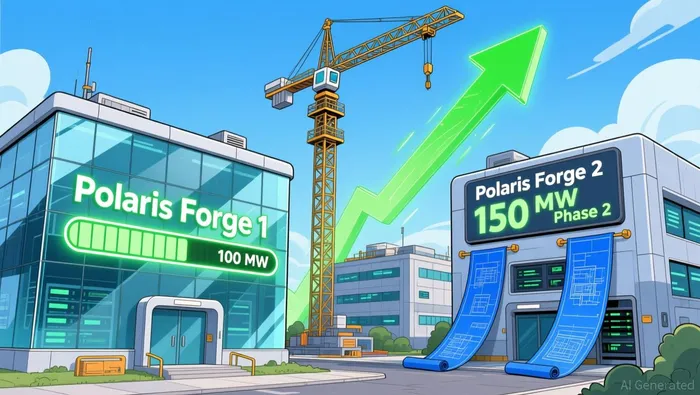 Complementing this is Polaris Forge 2, a $50 million-funded AI Factory campus set to begin operations in 2026 and reach full capacity by 2027. With two 150 MW buildings in its initial phase and scalability up to 1 gigawatt, this project is already supported by long-term commitments from investment-grade hyperscalers. These leases, combined with APLD's active 4 gigawatt development pipeline, create a compounding effect: as each phase ramps, the company's operating leverage increases, directly boosting margins.
Capital Efficiency and Balance Sheet Strength
APLD's financial strategy further amplifies its growth potential. The company has drawn $112.5 million from a $5 billion preferred equity facility with Macquarie Asset Management, a move designed to fund Polaris Forge 1 while minimizing future equity dilution. Additionally, a $200 million raise through its Series G Preferred Stock offering underscores APLD's ability to access capital at favorable terms, a critical advantage in an industry where upfront infrastructure costs are substantial.
This disciplined approach to capital allocation is key to margin expansion. By securing long-term, fixed-rate financing and leveraging partnerships with institutions like Macquarie, APLD reduces exposure to interest rate volatility and ensures that incremental cash flows from new leases translate directly into profitability. The company's management has set ambitious targets, including an annualized net operating income (NOI) run rate of $500 million upon Polaris Forge 1's full operation and a $1 billion NOI milestone within five years. These figures suggest a path to high-margin, scalable growth, which is rarely seen in capital-intensive sectors.
Valuation Re-Rating: From Infrastructure Play to AI-Centric Growth Story
The convergence of APLD's lease ramp and AI infrastructure alignment positions it for a valuation re-rating. Traditional data center operators are often valued based on cash flow yields and occupancy rates, but APLD's focus on AI-specific infrastructure-characterized by longer lease terms, higher per-megawatt revenue, and sticky customer relationships-aligns it more closely with software-driven growth companies.
For instance, the 15-year CoreWeave lease at Polaris Forge 1 not only ensures revenue visibility but also locks in a partner deeply integrated into the AI ecosystem. As AI workloads become the backbone of enterprise and consumer technologies, APLD's infrastructure will serve as a critical enabler, enhancing its strategic value. This dynamic is already reflected in its partnerships and development pipeline, which position the company to lead the next wave of AI infrastructure deployment.
Conclusion: A Catalyst-Driven Investment Thesis
APLD's 2026-2027 lease ramp is more than a series of construction milestones-it is a calculated, multi-year strategy to transform the company into an AI infrastructure leader. By securing long-term, high-margin leases, optimizing capital structure, and scaling capacity in tandem with demand, APLD is creating a flywheel effect: increased utilization drives higher NOI, which in turn supports further expansion and margin growth.
For investors, the implications are clear. APLD's transition from a conventional data center operator to an AI-centric infrastructure provider offers a rare combination of near-term cash flow stability and long-term growth potential. As the AI revolution accelerates, APLD's strategic positioning and disciplined execution make it a compelling candidate for valuation re-rating.





Comentarios
Aún no hay comentarios