
Apex Critical Metals' Strategic Re-Analysis of Rift Rare Earth Project: A Catalyst for Unlocking Undervalued Critical Metal Assets
Historical Data: A Foundation with Limitations
The Rift Project, situated within the Elk Creek Carbonatite Complex, has a legacy of exploration dating back to the 1970s and 1980s. Companies like Molycorp and Cominco completed over 106 drill holes, identifying a historic niobium resource of 39.4 million tons at 0.82% Nb₂O₅. However, REE mineralization was underexplored, with assays limited to light REEs such as lanthanum, cerium, and neodymium. Notable historical intercepts include 155.5 meters of 2.70% REO (EC-93) and 236.2 meters of 2.10% REO, including a high-grade interval of 68.2 meters at 3.32% REO (NEC11-004). These results, while promising, lack full validation under NI 43-101 standards, a gap that has historically constrained investor confidence.
Modern Analytics: Bridging the Past and Future
Apex's 2025 re-logging and re-sampling program, overseen by Dahrouge Geological Consulting, aims to address this gap. By re-analyzing preserved historical drill cores using advanced techniques like Fusion ICP-MS, ICP-OES, and XRF, the company is generating a more accurate and comprehensive dataset. This approach not only validates historical results but also identifies potential for heavy REEs and magnet feed materials (e.g., dysprosium, terbium), which are critical for high-performance magnets in electric vehicles and wind turbines. The results, expected in Q1 2026, will inform geological modeling of the carbonatite system, which hosts the mineralization according to technical analysis.
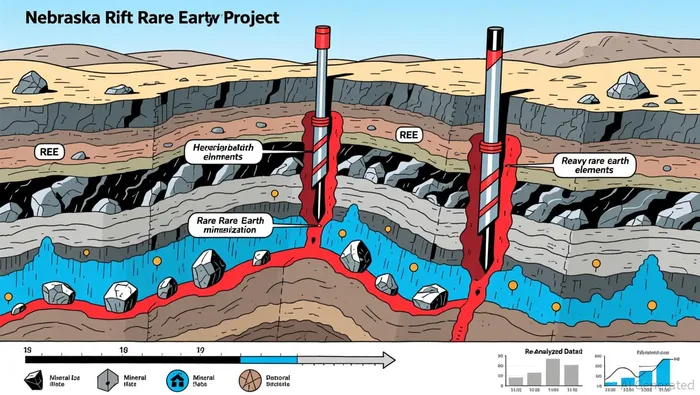
The strategic integration of historical and modern data is further supported by Apex's expanded land position of 3,024 acres, consolidating high-priority targets like EC-93, NEC11-004, and EC-43. CEO Sean Charland emphasized the company's focus on refining its Phase I drill plan and advancing permitting to begin drilling before year-end 2025 as reported in financial analysis. This dual approach-leveraging legacy data while applying cutting-edge analytics-reduces exploration risk and accelerates resource delineation.
De-Risking Through Expert Validation and Case Studies
A key differentiator for Apex is its emphasis on expert validation. Nathan Schmidt, P. Geo., has reviewed the technical content of the project, adding credibility to its findings. Additionally, Apex's experience at its Cap Critical Minerals Project in British Columbia provides a relevant case study. There, the company used airborne geophysical surveys and drilling to identify a 2.2 km by 1.8 km magnetic anomaly correlated with niobium mineralization. Drillhole CAP25-006 returned 0.59% Nb₂O₅ over 36.0 meters, demonstrating how modern techniques can unlock value in underexplored systems. According to market analysis, applying similar methodologies to the Rift Project could yield comparable results, particularly in areas where historical mineralization remains open for expansion.
Investment Implications: A Catalyst for Value Creation
The Rift Project's potential lies in its underexplored nature and alignment with global demand for critical minerals. By re-analyzing historical data, Apex is not only validating existing resources but also identifying new opportunities for heavy REEs, which command higher prices in the market. The upcoming Q1 2026 results could catalyze a step-change in the project's valuation, particularly if they confirm the presence of magnet feed materials.
Moreover, the project's location in the U.S. offers geopolitical advantages, as domestic production of critical minerals becomes a strategic priority. Apex's permitting progress and land consolidation further position it to capitalize on this trend. While risks remain-such as the need for additional drilling and market volatility-the company's strategic use of historical data and modern analytics provides a robust framework for de-risking exploration and unlocking value.
Conclusion
Apex Critical Metals' Rift Rare Earth Project exemplifies how historical data, when reinterpreted with modern analytics, can transform underexplored assets into high-potential opportunities. By bridging the gap between legacy exploration and contemporary technology, the company is not only de-risking its projects but also aligning with the global demand for critical minerals. As the Q1 2026 results emerge, investors will have a clearer view of the Rift Project's potential-and the broader implications for early-stage critical mineral exploration.







Comentarios
Aún no hay comentarios