
Why APEMARS Stage 3 Is a Strategic Entry Point for 2026 Crypto Growth
The cryptocurrency market in 2026 is poised for a paradigm shift, driven by projects that combine speculative potential with structured mechanics. Among these, APEMARS (APRZ) stands out as a high-conviction opportunity, particularly for investors targeting Stage 3 of its presale. With a projected 22,367% ROI, deflationary tokenomics, and a mission-driven narrative, APEMARS offers a compelling case for strategic entry. This analysis breaks down the timing, scarcity, and structured ROI dynamics that position APEMARS as a standout asset for 2026 growth.
Timing: The Urgency of Stage 3
APEMARS' presale operates through 23 weekly stages, each incrementally priced higher than the last. Stage 3, currently active, offers tokens at $0.00002448, a price point that closes permanently once the stage is filled or the time limit expires. This creates immediate urgency for investors, as subsequent stages (e.g., Stage 4 at $0.000027, Stage 5 at $0.000030) will significantly reduce potential returns.
The presale's fixed pricing structure is designed to reward early participation while aligning with the project's narrative of Commander Ape's journey to Mars. For example, a $1,000 investment at Stage 3 could yield approximately $224,000 if the token lists at the projected $0.0055. This ROI is anchored in the project's roadmap and deflationary mechanisms, making it one of the most aggressive yet structured returns in the current crypto landscape.
Scarcity: Burn Mechanics and Deflationary Design
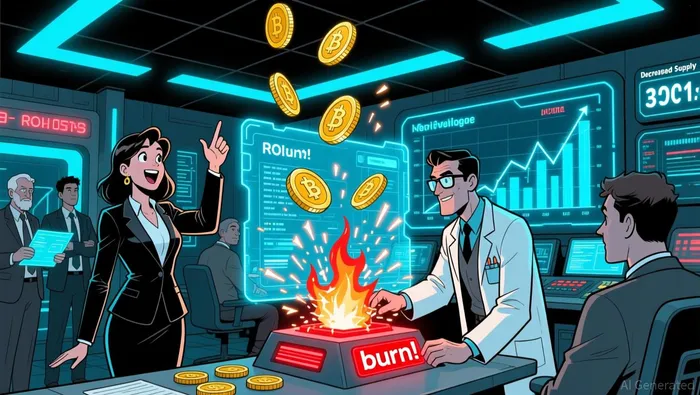
Scarcity is a cornerstone of APEMARS' value proposition. Unlike traditional presales, where unsold tokens often re-enter circulation, APEMARS implements scheduled token burns at Stages 6, 12, 18, and 23 according to project documentation. These burns permanently remove unsold tokens from supply, creating a deflationary effect that enhances scarcity and potential future value.
For instance, if 10% of the total supply remains unclaimed by Stage 6, those tokens are burned, reducing the circulating supply by 10%. This contrasts sharply with projects that rely solely on market demand to drive scarcity. By embedding burns into its presale structure, APEMARS ensures that supply reduction is programmatically enforced, not dependent on market sentiment as reported.
Structured ROI: High-Yield Staking and Projected Listing
Beyond the presale, APEMARS introduces 63% APY staking rewards for holders post-launch as detailed in project documentation. This yield, activated two months after the token's listing, provides a dual-income stream: capital appreciation from the projected $0.0055 listing price and passive income from staking. While the APY is subject to change and carries risks (e.g., smart contract vulnerabilities), it positions APEMARS as a hybrid asset-combining speculative growth with income generation.
The structured ROI is further reinforced by the project's institutional-grade infrastructure. Built on a Solana-based blockchain, APEMARS leverages high-speed transactions and low fees, aligning it with the technical robustness of established chains like BitcoinBTC-- and SolanaSOL-- while offering memeMEME-- coin-like upside.
Comparative Advantages: APEMARS vs. Meme Coins and Institutional Assets
Compared to traditional meme coins (e.g., DOGEDOGE--, SHIB), APEMARS introduces structured mechanics that mitigate the volatility and lack of governance typical of unstructured projects. Its burn events, staking rewards, and fixed presale pricing create a framework that balances speculation with long-term value retention.
When benchmarked against institutional-grade assets like Bitcoin and Solana, APEMARS offers a higher growth multiple. While Bitcoin's 2026 price projections hover around $100,000 (a ~100% ROI from current levels), APEMARS' 22,367% ROI dwarfs this, albeit with higher risk. Solana, despite its institutional adoption, lacks the deflationary and staking-driven incentives that APEMARS embeds into its design according to market analysis.
Conclusion: A Strategic Window for 2026 Growth
APEMARS Stage 3 represents a rare convergence of timing, scarcity, and structured ROI. The presale's aggressive pricing, coupled with scheduled burns and high-yield staking, creates a multi-layered value proposition. For investors seeking exposure to 2026's high-growth crypto assets, the urgency of Stage 3 participation is clear: delay risks missing the most favorable entry point in a project designed to outperform both meme coins and institutional benchmarks.
Immediate action is warranted for those who can tolerate the inherent risks of speculative assets. As the presale progresses, the cost of entry will rise, and the projected ROI will shrink. In a market increasingly defined by structured innovation, APEMARS' Stage 3 is not just an opportunity-it's a strategic imperative.







Comentarios
Aún no hay comentarios