
APEMARS: The Next 1000x Meme Coin Opportunity Before the Rocket Launches
In the volatile and speculative world of meme coins, timing and structure often determine the difference between a 1000x windfall and a lost opportunity. As 2025 draws to a close, APEMARS ($APRZ) has emerged as a standout project, blending meme-driven virality with engineered scarcity and utility. This article dissects APEMARS' presale mechanics, burn strategy, and whitelist advantages, contrasting them with PepePEPE-- (PEPE) and DogecoinDOGE-- (DOGE) to highlight why early-stage participation in APEMARS represents an asymmetric risk/reward profile.
APEMARS: A Structured Meme Coin with Engineered Scarcity
APEMARS' presale is a masterclass in psychological and economic design. The 23-stage model, with each stage lasting one week or until tokens sell out, creates artificial scarcity and urgency. Whitelisted users gain exclusive access to Stage 1, where tokens are priced at $0.000016990-over 32,000% below the projected listing price of $0.0055. This tiered pricing incentivizes early participation, as subsequent stages see incremental price hikes, mirroring a "mission to Mars" narrative that aligns with the project's branding.
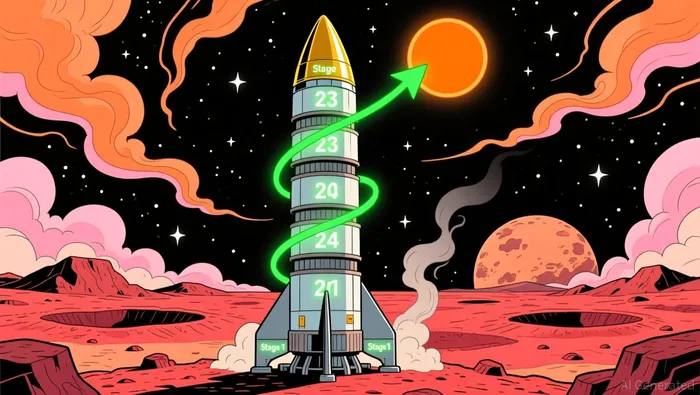
The Thermal Disposal Protocol further reinforces scarcity. At predefined checkpoints (Stages 6, 12, 18, and 23), all unsold presale tokens are burned, reducing supply and creating visible milestones. This mechanism contrasts sharply with Pepe's post-ignition phase, where supply dynamics remain uncontrolled, and DOGE's historical reliance on organic virality without structured burn events.
Whitelist Advantages and Referral Mechanics: Compounding Early-Mover Gains
Whitelisted participants are not only prioritized for Stage 1 access but also receive early updates, timelines, and allocation notices- critical advantages in a market where speed often determines success. For those who miss the whitelist, the Orbital Boost System offers a lifeline: referrals earn both parties a 9.34% allocation boost once the $22 eligibility threshold is met. This creates a self-sustaining growth loop, where early adopters are rewarded for expanding the network.
In contrast, Pepe's community-driven model lacks formal incentives for early participation. While projects like Pepeto ($PEPETO) have introduced structured staking and fixed supply, Pepe's original design-no presale, no team allocation, and no transaction taxes-leaves it vulnerable to market saturation and speculative dumping. DOGEDOGE--, meanwhile, has relied on grassroots virality and celebrity endorsements, but its historical price volatility (5.91% over 30 days in 2025) underscores the risks of unstructured growth.
Pepe's Post-Ignition Phase: A Cautionary Tale of Unstructured Growth
Pepe's 2025 trajectory highlights the limitations of meme coins without formal presale structures. While its community-driven ethos initially drove rapid adoption, the absence of a controlled supply or burn mechanism has led to price instability. Newer projects like Pepeto are now capitalizing on this gap, offering structured staking and utility features to attract capital flows. APEMARS, by contrast, embeds these features into its core design, ensuring that supply reduction and community incentives are baked into the protocol from day one.
DOGE's Historical Trajectory: Volatility vs. APEMARS' Predictability
Dogecoin's 2025 dynamics reveal a market in flux. Despite a projected price of $0.17 and a market cap exceeding $26 billion, DOGE's volatility (5.91% over 30 days) and lack of formal presale structures make it a less predictable bet . Projects like Maxi Doge, with staged presales and utility-driven features, have attempted to bridge this gap, but their success remains unproven . APEMARS, however, offers a clear roadmap: 23 stages of price escalation, four burn events, and a 63% APY staking reward for post-launch holders. This structured approach minimizes the guesswork inherent in DOGE's organic growth model.
The Asymmetric Risk/Reward of Timing
The key to APEMARS' appeal lies in its asymmetric risk/reward profile. For $0.000016990 per token in Stage 1, investors gain exposure to a project with a projected 32,000% ROI, assuming the listing price of $0.0055 is realized. The Thermal Disposal Protocol ensures that each burn event amplifies scarcity, while the referral system creates compounding incentives. By contrast, Pepe and DOGE lack these engineered levers, leaving their valuations to the whims of market sentiment.
Conclusion: Act Before the Rocket Launches
APEMARS represents a rare convergence of meme-driven virality and engineered scarcity. Its 23-stage presale, burn mechanics, and whitelist advantages create a compelling case for early-stage participation. As the project approaches its final stages, the urgency to secure a spot in the whitelist intensifies. For investors seeking asymmetric returns in a market still dominated by speculation, APEMARS offers a structured, data-backed opportunity-one that Pepe's post-ignition phase and DOGE's historical volatility cannot match.






Comentarios
Aún no hay comentarios