
Apeing: The Whitelist Advantage and Why It's Outpacing Dogecoin and Shiba Inu in 2025
The memeMEME-- coin market in 2025 has become a battleground for innovation, scarcity, and institutional intrigue. While DogecoinDOGE-- (DOGE) and Shiba InuSHIB-- (SHIB) dominate headlines, a new contender-Apeing-is redefining early-stage participation through a structured whitelist model that prioritizes timing, scarcity, and asymmetric upside potential. This article dissects Apeing's mechanics, compares its ROI potential to DOGEDOGE-- and SHIBSHIB--, and explains why it's positioned to outpace its rivals in the 2025 cycle.
Apeing's Whitelist Model: A Masterclass in Early-Stage Mechanics
Apeing's success hinges on its Stage 1 allocation strategy, where tokens are priced at $0.0001 during the whitelist phase and projected to list at $0.001, offering a theoretical ROI of 10,000% if the listing price is achieved. This model is intentionally simple: participants sign up via the official portal, complete verification, and secure their allocation before pricing increases. The process creates a gated entry that limits supply and incentivizes early adoption, a stark contrast to the speculative chaos of later-stage meme coins like PepePEPE-- and Fartcoin according to CoinStats analysis.
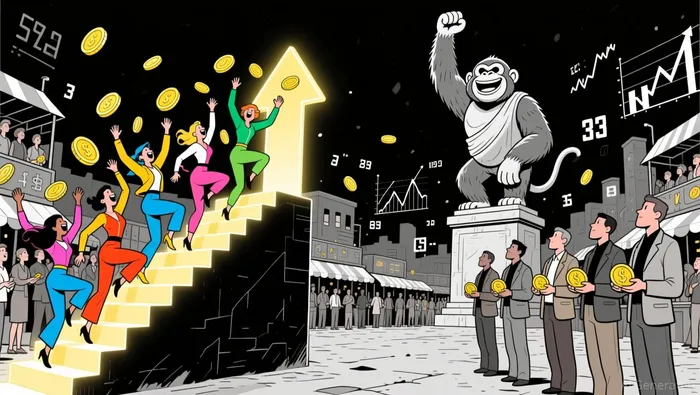
The key differentiator lies in scarcity engineering. Apeing's limited supply and transparent pricing create a clear edge for early adopters, who benefit from both price appreciation and the psychological advantage of being "in the know" before broader market awareness as research shows. This aligns with historical patterns in meme coin cycles, where early-stage projects with controlled distribution often outperform their later-stage counterparts according to CoinStats data.
Dogecoin: Institutional Adoption vs. Structural Weaknesses
Dogecoin's 2025 trajectory is shaped by institutional adoption and regulatory developments. CleanCore Solutions' $180+ million DOGE holdings and the SEC filings for DOGE ETFs by Bitwise, Grayscale, and 21Shares signal growing institutional confidence. However, these positives are offset by structural challenges:
- Unlimited supply: 5.2 billion new DOGE minted annually, diluting value over time.
- Volatility: A 74% drawdown in 2025 after a $0.43 peak, reflecting its risk-on nature.
- Macro dependency: Strong correlation with Fed policy (0.92 in October 2024) and inverse relationship with inflation.
While DOGE's price projections range from $0.19 to $0.57 by year-end 2025 according to Capital.com analysis, its ROI potential remains contingent on external factors like ETF approvals and retail sentiment. Unlike Apeing, DOGE lacks the controlled scarcity and early-stage exclusivity that drive asymmetric returns.
Shiba Inu: Burns and Ecosystem Growth, But Limited Utility
Shiba Inu's 2025 narrative is anchored in aggressive token burns and ecosystem expansion. In early 2026, SHIB's burn rate surged 10,728.80% in 24 hours, destroying $172 million in tokens and reducing circulating supply to 585.29 trillion. While this deflationary strategy is bullish, SHIB's utility remains constrained by its massive supply (nearly 589 trillion tokens) and limited real-world adoption.
Price projections for SHIB range from $0.00000879 to $0.00000971 in 2025, with a 54.53% ROI possible if it reaches $0.00001018 by February 2026. However, these gains pale in comparison to Apeing's 10,000% potential. SHIB's ecosystem-while growing with Shibarium and tokens like BONE-still lacks the early-stage momentum and gated entry that define Apeing's strategy according to Ultimate Markets analysis.
Why Apeing Outpaces the Competition
- Asymmetric Upside: Apeing's whitelist model creates a closed-loop of scarcity, ensuring early adopters capture outsized gains before public listings. This contrasts with DOGE and SHIB, where supply inflation and market volatility erode returns.
- Timing and Scarcity: By limiting access to a verified whitelist, Apeing leverages the FOMO (fear of missing out) dynamic more effectively than open-market projects. This mirrors Bitcoin's early adoption curve, where scarcity and exclusivity drove exponential growth.
- Institutional vs. Retail Dynamics: While DOGE benefits from institutional interest, Apeing's focus on retail-driven virality taps into the grassroots energy that fuels meme coin cycles. This duality-institutional validation for DOGE and retail momentum for Apeing- positions both for growth but with divergent risk profiles.
Conclusion: The 2025 Meme Coin Cycle's New King
Apeing's whitelist model is a masterstroke in modern meme coin design. By combining controlled scarcity, transparent pricing, and early-stage exclusivity, it creates a blueprint for ROI that outpaces DOGE's institutional bets and SHIB's deflationary burns. For investors, the lesson is clear: in the 2025 cycle, timing and access trump supply-side mechanics alone.
As the crypto market evolves, Apeing's success underscores a broader truth: the future belongs to projects that engineer scarcity and leverage community-driven momentum-not just those chasing institutional validation.






Comentarios
Aún no hay comentarios