
Apeing and the Psychology of Early Positioning in Q4 2025 Crypto Markets
The Q4 2025 crypto market was a masterclass in behavioral economics, where psychological biases and asymmetric risk-reward dynamics collided to shape investor behavior. As the U.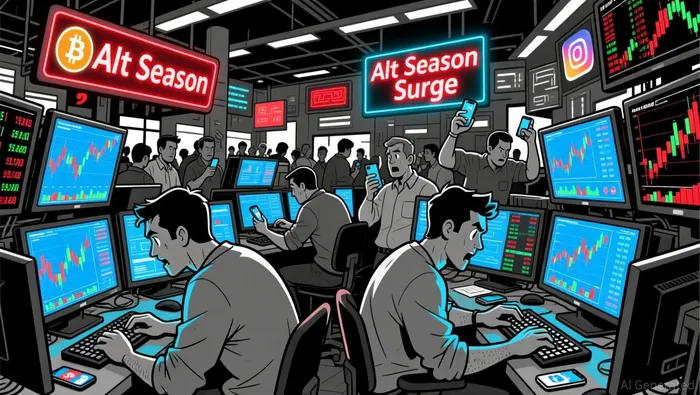 government shutdown froze critical economic data, leaving markets in a fog of uncertainty, investors turned to heuristics and social signals to navigate the chaos. This environment amplified "apeing" behavior-where investors jump into projects without rigorous analysis, often following the crowd-while also creating fertile ground for asymmetric returns in early-stage altcoin investments.
Behavioral Biases and the "Alt Season"
The Q4 2025 "alt season" saw altcoins outperform BitcoinBTC-- for the first time in years, driven by factors like stablecoin legislation, rising centralized exchange (CEX) volumes, and the proliferation of digital asset treasuries (DATs). This shift was not purely technical; it was deeply psychological. Behavioral economics principles such as herd behavior and overconfidence played pivotal roles. For instance, younger investors, particularly Gen Z and Millennials, allocated 25% of their portfolios to non-traditional assets like crypto and NFTs-three times the allocation of older investors. This demographic's risk tolerance and susceptibility to social media-driven hype created a feedback loop where FOMO (fear of missing out) drove capital into speculative altcoins.
The asymmetric returns in this period were stark. Tokens like SolanaSOL-- (SOL) and EthereumETH-- (ETH) surged by 6% following the Federal Reserve's rate cuts, while Bitcoin lagged. This divergence highlights how information asymmetry-where informed traders exploit market inefficiencies-amplified gains for those who positioned early in altcoins. However, such gains came with heightened risks, as over-leveraged positions and capital inefficiencies led to a 32% return for the VanEck Onchain Economy ETF, which deliberately underweighted volatile names.
The Role of Regulatory Clarity and Investor Psychology
Regulatory developments, such as the GENIUS Act, which provided a framework for stablecoins, further tilted the playing field. Stablecoin adoption surged, driving transaction volumes on platforms like Ethereum and Binance Smart Chain. This created a perceived value narrative, where investors associated regulatory progress with long-term viability, even if fundamentals were unproven. Behavioral traits like self-efficacy-the belief in one's ability to manage risk-also influenced decisions. Investors who overestimated their ability to pick winners in a volatile market often "aped in" without proper due diligence, exacerbating price swings.
The psychological toll of Q4 2025's volatility was evident in the market's correction events. Liquidations spiked as panic-driven selling overrode rational analysis, a classic example of loss aversion. Yet, for those who maintained discipline, the asymmetric upside was undeniable. For example, tokens in the Financials and Smart Contract Platforms sectors, such as BNBBNB-- and CRO, saw volatility-adjusted returns outpacing broader indices.
Lessons for Future Positioning
The Q4 2025 experience underscores the need for strategies that account for behavioral biases. Active management, as demonstrated by the VanEck ETF, proved critical in mitigating downside risks while capitalizing on asymmetric opportunities. Similarly, institutional adoption of crypto ETFs and hedged strategies reflects a maturing market where psychological noise is increasingly filtered out.
However, the allure of "apeing" remains potent. As behavioral economist Marija Vuković notes, investor psychology will continue to drive heterogeneous outcomes in crypto markets, particularly in environments of macroeconomic uncertainty. For early-stage altcoin investors, the key lies in balancing optimism with rigor-leveraging behavioral insights to avoid the pitfalls of herd mentality while seizing the asymmetric upside when it arises.






Comentarios
Aún no hay comentarios