
Apeing: The Early-Access Meme Coin Poised to Outperform in 2025
The memeMEME-- coin market in 2025 is a battlefield of narratives, tokenomics, and community velocity. Amid this chaos, Apeing ($APEING) emerges as a standout contender, leveraging a meticulously designed first-mover advantage to capture liquidity and momentum. Unlike many meme coins that rely on viral virality alone, Apeing combines structured early access, incentive-driven community growth, and transparent tokenomics to create a compelling case for asymmetric upside. This analysis unpacks how Apeing's strategy positions it to outperform peers like Pudgy PenguinsPENGU--, PepePEPE--, and ApeCoin-and why securing a whitelist spot is critical before broader awareness erodes its value proposition.
Strategic First-Mover Advantage: Apeing's Early Access Model
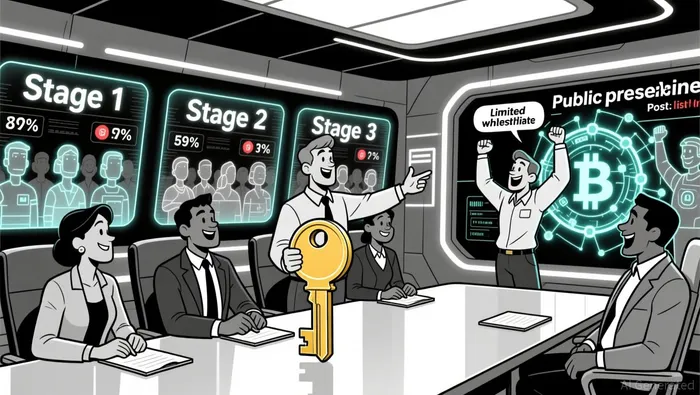
Apeing's core strength lies in its tiered early access framework, which rewards early adopters with a projected 10,000% return on investment. Stage 1 tokens are available at $0.0001 for whitelist participants, with a projected listing price of $0.001-a 10x gain before the token even hits major exchanges according to a report. This scarcity-driven model is further reinforced by limited-stage allocations, ensuring that only a fraction of the total supply is released initially.
The urgency is amplified by third-party audits and Ethereum-based deployment, which build trust in a space often plagued by rug pulls according to market analysis. By prioritizing security and transparency, Apeing mitigates the skepticism that has historically hindered meme coin adoption. Additionally, referral incentives (9.34% rewards via Orbital Boost) and staking mechanisms (63% APY for two-month lock-ups) create a flywheel effect, aligning community behavior with long-term value retention according to an industry report.
Tokenomics: Balancing Scarcity and Utility
Apeing's tokenomics are engineered to avoid the pitfalls of oversupply and volatility. Unlike Pepe, which launched with a staggering 420.69 trillion tokens and burned 50% immediately according to CoinMarketCap data, Apeing's limited supply and phased distribution ensure controlled liquidity. This approach contrasts sharply with Pudgy Penguins (PENGU), which has a circulating supply of 63 billion tokens and a max supply of 89 billion-a structure that could dilute value over time.
ApeCoin (APE), while more established, faces challenges from its recent governance shift to ApeCo, a centralized entity controlled by Yuga Labs according to Messari analysis. This move, while streamlining decision-making, risks alienating the decentralized ethos that initially drove APE's success. Apeing, by contrast, maintains a community-first governance model, with structured token burns and milestone-based rewards tied to ecosystem growth according to MEXC market insights.
Community-Driven Growth: Incentives and Narrative Momentum
Apeing's community growth is fueled by asymmetric incentives that reward early participation. Whitelist access requires only an email submission, democratizing entry while maintaining exclusivity according to Digital Journal coverage. Once onboarded, participants gain access to referral programs, staking benefits, and limited allocations-features that Pepe and Pudgy Penguins lack.
For example, Pepe's decentralized launch relied on grassroots meme culture and influencer seeding, but it lacks structured post-launch incentives according to CoinMarketCap updates. Pudgy Penguins, while successful in physical-to-digital integration (e.g., Walmart toys with QR codes), has struggled to translate brand loyalty into token utility according to LinkedIn analysis. Apeing's Orbital Boost and APE Yield Station directly address this gap, creating a self-sustaining ecosystem where holders are rewarded for both liquidity provision and long-term commitment according to industry reports.
Contrasting with Peers: Why Apeing Stands Out
- Pudgy Penguins (PENGU): While Pudgy Penguins has excelled in real-world brand expansion (e.g., Las Vegas Sphere ads, Walmart partnerships), its tokenomics are diluted by a massive supply and limited post-launch utility according to MEXC analysis. Apeing's structured token burns and incentive mechanisms offer a clearer path to value accrual.
- ApeCoin (APE): APE's ApeChain and cross-chain integrations are undeniably innovative, but its recent governance centralization and declining new holder numbers (down 24.6% QoQ) signal waning community enthusiasm according to Messari analysis. Apeing's decentralized governance and focus on meme-driven virality position it as a more agile alternative.
- Pepe: Pepe's viral launch and massive supply burn created a frenzy, but its lack of post-launch utility and reliance on speculative trading make it a high-risk, high-volatility asset according to CoinMarketCap data. Apeing's structured roadmap and incentive mechanisms provide a more sustainable foundation for growth.
Urgency: The Whitelist Window is Closing
The most critical takeaway for investors is urgency. Apeing's Stage 1 presale is limited to a small number of whitelist participants, and once this window closes, the cost of entry will rise significantly. According to a report by Digital Journal, Apeing's projected listing price of $0.001 implies a 10x return for early buyers-a stark contrast to Pepe's optimistic 2030 target of $0.0001 according to an investment analysis.
Moreover, the project's roadmap includes third-party audits and EthereumETH-- deployment, which are expected to drive broader institutional and retail adoption by Q1 2026 according to market analysis. Delaying participation risks missing the window to secure tokens at the lowest possible price point.
Conclusion: Apeing as the 2025 Meme Coin to Watch
Apeing's strategic first-mover advantage-rooted in limited early access, incentive-driven community growth, and transparent tokenomics-positions it as a standout in the 2025 meme coin landscape. While peers like Pudgy Penguins, Pepe, and ApeCoinAPE-- have carved out niches, Apeing's structured approach to liquidity, utility, and governance creates a more robust foundation for long-term value. For investors seeking asymmetric upside in a high-growth asset class, securing a whitelist spot is not just advisable-it's imperative.






Comentarios
Aún no hay comentarios