
APAC Crypto Surge: Unlocking the Investment Potential of Regulatory-Driven Adoption
The Asia-Pacific (APAC) region has emerged as a global epicenter for cryptocurrency adoption, driven by a unique confluence of regulatory innovation, institutional demand, and technological infrastructure. From 2023 to 2025, jurisdictions across the region-from Singapore's forward-thinking Payment Services Act to Hong Kong's stablecoin licensing regime-have created a fertile ground for crypto infrastructure and compliance firms to thrive. For investors, this regulatory clarity is unlocking a multi-trillion-dollar opportunity in digital assets, with APAC-based firms positioned to lead the next phase of global crypto adoption.
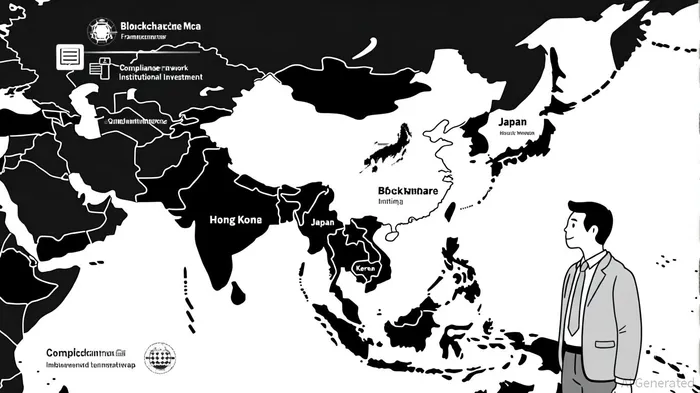
Regulatory Catalysts: From Fragmentation to Frameworks
The APAC crypto landscape has long been fragmented, with countries adopting divergent approaches to digital assets. However, 2025 marks a turning point. Singapore's Monetary Authority of Singapore (MAS) updated its Payment Services Act in 2024 to include digital asset custody, mandating that custodians hold at least 90% of client assets in cold storage, according to a Ripple report. Hong Kong's Securities and Futures Commission (SFC) introduced a licensing regime for stablecoin issuers in August 2025, requiring full asset-backed reserves and AML compliance, per a Bolder Group snapshot. Japan's Financial Services Agency (FSA) has also advanced security token offerings (STOs), while South Korea's Digital Asset Basic Act, enacted in June 2025, established a comprehensive regulatory structure for crypto exchanges and custodians, as outlined in a CoinMonks overview.
These developments are not isolated. They reflect a broader trend of APAC regulators balancing innovation with risk mitigation. For instance, India's central bank has moved toward clearer AML standards, while Australia's Australian Securities and Investments Commission (ASIC) is piloting real-world asset (RWA) tokenization projects like Project Acacia, according to a Crowdfund Insider report. The result? A regulatory environment that attracts institutional capital and fosters infrastructure growth.
Infrastructure Boom: Custody, Exchanges, and RWA Tokenization
The surge in regulatory clarity has directly fueled infrastructure expansion. Digital asset custody, once a niche service, is now a cornerstone of APAC's crypto ecosystem. Major banks like DBS, HSBC, and Standard Chartered have launched custody platforms, while startups such as Zodia Custody and Ripple Custody are scaling institutional-grade solutions, according to a Laser Digital interview. South Korea's mandate for exchanges to hold 80% of client deposits in cold storage has further accelerated demand for secure custody services, as noted in the Ripple report.
Beyond custody, APAC is leading in RWA tokenization. Singapore's Project Guardian, Hong Kong's multi-currency digital bond initiatives, and Japan's STOSTO-- frameworks are transforming traditional assets into blockchain-native instruments, per a BeInCrypto report. According to a FinTech Magazine piece summarizing Chainalysis data, the Central & Southern Asia and Oceania (CSAO) region became the third-largest crypto market globally, with over $750 billion in inflows between July 2023 and June 2024 [https://fintechmagazine.com/articles/asia-pacific-emerges-as-crypto-adoption-hotspot]. This growth is supported by infrastructure players like ImmutableIMX-- (Australia) and Polygon (Singapore), which are building cross-chain interoperability and NFT ecosystems, as highlighted in a Tracxn list.
Compliance as a Competitive Edge: Funding and Innovation
As APAC's crypto ecosystem matures, compliance has become a critical differentiator. Firms that navigate the region's complex regulatory tapestry are attracting significant investment. In Q3 2025 alone, APAC-based compliance startups raised over $200 million across 15 funding rounds, according to VentureRadar data. AiPrise, a global compliance operating system provider, closed a $12.5 million Series A round in October 2025, while AMDAX secured $35 million to launch Europe's first BitcoinBTC-- treasury company.
The Native AI in Governance, Risk, and Compliance (GRC) sector has also seen explosive growth. OnFinance AI and Haast raised $4.2 million and $6 million, respectively, in 2025, leveraging AI-driven AML tools to address APAC's stringent regulatory demands, per a Tracxn report. These firms are not just surviving in the region-they're thriving by aligning with regulators. For example, Sumsub's report highlights that APAC's fraud rates declined by 23% from 2023 to 2024, driven by biometric checks and AI-backed automation.
Strategic Entry Points for Investors
For investors seeking exposure to APAC's crypto surge, three sectors stand out:
1. Custody Platforms: Firms like Zodia Custody and DBS Bank are scaling institutional custody solutions, supported by regulatory mandates.
2. Compliance Tech: Startups such as AiPrise and AMDAX are addressing AML and KYC challenges, with funding trends indicating strong institutional confidence.
3. RWA Tokenization: Projects like Singapore's Project Guardian and Hong Kong's digital bond initiatives are creating new asset classes, attracting both retail and institutional capital.
A would illustrate the region's disproportionate share of investment. Similarly, a underscores the region's accelerating adoption.
Conclusion: A New Era for APAC Crypto
The APAC region is no longer a crypto frontier-it's a fully realized ecosystem. Regulatory clarity, infrastructure innovation, and compliance-driven growth are creating a flywheel effect, attracting capital and talent at an unprecedented rate. For investors, the key is to align with firms that are not just adapting to APAC's regulatory environment but actively shaping it. As noted in a CoinReporter analysis, the region's on-chain transaction volume grew by 69% year-over-year in 2025, reaching $2.36 trillion. This is not just a market-it's a movement.







Comentarios
Aún no hay comentarios