
Antitrust Risks and Corporate Profitability: The Walmart-PepsiCo Case and Its Implications for Retail and CPG Sectors
The recent antitrust allegations against WalmartWMT-- and PepsiCoPEP-- have ignited a critical debate about the intersection of pricing strategies, market power, and regulatory enforcement in the retail and consumer packaged goods (CPG) sectors. A proposed class action lawsuit accuses the two companies of maintaining a decade-long price-fixing scheme that allegedly inflated soft drink prices at non-Walmart retailers while securing preferential terms for the retail giant. This case, coupled with the Federal Trade Commission's (FTC) earlier but dismissed lawsuit against PepsiCo, underscores a broader shift in antitrust enforcement priorities and raises urgent questions for investors about corporate profitability, consumer trust, and capital allocation strategies.
Historical Context: From Chicago School to New Brandeisianism
Antitrust enforcement in the U.S. has long been shaped by the Chicago School's emphasis on market efficiency and the consumer welfare standard, which prioritized low prices over structural concerns about market concentration. However, recent years have seen a resurgence of New Brandeisian critiques, which argue that concentrated power in dominant firms distorts competition and harms long-term consumer interests. This ideological pivot has emboldened regulators to scrutinize practices such as discriminatory pricing, even when they appear to benefit consumers in the short term. The Walmart-PepsiCo case exemplifies this tension: while the companies claim their arrangements delivered "everyday low prices" for Walmart shoppers, critics argue the strategy suppressed competition by artificially inflating prices for rival retailers and their customers. 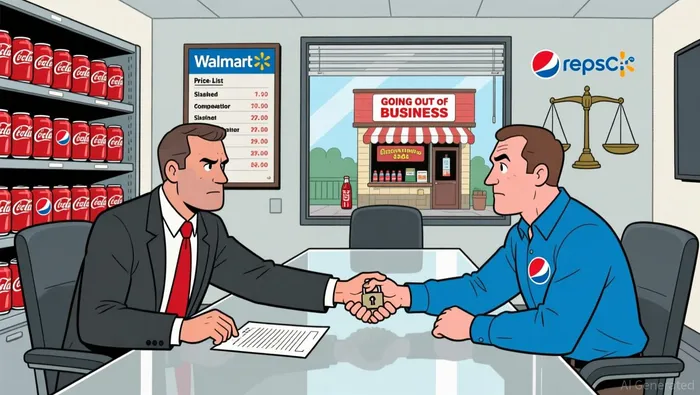
Financial and Regulatory Risks in the Walmart-PepsiCo Case
The financial stakes for Walmart and PepsiCo are significant. The class action lawsuit seeks damages from consumers who purchased PepsiPEP-- products at non-Walmart retailers since 2015, a claim that could result in substantial liability if the court rules in favor of plaintiffs. While the FTC's earlier case against PepsiCo was dismissed without prejudice, the unsealed complaint revealed detailed allegations of promotional payments, allowances, and price-tracking mechanisms designed to maintain a "price gap" favoring Walmart. These practices, if proven, could set a precedent for how regulators define and penalize anticompetitive behavior in supply chain agreements.
Historical antitrust enforcement in the sector provides further context. For example, a EUR 600 million fine imposed on French appliance firms for resale price maintenance highlights the growing willingness of regulators to penalize even indirect collusion. Similarly, the FTC's recent $5.6 million "gun-jumping" penalty against crude oil producers signals a broader trend of aggressive enforcement against pre-merger coordination. For Walmart and PepsiCo, the risk extends beyond financial penalties to reputational damage and operational disruptions, which could erode investor confidence.
Investor Behavior and Capital Allocation Shifts
The intensifying antitrust landscape has already reshaped investor behavior in the retail and CPG sectors. Between 2020 and 2025, investors have increasingly favored firms with robust compliance frameworks, particularly in areas such as AI-driven pricing tools and data governance. The rise of "dawn raids" and expanded scrutiny of labor market practices-such as no-poach agreements- has further heightened risk profiles for companies lacking transparent governance. In this environment, Walmart and PepsiCo's case could accelerate capital flows toward firms that prioritize antitrust compliance as a core competitive advantage.
Moreover, the case highlights the growing importance of omnichannel integration and supply chain efficiency in investor decision-making. As brands like Levi's and Zara expand in-house resale channels to avoid antitrust pitfalls, investors are prioritizing companies that balance innovation with regulatory prudence. For Walmart and PepsiCo, the challenge will be to demonstrate that their pricing strategies align with evolving antitrust standards while maintaining profitability-a balancing act that could influence broader capital allocation trends in the sector.
Future Implications for Enforcement and Consumer Trust
The Walmart-PepsiCo case may also signal a new era of antitrust enforcement focused on supply-side collusion. Unlike traditional price-fixing cartels, which involve direct coordination among competitors, the alleged arrangement between Walmart and PepsiCo leverages vertical integration to suppress competition. This model, if deemed illegal, could prompt regulators to expand their focus to include indirect collusion through supplier-retailer dynamics. Such a shift would have profound implications for corporate strategy, particularly in industries where dominant retailers or manufacturers hold outsized market power.
Consumer trust, meanwhile, remains a fragile asset. Persistent inflation and price volatility have heightened public sensitivity to allegations of market manipulation, with studies showing that antitrust violations can lead to long-term brand devaluation. For Walmart and PepsiCo, the reputational fallout from the lawsuit-regardless of its legal outcome-could exacerbate consumer skepticism, particularly among price-sensitive shoppers who form a significant portion of their customer base.
Conclusion
As the Walmart-PepsiCo case unfolds, it serves as a microcosm of the broader tensions reshaping antitrust enforcement in the 21st century. For investors, the key takeaway is clear: antitrust risk is no longer confined to high-profile mergers or overt cartels. Instead, it extends to nuanced supply chain arrangements and pricing strategies that regulators are increasingly willing to challenge. The financial and reputational costs of non-compliance are rising, and companies that fail to adapt risk not only legal penalties but also a loss of investor and consumer trust. In this evolving landscape, proactive compliance and strategic transparency will be critical to sustaining profitability-and market leadership-in the retail and CPG sectors.





Comentarios
Aún no hay comentarios