
Antitrust Regulation and Big Tech: Navigating Valuation Shifts and Strategic Reallocation in a Fragmented Market
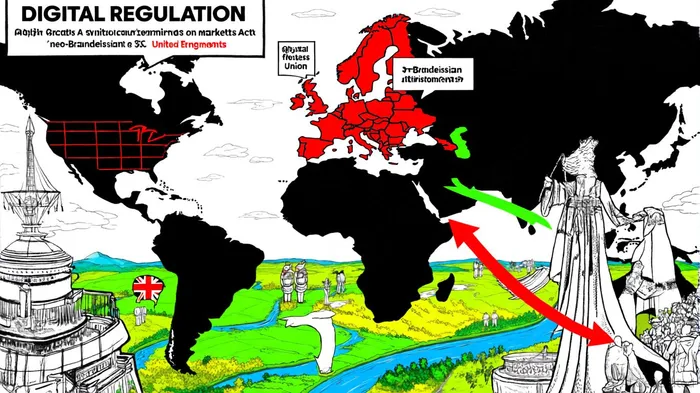
The antitrust landscape for Big Tech in 2025 is a battleground of regulatory scrutiny, market fragmentation, and strategic recalibration. As governments worldwide intensify efforts to curb monopolistic dominance, the sector's valuation dynamics and growth trajectories are being reshaped by a combination of legal pressures, compliance costs, and adaptive capital strategies. For investors, understanding these shifts is critical to assessing long-term risks and opportunities.
The Financial Impact of Antitrust Litigation: Resilience Amid Uncertainty
While antitrust lawsuits have historically led to immediate stock declines in markets like China—where AlibabaBABA-- and Tencent faced sharp valuation corrections due to heavy fines and operational restrictions[3]—the U.S. and EU contexts tell a different story. In the U.S., prolonged litigation timelines have muted short-term financial impacts. For example, despite ongoing antitrust cases against GoogleGOOGL--, AppleAAPL--, and AmazonAMZN--, their market valuations have remained robust, with Alphabet's stock surging 60.5% in the past year amid a favorable court ruling on its search monopoly[1]. Similarly, Apple's P/E ratio of 26.4 reflects investor confidence in its ability to navigate regulatory hurdles[1].
However, this resilience masks underlying volatility. Prolonged legal uncertainty has increased securities volatility and reduced liquidity in Big Tech stocks[3], as seen in Meta's stock sensitivity to ad budget fluctuations and regulatory outcomes[5]. The European Union, meanwhile, is adopting a more proactive stance through the Digital Markets Act (DMA), which has already imposed a 500 million euro fine on Apple for App Store restrictions[4]. These trends suggest that while U.S. tech giants may weather antitrust pressures with relative stability, global regulatory fragmentation is creating a more complex risk profile.
Strategic Adaptation: Capital Reallocation and Regulatory Arbitrage
Big Tech firms are responding to antitrust pressures through a mix of defensive and offensive strategies. One key approach is leveraging SPACs to acquire startups and expand market influence while avoiding traditional merger scrutiny[2]. For instance, Microsoft and Amazon have used SPACs to invest in AI infrastructure and cybersecurity firms, enabling ecosystem consolidation without triggering the same level of antitrust review as direct acquisitions[2]. This tactic highlights a broader trend of regulatory arbitrage, where firms exploit jurisdictional differences to maintain competitive advantages.
Another critical adaptation is the shift toward structural remedies. The U.S. Department of Justice's recent push for divestitures—such as requiring Synopsys and Ansys to sell optical design tools to preserve competition in semiconductor software[5]—signals a neo-Brandeisian enforcement philosophy favoring structural over behavioral fixes. Similarly, the EU's DMA mandates data interoperability and access for gatekeepers, forcing companies like Google and Apple to overhaul business models in digital advertising and app distribution[4]. These changes are driving significant compliance costs, with firms investing in AI governance frameworks and real-time compliance monitoring systems[2].
Market Fragmentation and Regional Operational Adjustments
Regulatory divergence is accelerating market fragmentation, compelling Big Tech to adopt region-specific strategies. In the EU, the DMA's strict gatekeeper designations and interoperability rules have led to operational overhauls, such as Apple's App Store policy revisions[4]. In contrast, the U.S. under the Trump administration has signaled a more pro-business stance, with a merger-friendly FTC chair and relaxed antitrust enforcement encouraging a projected $700 billion in tech M&A activity for 2025[2]. This divergence creates opportunities for firms to optimize capital allocation by focusing on jurisdictions with favorable regulatory climates while maintaining compliance in stricter markets.
Emerging markets are also reshaping the landscape. India's investigations into Amazon's e-commerce partnerships[4] and Brazil's exploration of digital market regimes[1] underscore the global spread of antitrust enforcement. For investors, this fragmentation necessitates a nuanced approach to portfolio diversification, balancing exposure to resilient U.S. tech giants with regional players better positioned to navigate local regulations.
Investment Implications: Preparing for a Regulated Future
The antitrust-driven recalibration of Big Tech's business models has profound implications for valuation metrics. While structural remedies and compliance costs may erode short-term margins, they also create long-term opportunities for innovation and market democratization. For example, Google's potential divestiture of its Ad Manager service[1] could spur competition in digital advertising, benefiting smaller players and fostering ecosystem diversity. Similarly, the EU's emphasis on data interoperability[4] may catalyze new business models in AI and cloud computing.
Investors should prioritize firms demonstrating agility in regulatory compliance and strategic flexibility. Microsoft's diversified approach—combining cloud investments with AI-driven compliance tools[5]—offers a blueprint for navigating this environment. Conversely, companies reliant on high-margin, antitrust-sensitive segments (e.g., Apple's App Store fees) face greater exposure to structural penalties and operational overhauls[4].
Conclusion
Antitrust regulation in 2025 is no longer a peripheral risk but a defining force shaping Big Tech's valuation and growth. As legal battles intensify and regulatory frameworks diverge, firms must balance compliance costs with strategic innovation. For investors, the key lies in identifying companies that can adapt to fragmented markets while leveraging antitrust-driven opportunities—whether through AI-driven compliance, SPAC-enabled expansion, or structural resilience. The future of Big Tech will be defined not by its ability to avoid regulation, but by its capacity to thrive within it.





Comentarios
Aún no hay comentarios