
Antimony's Strategic Role in the Clean Energy Transition: Geopolitical and Industrial Catalysts for U.S. Rare Metal Producers
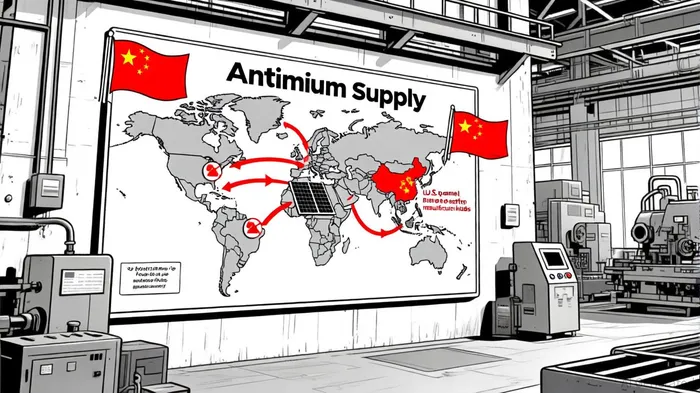
The clean energy transition is no longer a distant promise but a present imperative. As nations race to decarbonize, the demand for critical minerals like antimony has surged, exposing vulnerabilities in global supply chains and creating opportunities for U.S. producers. Antimony, a metalloid with applications in solar panels, lead-acid batteries, and flame retardants, has become a linchpin in the energy transition. Yet its supply is dominated by China, which imposed export restrictions in late 2024, tightening global markets and spurring a strategic response from Washington. For investors, the interplay of geopolitical risk and industrial innovation presents a compelling case for U.S. rare metal producers.
The Antimony Conundrum: A Critical Input in a Fragile Supply Chain
Antimony's role in clean energy technologies is both underappreciated and indispensable. In photovoltaic glass, it acts as a clarifier, enhancing light absorption and efficiency in solar panels. Demand for antimony in this application grew 13.8-fold between 2010 and 2022, driven by the global solar boom[1]. Meanwhile, lead-acid batteries—still the workhorse of energy storage for renewables—rely on antimony to improve durability and performance[3]. Yet the U.S., which mined no antimony in 2023, has long depended on imports, with China historically supplying the lion's share[2].
This dependency has been exacerbated by China's recent export controls. Starting in December 2024, Beijing officially banned antimony exports to the U.S. and EU, citing national security concerns[4]. The move sent shockwaves through global markets, with antimony prices in Rotterdam spiking to $50,000–$60,000 per ton in early 2025, compared to domestic Chinese prices of $20,000 per ton[4]. For context, U.S. antimony imports in 2023 fell 8.1% to 7.7K tons, with China's absence creating a void that no single supplier could fill[2].
U.S. Response: From Vulnerability to Strategic Self-Reliance
The Biden administration's response has been twofold: securing alternative supply and accelerating domestic production. The Department of Commerce's SCALE Tool, launched in 2024, now assesses supply chain risks across industries, prioritizing critical minerals like antimony[5]. But the most tangible step has been the Pentagon's $245 million contract with United States Antimony Corporation (USAC), awarded in September 2025. This sole-source deal ensures the U.S. Defense Logistics Agency receives antimony metal ingots mined in Alaska and refined in Montana, bypassing Chinese imports entirely[1].
The contract is more than a stopgap measure—it signals a broader shift. USAC's vertically integrated supply chain, from high-grade Alaskan deposits to Montana smelting, positions it as a key player in both military and civilian applications. Meanwhile, companies like Perpetua Resources are advancing projects such as the Stibnite Gold-Antimony Project in Idaho, aiming to diversify U.S. production[1]. These efforts align with the administration's goal of reducing reliance on foreign suppliers for critical minerals, a priority underscored by the 2024 CHIPS and Science Act.
Industrial Catalysts: Innovation and Resilience in a Tight Market
The antimony market's volatility has also spurred innovation. U.S. Antimony Corporation recently expanded its smelting operations in Mexico, aiming to bolster North American supply chains[4]. This move reflects a broader trend: companies leveraging regional partnerships to mitigate geopolitical risks. Similarly, research into advanced battery technologies—such as antimony-based liquid-metal batteries—could unlock new demand streams, particularly for grid-scale storage[4].
For investors, the convergence of supply constraints and strategic demand creates a favorable backdrop. Antimony's price trajectory, which rose from $13,500 per ton in Q1 2024 to $14,100 in Q1 2025 projections[1], underscores its value as a strategic asset. While China remains the dominant producer (accounting for 59.9% of global output in 2023[5]), its export restrictions have forced buyers to pay a premium for alternatives, incentivizing U.S. producers to scale up.
Conclusion: A Strategic Investment in Resilience
The antimony story is emblematic of the broader clean energy transition: a race to secure resources while navigating geopolitical headwinds. For U.S. producers, the combination of government support, technological innovation, and market-driven demand presents a unique opportunity. As China's grip on global antimony supplies tightens, the U.S. is betting on domestic production to insulate its energy infrastructure from disruption. For investors, this is not just a bet on a metal—it's a bet on the resilience of the clean energy economy.





Comentarios
Aún no hay comentarios