
Anticipating Federal Reserve Rate Cuts: Strategic Asset Reallocation in a Cooling Labor Market
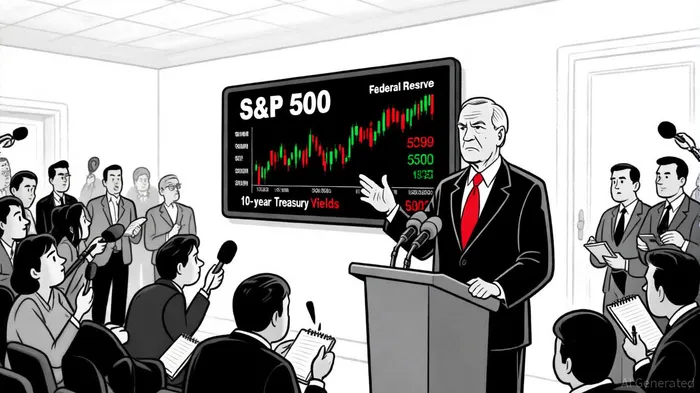
The Federal Reserve's September 2025 decision to cut the federal funds rate by 25 basis points—bringing the target range to 4.00–4.25%—marks a pivotal shift in monetary policy amid a cooling labor market and persistent inflationary pressures[1]. With the FOMC projecting two additional rate cuts in 2025 and one in 2026, investors now face a critical juncture: how to position portfolios to hedge against economic uncertainty while capitalizing on the Fed's easing trajectory.
The Fed's Dilemma: Balancing Employment and Inflation
The September rate cut reflects the Fed's dual mandate struggle. While job gains have slowed and downside risks to employment have risen, inflation remains stubbornly above the 2% target[1]. Fed Chair Jerome Powell emphasized a “gradual path” of cuts, acknowledging that a single 25-basis-point reduction is unlikely to significantly alter economic dynamics[3]. This cautious approach underscores the Fed's desire to avoid reigniting inflation while mitigating the risk of a recession. However, the divergence among policymakers—nine of 19 participants not expecting further 2025 cuts—reveals deep uncertainty about the economy's trajectory[3].
Historical Lessons: Fixed Income and Defensive Equities as Ballast
Historical data offers mixed but instructive insights for investors. During Fed rate-cut cycles from 2000 to 2025, the S&P 500 averaged a 14.1% return in the 12 months following the first cut, though volatility remained elevated[2]. Defensive equities, such as healthcare and utilities, often outperformed during these periods, particularly in recessionary environments[2]. For example, during the 2008 financial crisis, high-quality government bonds and defensive sectors provided critical diversification benefits as equities plummeted[4]. Conversely, the 2020 pandemic recession saw the Fed's aggressive quantitative easing (QE) support both fixed income and equity markets, though inflationary pressures later emerged[1].
Fixed income, however, presents a nuanced picture. Shorter-dated bonds typically benefit from rate cuts as yields fall, but income investors may struggle to maintain returns in a low-yield environment[1]. Long-term bonds, on the other hand, historically outperform during recessions due to their inverse relationship with yields when the Fed cuts rates[2]. For instance, during the 2008 crisis, long-term Treasuries surged as investors fled riskier assets[5].
Strategic Reallocation: Navigating the 2025 Landscape
Given the Fed's projected easing cycle and the current economic backdrop—a soft landing remains the base case—investors should prioritize strategic reallocation toward fixed income and defensive equities. Here's how:
Short- and Intermediate-Term Bonds: With the Fed likely to continue cutting rates, shorter-duration bonds offer protection against reinvestment risk while benefiting from rising prices as yields decline[1]. High-quality corporate bonds and Treasury notes could provide both income and capital appreciation.
Defensive Equities: Sectors like healthcare, consumer staples, and utilities have historically demonstrated resilience during economic slowdowns. These industries provide essential goods and services, ensuring stable cash flows even in weak demand environments[2].
Diversified Alternatives: High-yield bonds and dividend-paying equities can complement traditional fixed income, offering higher returns while maintaining a buffer against volatility[1]. Covered call strategies on defensive equities may further enhance income.
Liquidity Buffers: Maintaining a portion of the portfolio in cash or cash equivalents ensures flexibility to capitalize on market dislocations that may arise during a Fed-driven easing cycle[2].
Conclusion: Preparing for Uncertainty
The Fed's rate-cutting path in 2025 is far from certain, with policymakers divided on the timing and magnitude of future reductions. However, historical patterns suggest that fixed income and defensive equities will serve as critical hedges against economic volatility. By reallocating toward these asset classes, investors can position themselves to navigate a potential slowdown while capturing the benefits of a Fed-driven easing cycle. As always, vigilance and adaptability will be key in an environment where the line between a soft landing and a hard correction remains perilously thin.







Comentarios
Aún no hay comentarios