
Anticipating the Fed Rate Cut: Strategic Entry Points in Equities
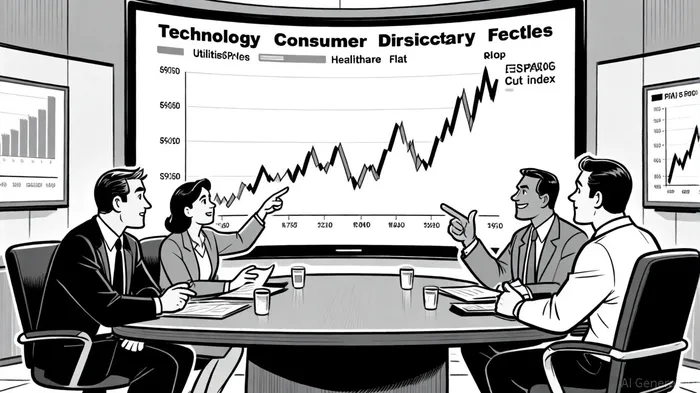
The Federal Reserve's September 2025 rate cut—marking the first reduction in over a year—has reignited debates about equity positioning in a shifting monetary policy landscape. With the central bank signaling two additional cuts by year-end and projecting a cumulative 50-basis-point reduction, investors are recalibrating strategies to capitalize on the evolving cycle. According to a report by CNBC, the Fed's decision reflects growing concerns over a slowing labor market, with job gains averaging just 29,000 per month in recent quarters and downside risks to employment rising[2]. While inflation remains stubbornly elevated at 3.1% for core PCE, the Fed's updated economic projections suggest a modest upward revision in 2025 GDP growth to 1.6%[3].
Sector Rotation: From Defense to Offense
Historical data underscores a consistent pattern during Fed rate cut cycles: a shift from defensive to growth-oriented sectors. MorningstarMORN-- notes that early in such cycles, defensive areas like utilities, healthcare, and consumer staples often outperform due to heightened volatility and uncertainty[1]. However, as policy easing gains traction, cyclical and growth sectors—particularly technology and consumer discretionary—tend to lead. This dynamic is already emerging in 2025, with tech-heavy sectors like communications services and consumer discretionary outpacing traditional defensive plays[1].
Notably, this cycle has shown divergence. While technology remains dominant, driven by artificial intelligence innovation and strong earnings, traditional cyclicals like industrials and financials have also gained momentum[3]. Small-cap stocks, as highlighted by iShares, are another focal point. The Russell 2000's outperformance against large-cap benchmarks suggests that rate-sensitive small-cap equities could benefit further if the Fed continues its easing trajectory[1].
Strategic Entry Points and Market Positioning
For investors, the key lies in aligning portfolios with the stage of the rate-cut cycle. Early-stage positioning typically favors defensive sectors, but the current environment—marked by a weaker U.S. dollar and global economic rebalancing—suggests a pivot toward growth and cyclical plays. As stated by the New York Times, the Fed's acknowledgment of a “slowing economy” as a justification for cuts could amplify the appeal of small-cap and international equities[4].
International markets, in particular, stand to gain from dollar depreciation. A weaker greenback reduces the cost of dollar-denominated debt for emerging economies and boosts export competitiveness, historically supporting global equity returns[2]. This dynamic is critical for investors seeking diversification beyond U.S. borders.
The Long Game: Quality and Momentum
While sector rotation is central, factor-based strategies also warrant attention. Historical analysis by Northern TrustNTRS-- reveals that the quality factor has consistently outperformed during rate cut cycles, whereas value and momentum returns vary depending on the economic context[1]. For instance, during the 1998 dot-com boom, low-volatility stocks lagged, while in 2001, they outperformed amid market stress[1]. This underscores the importance of balancing sectoral bets with factor diversification.
Conclusion
The Fed's 2025 rate-cut cycle presents a nuanced opportunity for equity investors. By leveraging historical patterns and current market signals, portfolios can be strategically positioned to capitalize on sector rotation, small-cap strength, and international exposure. As the central bank navigates a delicate balance between inflation control and economic stability, proactive positioning—rooted in both data and adaptability—will be key to unlocking long-term value.







Comentarios
Aún no hay comentarios