
Anticipated Altcoin Airdrop Mechanics and Investment Implications
In 2025, altcoin airdrops have transcended their early days as mere marketing gimmicks, evolving into sophisticated tools for decentralizing ownership and incentivizing ecosystem growth. For investors, understanding the mechanics of these airdrops-eligibility criteria, tokenomics design, and market positioning-is critical to identifying strategic entry points and mitigating risks. This analysis dissects the current landscape, drawing on recent data and historical trends to outline actionable strategies for navigating the airdrop-driven altcoin season.
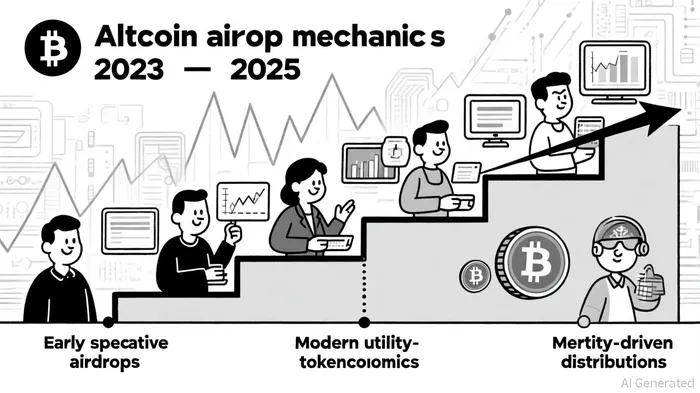
Airdrop Eligibility: From Hype to Merit-Based Participation
Modern airdrops prioritize genuine engagement over superficial activity. To qualify, participants must demonstrate on-chain utility, such as bridging assets to Layer 2 networks (e.g., Base, Arbitrum), staking, or providing liquidity, as described in an eligibility checklist. For instance, the Midnight airdrop distributed NIGHT tokens to XRPXRP-- holders with at least $100 in non-custodial wallets, emphasizing asset ownership and wallet activity, as shown in a CoinRank analysis. Similarly, projects like LayerZero and EigenLayer reward users for cross-chain interactions and technical contributions, such as securing decentralized protocols, according to a Mitosis report.
Anti-farming measures, including AI-driven behavior analysis and minimum activity thresholds, now filter out bot-like behavior and inactive wallets, according to a Gate overview. This shift underscores a broader industry trend: airdrops are increasingly meritocratic, favoring early adopters and active community members over speculative "airdrop hunters."
Tokenomics: Balancing Utility and Market Stability
Tokenomics structures in 2025 are designed to align incentives with long-term ecosystem growth. Projects like LayerZero allocate significant portions of their token supply (e.g., 38.3% of ZRO) to community distributions, with vesting schedules tied to measurable contributions - a mechanism detailed in the Mitosis report. These mechanisms discourage short-term dumping and instead reward sustained engagement.
However, airdrops remain a double-edged sword. While they can boost liquidity and trading volume-Hyperliquid's airdrop, for example, spurred a 300% surge in trading activity (Gate overview)-excessive token supply can trigger selling pressure. To mitigate this, projects implement phased token releases or deflationary mechanisms (e.g., token burns) to maintain scarcity, as outlined in the eligibility checklist. Investors must scrutinize these designs, as poorly structured tokenomics can lead to rapid depreciation, as seen with Apecoin (APE), which plummeted from $26.70 to $1.17 post-airdrop (Gate overview).
Market Positioning: Leveraging Liquidity and Sentiment
The success of an airdrop is inextricably linked to its market positioning. Platforms like Binance play a pivotal role, with $2.1 billion in stablecoin inflows and 45% of altcoin activity concentrated on its exchange, according to the eligibility checklist. High liquidity reduces slippage during token distributions, enabling smoother price discovery. Additionally, Binance's global infrastructure supports sophisticated trading strategies, allowing airdrop participants to hedge volatility or capitalize on short-term swings, as noted in the eligibility checklist.
Market sentiment also shapes airdrop outcomes. In October 2025, BitcoinBTC-- dominance fell below 59%, signaling a capital rotation into altcoins, according to a Cryptopolitan piece. This trend, coupled with a 40–50% spike in Google searches for altcoins, suggests a bullish environment for airdrop-driven projects. Investors should monitor these indicators, as they often precede significant price movements.
Historical Performance: Lessons from the Past
Historical data reveals a mixed bag of outcomes. Uniswap (UNI), a 2020 airdrop, surged to $44.92 in 2021 but stabilized at $14.83 by 2025 (Gate overview). Conversely, memeMEME-- coins like BONK and DEGEN defied trends, achieving exceptional returns. The broader pattern is clear: 74.2% of airdropped tokens trade below their initial listing price, as reported by CoinRank, underscoring the importance of due diligence.
For investors, the key takeaway is to prioritize projects with clear utility and active development teams. For example, Celestia (TIA) and Blur (BLUR) demonstrated resilience due to their governance and staking functionalities, as discussed in the Mitosis report.
Strategic Entry Points: Timing and Diversification
Timing remains a critical factor. Data shows that 46% of top airdrops peak within 14 days of distribution, with tokens like Ethereum Name Service (ENS) and LooksRare (LOOKS) surging rapidly, according to the Cryptopolitan piece. However, exceptions like Optimism (OP), which took over a year to reach its peak, highlight the need for patience.
A diversified approach is equally vital. Spreading investments across Ethereum, Layer 2 solutions, and NFT platforms reduces exposure to single-project risks, per the eligibility checklist. Additionally, converting airdropped tokens to Bitcoin or stablecoins immediately post-listing can lock in gains, given that 74.2% of tokens depreciate over time (CoinRank analysis).
Conclusion: Navigating the Airdrop-Driven Altcoin Season
As 2025 unfolds, altcoin airdrops are poised to play a central role in shaping market dynamics. For investors, success hinges on three pillars:
1. Eligibility: Focus on projects with merit-based criteria and anti-farming safeguards.
2. Tokenomics: Prioritize tokens with utility-driven designs and deflationary mechanisms.
3. Timing: Enter early, diversify broadly, and exit strategically based on market sentiment.
The airdrop landscape is no longer a lottery-it's a calculated game of ecosystem participation and economic alignment. Those who master its mechanics will find themselves at the forefront of the next bull run.






Comentarios
Aún no hay comentarios