
Anthropic's Expansion into India and AI's Regional Growth Potential
Anthropic's strategic expansion into India represents a pivotal moment in the global AI arms race, leveraging the country's burgeoning infrastructure and talent ecosystems to solidify its market position. As the AI sector matures, India's unique combination of government-backed initiatives, a rapidly growing technical workforce, and a demand-driven economy positions it as a critical hub for innovation. For investors, understanding the interplay between Anthropic's entry points and India's AI landscape offers insights into the region's long-term growth potential.
Strategic Alignment with India's AI Infrastructure
India's AI infrastructure has undergone a transformative shift in 2025, driven by the IndiaAI Mission - a national initiative approved by the Cabinet in March 2024 with an investment of ₹10,371.92 crore. This mission aims to establish a public AI compute infrastructure with over 34,000 GPUs, including 15,916 newly added units in 2025, enabling the training of large-scale models tailored to local needs. Anthropic's decision to open an office in Bengaluru aligns directly with this infrastructure boom. By tapping into India's GPU capacity, the company can enhance its Indic language models, such as Hindi, Bengali, and Tamil, to serve both enterprise and public sector clients, as reported in Anthropic to expand India ops.
The IndiaAI Mission also emphasizes ethical AI development and sovereign capabilities, a priority for Anthropic as it seeks partnerships with Indian conglomerates like Reliance Industries. A potential collaboration with Reliance, which has previously partnered with global tech giants like Google and Meta, could provide Anthropic with access to India's vast telecom and e-commerce networks, accelerating AI deployment in sectors like healthcare and agriculture, according to TechCrunch, which reports the company plans to open India office.
Talent Ecosystem: A Magnet for Global AI Leaders
India's AI talent pool has grown exponentially, with 416,000 professionals in 2025-a figure that reflects an 8X increase since 2017, according to a Quess Corp report. Anthropic's expansion into India is not merely about market access but also about capitalizing on the country's demographic dividend. The company plans to triple its global workforce by 2025, with India serving as a key hub for hiring in research, applied AI, and enterprise solutions, according to a StartupWired report. This aligns with India's own ambitions to close a 51% demand-supply gap in AI talent through upskilling programs and academic partnerships.
Anthropic's academic collaborations are already taking shape. The company has launched Claude for Education, a specialized AI tool for universities, and is likely to partner with institutions like the Indian Institutes of Technology (IITs) and the Indian Institute of Science (IISc) to fund research and internships. These partnerships not only bolster Anthropic's innovation pipeline but also align with India's push to integrate AI into higher education and workforce development.
Strategic Partnerships and Market Dynamics
Anthropic's engagement with India's public and private sectors underscores its nuanced approach to market entry. The company's CEO, Dario Amodei, is currently in India to meet with Prime Minister Narendra Modi and enterprise leaders, signaling a focus on regulatory alignment and large-scale collaborations, as noted in Anthropic expands global operations. Such partnerships are critical in a market where government initiatives like the IndiaAI Mission and private sector innovation are converging to drive adoption.
For instance, Anthropic's focus on Indic language support addresses a key barrier to AI adoption in India, where linguistic diversity has historically fragmented technology access. By enhancing Claude's capabilities in languages like Telugu and Punjabi, Anthropic is positioning itself to capture a broader user base, including rural and semi-urban markets; this localization strategy mirrors the success of Indian tech firms like PhonePe and Flipkart, which thrived by adapting global technologies to local contexts.
Risks and Opportunities
While the opportunities are substantial, challenges remain. India's AI talent ecosystem, despite its growth, still faces a reskilling gap, with over 1 million workers needing retraining by 2027, according to a Bain & Company study. Anthropic's investment in upskilling programs and academic partnerships will be critical to addressing this gap. Additionally, regulatory scrutiny of AI governance and data privacy could impact the pace of adoption. However, the IndiaAI Mission's emphasis on ethical frameworks provides a structured path for responsible innovation.
Conclusion
Anthropic's expansion into India is a masterclass in strategic market entry, combining infrastructure leverage, talent acquisition, and localized innovation. For investors, this move highlights India's emergence as a global AI powerhouse, with the potential to rival Silicon Valley in the next decade. The IndiaAI Mission's infrastructure investments, coupled with Anthropic's focus on Indic languages and enterprise partnerships, create a flywheel effect that could accelerate AI adoption across sectors. As the company navigates regulatory and talent challenges, its success in India will serve as a blueprint for other global AI firms seeking to tap into the region's vast potential.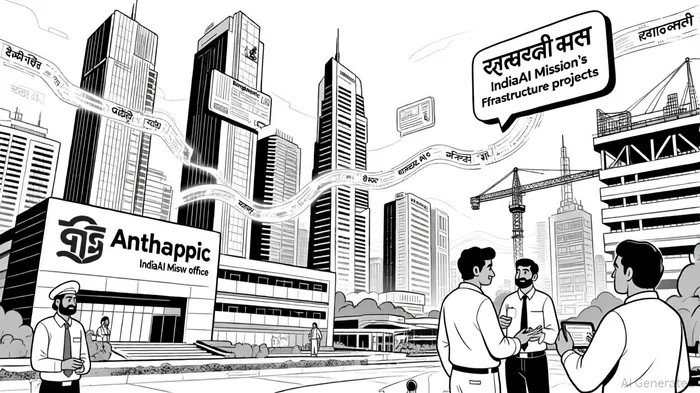







Comentarios
Aún no hay comentarios