
Ant Group's USDC Integration: The Regulatory Playbook for Stablecoin Dominance
The partnership between Ant Group and CircleCRCL--, announced in July 2023, marks a pivotal shift in the global payments landscape. By integrating Circle's regulated stablecoin, USDC, into Ant's blockchain ecosystem, the two firms are positioning themselves at the forefront of a $200+ trillion cross-border payments market primed for disruption. This collaboration is not merely a technical integration but a strategic play to leverage regulatory compliance as a competitive advantage in an era of rising central bank digital currency (CBDC) adoption and institutional scrutiny. For investors, this dynamic presents a compelling case to back Circle (CRCL) as a leader in compliant crypto infrastructure.
The Regulatory Compliance Edge: Why Ant and Circle's Alliance Matters
The cornerstone of this partnership lies in USDC's regulatory credibility. Circle's stablecoin, backed by reserves held in U.S. Treasury bills and commercial paper, has been a focal point of regulatory scrutiny. However, its alignment with the U.S. Senate's GENIUS Act (passed in 2023) and Circle's public disclosures—now enhanced by Ant's institutional-grade compliance framework—have turned USDC into a trusted instrument. Ant, in turn, is leveraging this to meet stringent requirements like Hong Kong's Stablecoin Ordinance (effective August 2025), which mandates 100% collateralization and robust anti-money laundering (AML) protocols.
This regulatory alignment is critical. Legacy systems like SWIFT, which dominate cross-border transactions today, face mounting pressure to compete with blockchain's speed and cost efficiency. Ant's blockchain platform, already processing over $1 trillion in annual global transactions, could slash fees from 7–10% to under 1% and reduce settlement times from days to minutes. For example, a $1 million payment from China to Brazil via USDC would save $70,000–$100,000 in fees and eliminate 3–5 days of delay—a value proposition that institutions cannot ignore.
The Institutionalization of Stablecoins: A Tipping Point
The partnership's true power lies in its ability to institutionalize stablecoins. Ant International, Ant's global arm, has secured licenses in Hong Kong, Singapore, and Luxembourg—geographies pivotal to global trade. By 2026, this could double blockchain transaction volumes through Ant's platform, driven by partnerships with banks like HSBCHSBC-- and JPMorganJPM--, which already tokenize assets on its blockchain.
Meanwhile, Circle's USDC has expanded its infrastructure via alliances with firms like OpenPayd and RippleXRP--, enabling fiat and stablecoin transactions across traditional and blockchain networks. This ecosystem play ensures USDC is not just a currency but a borderless settlement layer, appealing to enterprises seeking to avoid the inefficiencies of SWIFT.
Investors should note that Circle's stock surged 40% in Q3 2025 amid partnership momentum, reflecting market optimism. The company's valuation, now approaching $6 billion, signals investor confidence in its role as a compliant infrastructure provider—a role that could only be strengthened by Ant's scale.
Navigating Challenges: Regulatory Hurdles and Competitive Risks
Despite the promise, risks remain. Regulatory delays in the EU's AML directives and competition from rival stablecoins like USDG (Paxos) and JPM Coin could slow adoption. Public skepticism, fueled by the 2022 TerraUSD collapse, demands rigorous transparency on USDC reserves—a challenge Circle has met head-on through real-time reserve audits.
Ant's own regulatory journey is also pivotal. Its Hong Kong license, among the first approved, sets a template for expansion into regulated markets. Success here could attract institutional clients, creating a self-reinforcing network effect. Ant International's $3 billion in revenue (2025) and plans for an $8–$24 billion Hong Kong IPO underscore its financial viability—a stabilizing force for the partnership.
Investment Thesis: Why Back Circle Now?
The Ant-Circle alliance is a regulatory compliance-driven land grab in a market transitioning from legacy systems to tokenized, real-time settlement. Circle's USDC stands to benefit from:
1. Ant's transactional scale: Processing $1 trillion+ annually, Ant's blockchain can catapult USDC's market cap further.
2. Institutional trust: Partnerships with HSBC and JPMorgan validate USDC's use in high-stakes enterprise payments.
3. Regulatory tailwinds: The Hong Kong license and U.S. regulatory clarity reduce risks for investors.
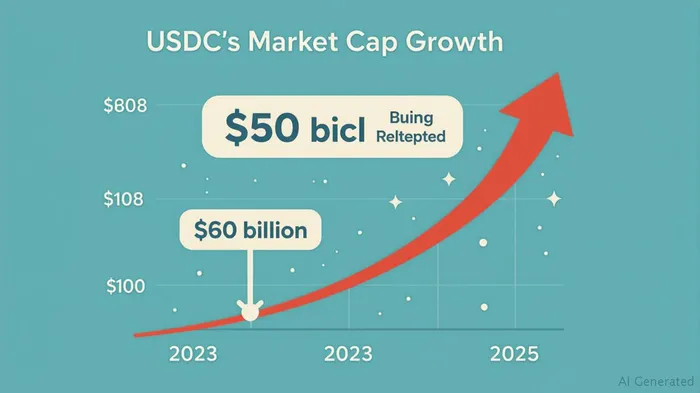
For investors, CRCL is a leveraged play on this trend. With USDC's market cap doubling since 2023 and Ant's blockchain adoption accelerating, the stock is positioned to outperform as stablecoins displace SWIFT. A buy-and-hold strategy, with a focus on regulatory milestones (e.g., EU approvals, CBDC collaborations), offers asymmetric upside.
In conclusion, Ant Group's USDC integration is more than a tech partnership—it's a regulatory masterstroke. By marrying Ant's reach with USDC's credibility, Circle is primed to dominate a $1 trillion+ market. For investors, this is a rare opportunity to bet on the institutionalization of blockchain before it becomes the new normal.
Recommendation: Accumulate CRCLCRCL-- stock ahead of Ant's Hong Kong IPO and monitor USDC's market share gains in cross-border settlement. This is a long-term play with multiyear growth potential.





Comentarios
Aún no hay comentarios