
Ant Group's Jovay: A Catalyst for Institutional Adoption in Tokenized Finance
In the rapidly evolving landscape of blockchain-enabled finance, Ant Group's Jovay platform has emerged as a pivotal innovation, redefining how real-world assets (RWAs) are tokenized and traded in institutional markets. Launched as a high-speed EthereumETH-- Layer-2 scaling network, Jovay is engineered to bridge traditional financial systems with decentralized infrastructure while prioritizing compliance, performance, and interoperability. With testnet trials achieving 15,700 to 22,000 transactions per second (TPS) and ambitions to scale to 100,000 TPS through node clustering, the platform is positioning itself as a critical infrastructure layer for the next phase of tokenized finance, according to a Coinalertnews report.
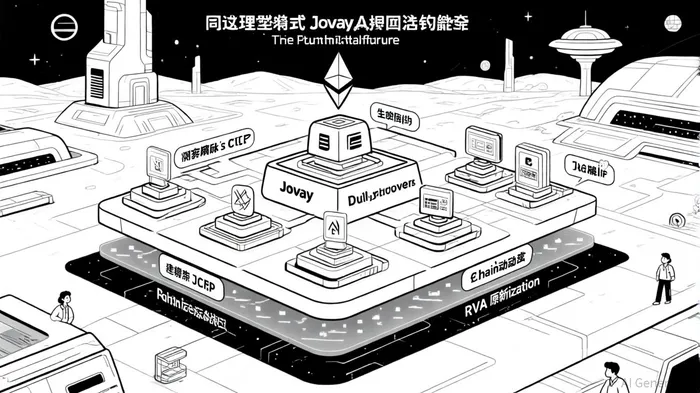
Technical Architecture: Scalability Meets Compliance
Jovay's dual-prover architecture combines zero-knowledge (ZK) proofs and optimistic rollups, a design that balances security with throughput. This hybrid approach addresses a key limitation of traditional Layer-2 solutions: the trade-off between verification speed and trust assumptions. By leveraging ZK proofs for immediate finality and optimistic rollups for cost efficiency, Jovay ensures institutional-grade performance without compromising on-chain transparency, according to a CoinTrust analysis.
The platform's five-phase operational model-asset registration, tokenization, compliance checks, trading, and reporting-further underscores its focus on regulatory oversight. For instance, during the compliance phase, AI tools verify on-chain and off-chain data in real time, ensuring adherence to jurisdictional requirements, as reported by Coinalertnews. This is particularly critical in markets like China, where Ant Group has tailored Jovay to align with 2025 cybersecurity regulations. The platform's modular design also allows for independent upgrades, enabling it to adapt to evolving compliance frameworks, as noted in a Manila Times press release.
Institutional Adoption and Strategic Partnerships
Jovay's institutional appeal is bolstered by its integration with Chainlink's Cross-Chain Interoperability Protocol (CCIP) and Data Streams. These partnerships enable secure cross-chain messaging and sub-second market data delivery, essential for high-throughput applications like tokenized bonds and trade finance instruments, according to a CryptoTimes report. As of October 2025, Jovay has attracted $50 million in total value locked (TVL), with testnet participants including banks and asset managers exploring use cases such as green finance (e.g., tokenizing solar panels) and government bond settlements, as reported in a CoinLive article.
Ant Group's decision to build on Ethereum, rather than a proprietary chain, is a strategic masterstroke. By leveraging Ethereum's existing infrastructure, Jovay reduces development costs and taps into a $30 trillion RWA market projected to mature by 2034, as the Manila Times press release noted. This move also aligns with a broader industry trend: major corporations are increasingly adopting public blockchains for regulated digital assets, as noted in a 2025 CoinTrust analysis.
Regulatory Alignment and Risk Mitigation
Regulatory compliance is a cornerstone of Jovay's design. In China, the platform avoids issuing a native token-a move that aligns with the country's strict 2025 cybersecurity requirements and mitigates risks of retail speculation, as CoinTrust observed. Instead, Jovay's compliance-first model emphasizes institutional utility, with a focus on licensed entities. For example, its parallel execution architecture and hybrid verification mechanism address verification delays and trust issues, critical for meeting China's advanced technical standards, according to the Manila Times coverage.
Globally, Jovay's architecture is also designed to navigate evolving regulatory landscapes. By integrating Chainlink's Data Streams, the platform ensures real-time data accuracy, a requirement for markets like Hong Kong and Singapore, where stricter cybersecurity standards and private market access reforms are reshaping compliance frameworks, as CryptoTimes reported.
Strategic Implications for Ant Group and Tokenized Finance
Jovay's potential extends beyond technical innovation. With Ant Digital Technologies at the helm, the platform could integrate Alipay's 1.4 billion users into a blockchain ecosystem, creating a flywheel effect for tokenized assets. For instance, tokenizing energy credits or trade finance instruments could unlock liquidity in traditionally illiquid markets, as highlighted in an OKX analysis.
From an investment perspective, Jovay represents a strategic bet on Ethereum's maturation as institutional infrastructure. As noted in a 2025 Coinalertnews report, the platform's launch marks a pivotal moment in tokenized finance, demonstrating how public blockchains can support regulated digital assets at scale. With a planned mainnet launch by Q4 2025 and ambitions to scale TPS to 100,000, Jovay is well-positioned to capture a significant share of the RWA market.
Conclusion: A Strategic Investment Opportunity
Ant Group's Jovay is more than a technical achievement-it is a strategic infrastructure play that addresses the scalability, compliance, and interoperability challenges hindering institutional adoption of tokenized finance. By leveraging Ethereum's ecosystem, integrating AI-driven compliance tools, and forming partnerships with ChainlinkLINK--, Jovay is poised to become a foundational layer for the next generation of financial markets. For investors, the platform's alignment with macro trends-such as the $30 trillion RWA market and global regulatory harmonization-makes it a compelling opportunity in the blockchain-enabled financial infrastructure space.






Comentarios
Aún no hay comentarios