
Anomalous On-Chain Behavior and Its Implications for Solana (SOL) Price Volatility
On-Chain Metrics and Anomalous Behavior
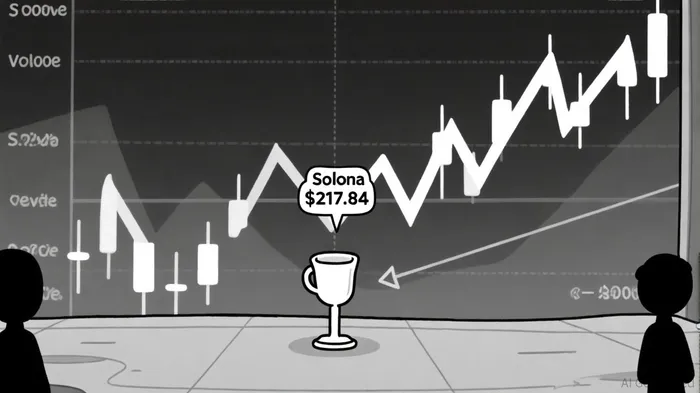
Solana's on-chain activity in 2025 reveals a network grappling with conflicting signals. While daily active addresses peaked above 7 million in early 2025, and transaction volume surged 12% weekly, the price action has struggled to break key resistance levels, such as the $217.84 Fibonacci retracement, according to The Currency Analytics. This divergence between utility and price highlights anomalous behavior. For instance, the Total Value Locked (TVL) in Solana's DeFi ecosystem hit an all-time high of $13.22 billion, driven by liquid staking tokens (LSTs) like JitoJTO-- and bnSOLBNSOL--, which now account for 10.4% of total staked SOLSOL--, per FXStreet. Yet, despite this growth, the price of SOL has faced repeated failures to sustain above $231.46, a critical support level noted by The Currency Analytics.
The surge in open interest (OI) in derivatives markets-reaching $16.58 billion-further underscores speculative fervor. This metric, which measures the total amount of open derivative contracts, reflects heightened betting on price swings. However, the same OI data also reveals a fragile equilibrium: large on-chain withdrawals and concentrated validator stakes could trigger sudden liquidity shifts, amplifying volatility, according to FXStreet.
Validator Concentration and Decentralization Risks
A critical anomaly lies in Solana's validator distribution. As of Q3 2025, the top 25 validators control 46.3% of staked SOL, with the top five alone holding over 16.4%, according to Datawallet. This concentration raises decentralization concerns, as a small group of validators could theoretically manipulate network outcomes or prioritize MEV (maximal extractable value) strategies. Jito, the leading LST provider, dominates this landscape with 17.6 million staked SOL and 11,200 wallets holding over 10 SOL (Datawallet). While this centralization boosts efficiency, it also creates a single point of failure risk, which could destabilize the network during periods of high demand or market stress.
The Alpenglow consensus upgrade, set to reduce finality latency to under 200 milliseconds, aims to mitigate some of these risks by improving scalability (Datawallet). However, the reintroduction of Validator Admission Tickets (VATs) in Alpenglow v1.1 has tempered optimism, as it may further concentrate validator profits and reduce equity in the validator set, according to Chorus.
Institutional Influence and Speculative Pressure
Institutional demand has emerged as a double-edged sword. Galaxy DigitalGLXY-- and Forward Industries' $1.65 billion raise and purchase of 6.5 million SOL tokens have injected capital into the ecosystem, while the Rex-Osprey Solana Staking ETF's inflows have added a new layer of demand (Datawallet). These developments suggest growing institutional confidence, yet they also amplify speculative pressure. For example, the ETF's success has led to a 24-hour trading volume exceeding $2.8 billion, a 12% weekly increase, as reported by The Currency Analytics. Such inflows can drive short-term price spikes but may also create overbought conditions, increasing the risk of sharp corrections.
The interplay between institutional and retail activity is further complicated by LSTs. With LSTs comprising 40.3% of DeFi TVL, their integration into lending markets has created a feedback loop: higher TVL attracts more stakers, which in turn boosts network activity and transaction fees (Datawallet). However, this cycle is vulnerable to sudden outflows, particularly if macroeconomic conditions deteriorate or regulatory scrutiny intensifies.
Network Upgrades and Future Outlook
Looking ahead, the formation of a bullish cup-and-handle pattern on price charts suggests a potential breakout past $270, with analysts targeting $300–$480 depending on macroeconomic conditions, according to Analytics Insight. However, this optimism is tempered by the risk of ETF delays and regulatory uncertainty, which could disrupt inflows and exacerbate volatility.
Historical backtests of similar cup-and-handle breakouts, however, reveal a mixed performance: a 30-day hold strategy from 2022 to 2025 yielded an average negative return, with a Sharpe ratio well below zero and maximum drawdowns reaching approximately one-third of capital, suggesting the pattern's reliability may be limited without additional risk management.
Conclusion
Solana's 2025 market environment is defined by a tug-of-war between bearish technical indicators and bullish on-chain fundamentals. The network's robust TVL, institutional adoption, and staking innovations are powerful tailwinds, but validator concentration, speculative pressure, and regulatory risks pose significant headwinds. For investors, the key lies in monitoring on-chain metrics like TVL, validator distribution, and OI, while staying attuned to macroeconomic shifts and network upgrades. As the Alpenglow upgrade rolls out and the DeFi ecosystem matures, Solana's price volatility will likely persist-offering both opportunities for those who can navigate its complexities and risks for those who underestimate its fragility.







Comentarios
Aún no hay comentarios